Khatumo State
The name Khaatumo means "a positive or final decision," and for the Dhulbahante clan of northern Somalia, it represented exactly that. Caught for decades between the competing claims of Somaliland to the west and Puntland to the east, the Dhulbahante of the Sool, Sanaag, and Togdheer regions -- collectively known as SSC -- declared in 2012 that they would govern themselves. It was neither the first nor the last attempt, but it was the most consequential. What followed was a decade of intermittent fighting, collapsed negotiations, exile, and eventually a 2023 uprising that redrew the political map of the Horn.
Trapped Between Two Flags
The territory claimed by Khatumo has been contested since the early 1990s, when the collapse of the Somali central government left the Dhulbahante wedged between two rival polities. Somaliland, which declared independence in 1991, claimed the SSC regions as part of its territory based on colonial-era British Somaliland boundaries. Puntland, established in 1998 as an autonomous region of Somalia, claimed the same land based on clan affiliations. The Dhulbahante were divided among themselves -- some supported Somaliland, others Puntland, and a growing number wanted neither. As early as 2003, according to researcher Markus Virgil Hoehne, many Dhulbahante were already calling for an independent administration. Some even proposed the name "Dervishland," an echo of Mohammed Abdullah Hassan's anti-colonial movement that had made its last stand in the same territory a century earlier.
The First Attempts
The movement coalesced in 2009 when diaspora leaders gathered in Nairobi to declare the SSC regional government. Ali Khalif Galaydh, a former prime minister of Somalia, was among the architects. The new entity claimed Las Anod as its capital, but since Somaliland controlled the city, operations ran from the small towns of Dharkayn Geenyo and Buuhoodle. From the beginning, SSC was economically weak and militarily outmatched. Its fighters were poorly organized militias, its officials worked without salaries, and its support base, while passionate, was fractured along sub-clan lines. Skirmishes with Somaliland forces erupted in 2010 and 2011 around Buuhoodle and Kalshaale, drawing in tanks, heavy artillery, and eventually diplomatic pressure from Ethiopia. By the end of 2011, the SSC had effectively collapsed, its leaders scattered abroad or into the countryside.
Khatumo Rises and Falls
A ten-day conference in the historic town of Taleh in January 2012 produced a second attempt: Khatumo State, with roughly 2,300 Dhulbahante representatives in attendance. The new government featured a rotating presidential council and broad clan support. Two days later, fighting erupted near Buuhoodle. Somaliland deployed tanks and artillery, and images of dead and wounded civilians spread online, fueling protests in Las Anod where Somaliland troops opened fire on demonstrators, killing several and arresting more than 70. Khatumo forces attempted to take Las Anod in April 2012 but were pushed back to Taleh, Hudun, and Bo'ame. Internal divisions and defections to Puntland hollowed out the movement. By 2015, Khatumo had practically ceased to function. A 2017 agreement between its president and Somaliland brought only paper concessions that could not be implemented amid continued civil unrest.
The 2023 Uprising
Everything changed in early 2023. Mass protests in Las Anod, building since December 2022, created an opening for the Dhulbahante to reassert themselves. On February 6, clan elders declared the formation of SSC-Khatumo as a state within federal Somalia. The supreme Garad of the Dhulbahante, Garad Jama Garad Ali -- exiled from Las Anod since 2007 -- returned to the city. He accused Somaliland of genocide. Within a week, fighting and civilian bombardments had killed at least 82 people, displaced 90 percent of Las Anod's residents, and created 185,000 internally displaced people. By August, SSC-Khatumo forces had overrun Somaliland strongholds at Maraaga and Goja'adde. On October 19, 2023, the Federal Government of Somalia formally recognized the interim administration.
A State Still Forming
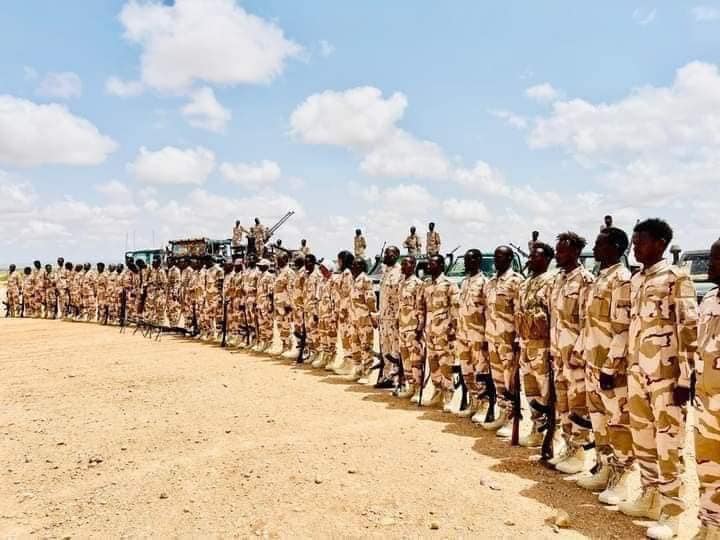
Recognition by Mogadishu was only the beginning. Puntland immediately objected, claiming the SSC regions as its own and withdrawing recognition of the federal government in March 2024. Fighting between Khatumo and Puntland forces broke out in 2025 at Dhahar and the border village of Shahda. In July 2025, delegates reconstituted Khatumo as the North Eastern State, establishing an 83-member parliament, electing speakers, and choosing Abdikhadir Ahmed Aw-Ali as president. The administration maintains its own security forces, deployed along a front line roughly 170 kilometers from Las Anod. Whether the North Eastern State can survive the pressures of clan division, regional rivalries, and the absence of international recognition remains the defining question for the Dhulbahante -- a people whose name for their state means, fittingly, a final decision.
From the Air
Centered on Las Anod at approximately 8.47°N, 47.36°E in the Sool region of northern Somalia. The terrain below is semi-arid plateau dissected by seasonal wadis. The historic town of Taleh lies northeast at 9.15°N, 48.42°E. The nearest airstrip is Las Anod Airport (HCLA). Hargeisa Egal International Airport (HCMH) lies to the west, and Garowe Airport in Puntland to the southeast.