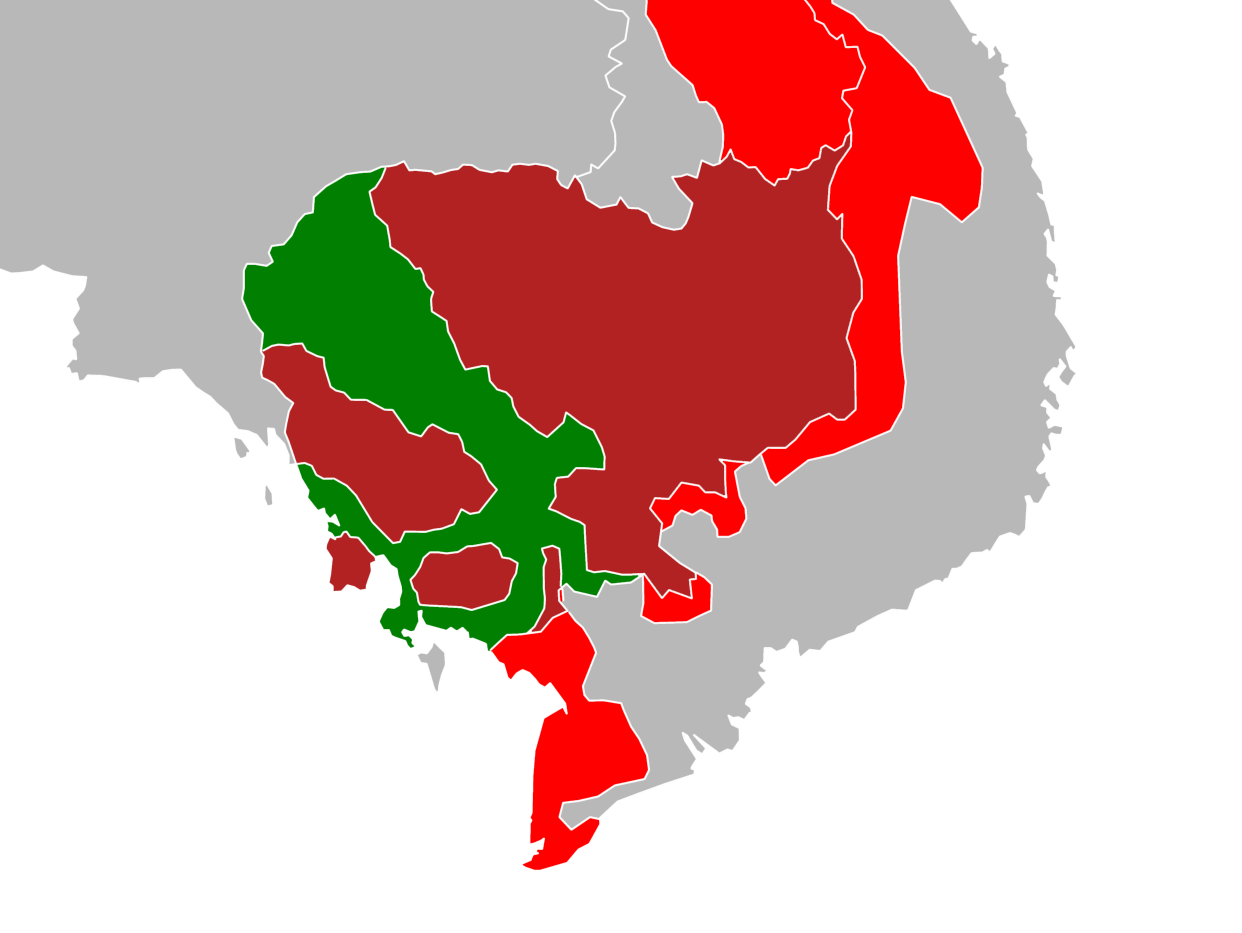
Khmer Republic
Sirik Matak, accompanied by three army officers, compelled a weeping Lon Nol to sign the documents at gunpoint. That scene in March 1970 -- a reluctant prime minister forced into a coup he had not fully chosen -- set the tone for the Khmer Republic, a state born of fear and sustained by foreign money that would burn through almost exactly one million dollars of American aid every day of its brief, chaotic existence. What began as a bid to push North Vietnamese forces out of Cambodia instead dragged the country deeper into war, political infighting, and ultimately into the hands of the Khmer Rouge.
A Coup Born of Frustration
By 1970, Prince Norodom Sihanouk's balancing act had worn thin. His policy of neutrality tolerated North Vietnamese forces operating from Cambodian territory, and the economy was deteriorating. While Sihanouk traveled abroad in France, Prime Minister Lon Nol and his deputy Prince Sisowath Sirik Matak moved against him. Anti-Vietnamese riots erupted in Phnom Penh, the North Vietnamese embassy was sacked, and an impossible 72-hour ultimatum was issued for all foreign communist forces to leave Cambodian soil. On 18 March, the National Assembly voted to strip Sihanouk of power. Pro-Sihanouk demonstrations in provincial cities were suppressed with great brutality, killing hundreds. The kingdom became a republic on 9 October, but the new state inherited a problem far larger than the one it had tried to solve: the Vietnam War had now fully arrived in Cambodia.
An Army Undermined From Within
The Royal Khmer Armed Forces had numbered roughly 35,000 troops at the time of the coup -- appropriate for a neutral country, hopelessly inadequate for the war now engulfing it. Reorganized as the Khmer National Armed Forces (FANK), the military ballooned to 150,000 within months, then past 200,000 at American insistence, despite warnings about the toll on Cambodia's fragile economy. The US flew in Khmer Serei and Khmer Kampuchea Krom militia trained at South Vietnamese bases, and demanded the army restructure along American lines, which created chaos in the supply chain. Corruption devoured much of the effort: officers claimed salaries for soldiers who did not exist. The large-scale offensives Operations Chenla I and II ended in heavy defeat. Individual Cambodian infantrymen fought with conspicuous bravery, but their leadership was inexperienced and their cause was being hollowed out from the inside.
Power Struggles in Phnom Penh
Sihanouk's decades of political dominance had left Cambodia with few experienced civilian leaders, and the republic's politicians proved no exception. Lon Nol and Sirik Matak, the two men who had together engineered the coup, quickly turned on each other. When Lon Nol returned from medical treatment in Hawaii in April 1971, he maneuvered to dissolve the government. By March 1972, he and his influential brother Lon Non had driven Sirik Matak from power entirely, placing the prince under effective house arrest. Lon Nol then ousted the head of state, Cheng Heng, and assumed the presidency himself. Elections held that year were rigged in his favor, but even the manipulated results revealed deep public dissatisfaction. A succession of prime ministers rotated through office while the country's military position deteriorated with each passing season.
Consecrated Sand and Closing Walls
The Paris Peace Accords of January 1973 offered a brief glimmer of hope. Lon Nol declared a ceasefire, and moderate Khmer Rouge elements made tentative contact with the government. But the Khmer Rouge leadership refused to negotiate, and fighting resumed in February. American bombing halted the communist advance on Phnom Penh at horrific human cost -- an experience some historians believe contributed to the radicalization and brutality of Khmer Rouge cadres. By 1974, communist forces had captured the former royal capital of Oudong, evacuating its population and executing government officials and teachers. The walls were closing in. Lon Nol, deeply superstitious, ordered consecrated sand scattered from helicopters to protect the capital. Sihanouk refused peace talks unless Lon Nol stepped down. On 1 April 1975, Lon Nol resigned and fled into exile. The FANK disintegrated almost immediately.
Seventeen Days in April
While Sirik Matak, Prime Minister Long Boret, and Lon Non remained in Phnom Penh hoping to negotiate, the Khmer Rouge entered the capital on 17 April 1975. Within days, many representatives of the old regime were executed. Sirik Matak, offered evacuation by the American embassy, refused in a letter that would become famous: he chose to stay and face whatever came. The Khmer Republic's last holdout was the temple of Preah Vihear in the Dangrek Mountains, which FANK forces occupied until the Khmer Rouge overran it on 22 May. Five years of civil war, foreign intervention, internal betrayal, and a million dollars a day in American aid had produced not stability but the conditions for something far worse. The regime that replaced the republic -- Democratic Kampuchea -- would kill an estimated 1.5 to 2 million Cambodians in less than four years.
From the Air
Centered on Phnom Penh at 11.56°N, 104.93°E. The capital sits at the confluence of the Tonle Sap, Mekong, and Bassac rivers, visible as a distinctive water junction from altitude. Phnom Penh International Airport (VDPP) lies 10 km west of the city center. The former royal capital of Oudong is visible approximately 40 km northwest. At cruising altitude, the flat Cambodian lowlands and Lake Tonle Sap to the northwest dominate the landscape.