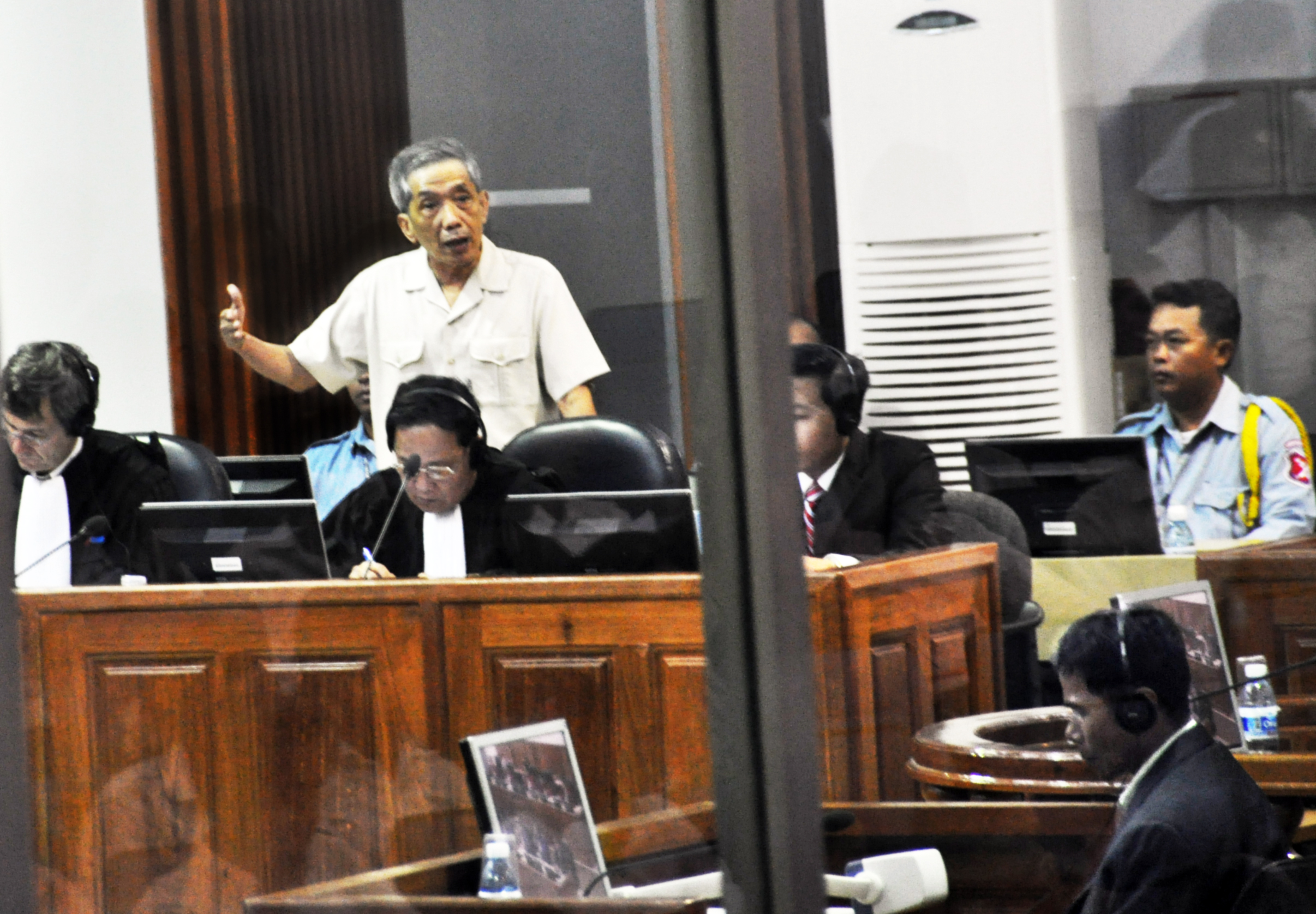
Khmer Rouge Tribunal
Three convictions. That was the final tally when the Extraordinary Chambers in the Courts of Cambodia closed its doors in December 2022, after sixteen years of hearings, over $330 million in expenditures, and the deaths of several defendants before verdicts could be reached. Whether those three convictions represented justice or its failure depends on whom you ask -- but for the more than 353,000 Cambodians who attended or participated in the proceedings, the tribunal offered something the Khmer Rouge had tried to destroy: an official record of what happened between April 1975 and January 1979.
Twenty Years to Build a Courtroom
The path to prosecution began in 1997, when Cambodia's co-prime ministers Norodom Ranariddh and Hun Sen wrote to UN Secretary-General Kofi Annan requesting help establishing trial proceedings against senior Khmer Rouge leaders. Negotiations dragged on for six years before an agreement was signed on 6 June 2003. The resulting tribunal was a hybrid -- a Cambodian national court with international participation, staffed by both local and foreign judges. This structure was deliberate: trials would be held on Cambodian soil under Cambodian authority, but with international oversight meant to ensure adherence to global legal standards. In May 2006, thirty judges were approved. They were sworn in early July of that year, nearly three decades after the regime they would judge had fallen.
Comrade Duch and the Prison Commander
Kang Kek Iew, known as Comrade Duch, was the first defendant to face the tribunal. He had run the Santebal, the Khmer Rouge's internal security apparatus, and commanded the notorious Tuol Sleng prison -- S-21 -- where an estimated 12,000 to 20,000 people were tortured and killed. His hearings began in September 2009. On 26 July 2010, the tribunal found him guilty of crimes against humanity and grave breaches of the Geneva Conventions. He was initially sentenced to 35 years, reduced for time served and illegal pretrial detention. On appeal, the sentence was extended to life imprisonment. Duch's case was the tribunal's cleanest: a single defendant, clear evidence, a conviction. The cases that followed would prove far more complicated.
The Aging Architects
Case 002 targeted the regime's most senior surviving figures. Nuon Chea, Pol Pot's right-hand man and the party's chief ideologist, was found guilty of crimes against humanity in 2014 and genocide against the Vietnamese and Cham peoples in 2018. He died in August 2019 while his appeal was pending. Khieu Samphan, the regime's head of state, received life imprisonment on the same charges. Ieng Sary, the foreign affairs minister alleged to have planned and overseen regime atrocities, died in March 2013 before any verdict. His wife Ieng Thirith, the first Cambodian woman to earn a degree in English and later the regime's minister of social affairs, was found mentally unfit for trial due to Alzheimer's disease in 2011. She died in 2015. Time was the tribunal's most relentless adversary -- defendants kept dying before the court could finish with them.
Justice Under Political Pressure
Beyond the initial cases, the tribunal ran into a wall of political resistance. Cases 003 and 004 targeted mid-level commanders including former navy chief Meas Muth, who allegedly oversaw the deaths of eleven Westerners whose boats strayed into Cambodian waters. But the Cambodian government, led by Hun Sen -- himself a former Khmer Rouge soldier -- openly opposed expanding prosecutions. Cambodian and international judges issued contradictory rulings on whether charges should proceed. Multiple international investigating judges resigned under pressure. One, German judge Siegfried Blunk, acknowledged that although he was not personally influenced by political statements, the perception of government interference called the entire proceedings into doubt. Meas Muth remained free despite outstanding arrest warrants, living in Battambang province. The tribunal's critics saw a clear pattern: justice extended only as far as Cambodia's political leadership would allow.
What the Record Holds
For all its imperfections, the tribunal created something that had not existed before: a formal, legal accounting of the Khmer Rouge's crimes. More than 98,000 people attended the 212-day hearings in Case 002. Nearly 67,000 rural Cambodians watched community video screenings of the proceedings. A University of California, Berkeley survey found that 83 percent of respondents believed the tribunal should be involved in responding to what happened during the regime. The Victims Support Section gave survivors a formal role in the proceedings -- not merely as witnesses but as recognized parties eligible for reparations. Victims were defined as anyone who suffered physical, psychological, or material harm as a direct consequence of crimes committed between 17 April 1975 and 6 January 1979. For many, testifying was itself a form of justice. As tribunal spokesman Neth Pheaktra put it, the court facilitated reconciliation while giving Cambodians an opportunity to come to terms with their history. Three convictions, measured against nearly two million deaths, looks like a thin accounting. But the alternative -- no trials at all -- would have left those deaths officially unexamined.
From the Air
The ECCC courthouse is located at 11.52°N, 104.79°E, in the western outskirts of Phnom Penh along National Route 4. Phnom Penh International Airport (VDPP) is approximately 5 km to the northeast. The Tuol Sleng Genocide Museum (S-21 prison), central to the tribunal's first case, sits in the city center at 11.55°N, 104.92°E. From the air, the broad Mekong and Tonle Sap rivers converge visibly at Phnom Penh's eastern edge.