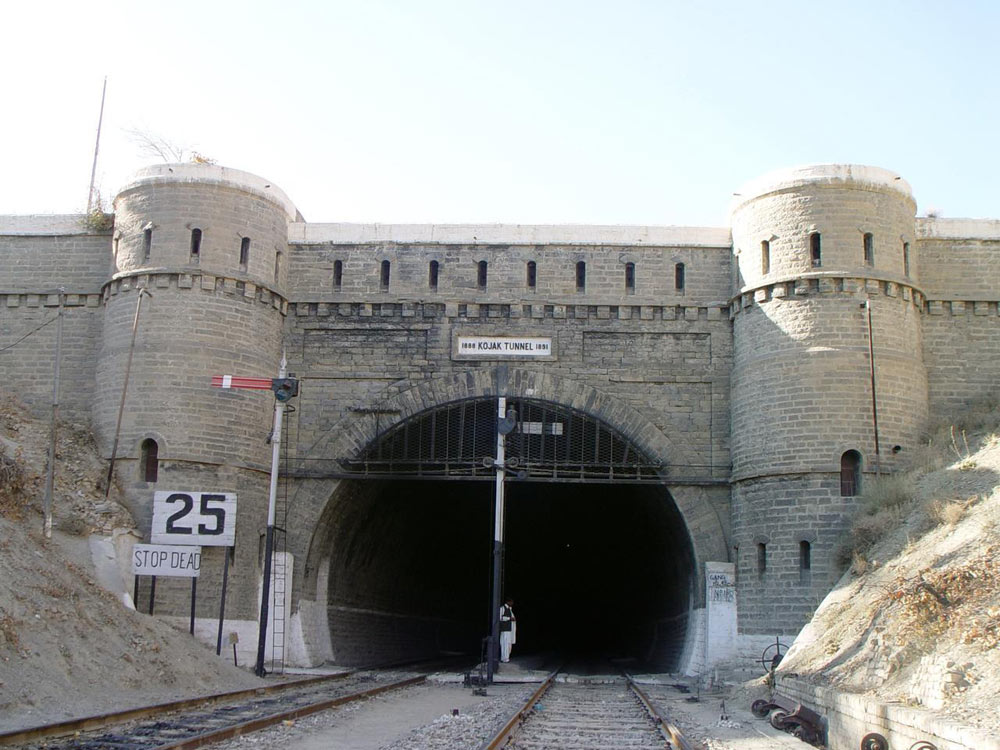
Khojak Tunnel
Place a mirror at the mouth of the Khojak Tunnel and angle it just right. Nearly four kilometers away, at the far end of this dead-straight bore through the Toba Achakzai mountains, someone will see the reflected light. That is not legend or folklore -- it is a fact of Victorian-era surveying so precise that the tunnel, completed in 1891, deviates not a single degree from its line. At 1,945 meters above sea level in Pakistan's Balochistan province, the Khojak Tunnel remains one of the longest railway tunnels in South Asia, a monument to imperial ambition and the labor of thousands who carved it from living rock.
Empire's Needle Through the Mountain
The British built the Khojak Tunnel for strategic reasons that had little to do with commerce. By the late 1880s, the Great Game between Britain and Russia was playing out across Central Asia, and the Khojak Pass -- sitting at the border between British India and Afghanistan -- was a critical military corridor. A railway through the mountains would allow rapid troop deployment to the frontier. Construction began in 1888, and for three years, workers drilled and blasted through 3.91 kilometers of the Toba Achakzai range in the Qilla Abdullah District. The precision was remarkable. Engineers ensured the tunnel ran so straight that daylight -- or reflected light from a mirror -- could be seen from one portal to the other. When it opened in 1891, the tunnel was the longest in the subcontinent, a distinction it held for over a century until the 8.75-kilometer Lowari Tunnel surpassed it in 2018.
The Men Who Moved the Mountain
Behind every imperial engineering triumph stood the laborers whose names history rarely records -- but the Khojak Tunnel preserves at least one. Waja Durra Khan Gorgigh Baloch, originally from Baho Kalat, migrated to Karachi in the early 1800s and secured his first contract as a teenager when the British were building Karachi Port. He went on to become the major track-laying and labor contractor for the Khojak railway line. His railway contracts eventually spanned the breadth of British India, from Balochistan to Assam, from Bangalore to Rangoon in Burma. After his death, his son Waja Fakir Muhammad Durra Khan continued the family's work, earning the honorary title of judge in Karachi city court from the British. A road in Lyari, running from Badshahi Road to 8 Chowk, still bears his name -- a quiet memorial to a family that built the sinews of an empire's infrastructure.
A Portrait on Paper Money
For decades, the Khojak Tunnel appeared on Pakistan's five-rupee banknote, its arched portal framed by the stark, treeless mountains of northern Balochistan. That choice was deliberate. In a young nation searching for symbols of capability and permanence, the tunnel offered both -- proof that the land itself could be reshaped by human determination. The note has since been redesigned, but the tunnel's presence in Pakistan's visual culture speaks to something deeper than nostalgia. In a province more often associated with insurgency and underdevelopment, the Khojak Tunnel is a reminder that Balochistan has also been a place of extraordinary engineering achievement. The tunnel sits today much as it did in 1891: functional, unadorned, and quietly astonishing in its simplicity.
Silence in the Pass
The railway line through the Khojak Pass has seen sporadic service over the decades, and the tunnel itself reflects the broader fate of Pakistan's railway network -- built for strategic purposes that faded, maintained unevenly, celebrated more in memory than in use. The landscape around it is austere: brown, folded mountains with little vegetation, dust storms that obscure the horizon for days at a time, and a silence broken only by wind funneling through the pass. For travelers who do make the journey to the tunnel's portal, the experience is one of stark contrast. The surrounding terrain is vast and open, all sky and ridge. Then the tunnel mouth appears, a precise rectangle of darkness in the mountainside, and the scale shifts from geological to human. Someone made this. Someone drilled through nearly four kilometers of mountain and came out the other side exactly where they intended.
From the Air
Located at 30.83°N, 66.59°E in the Toba Achakzai mountain range, Qilla Abdullah District, Balochistan, Pakistan, at an elevation of 1,945 meters (6,381 feet). The tunnel portal is visible from moderate altitude as a dark opening in the barren brown ridgeline of the Khojak Pass. The surrounding terrain is arid and mountainous with minimal vegetation. Nearest major airport is Quetta International Airport (OPQT), approximately 100 km to the southeast. The Afghan border lies just to the northwest. Best viewed in clear weather conditions; dust storms can reduce visibility significantly in this region.