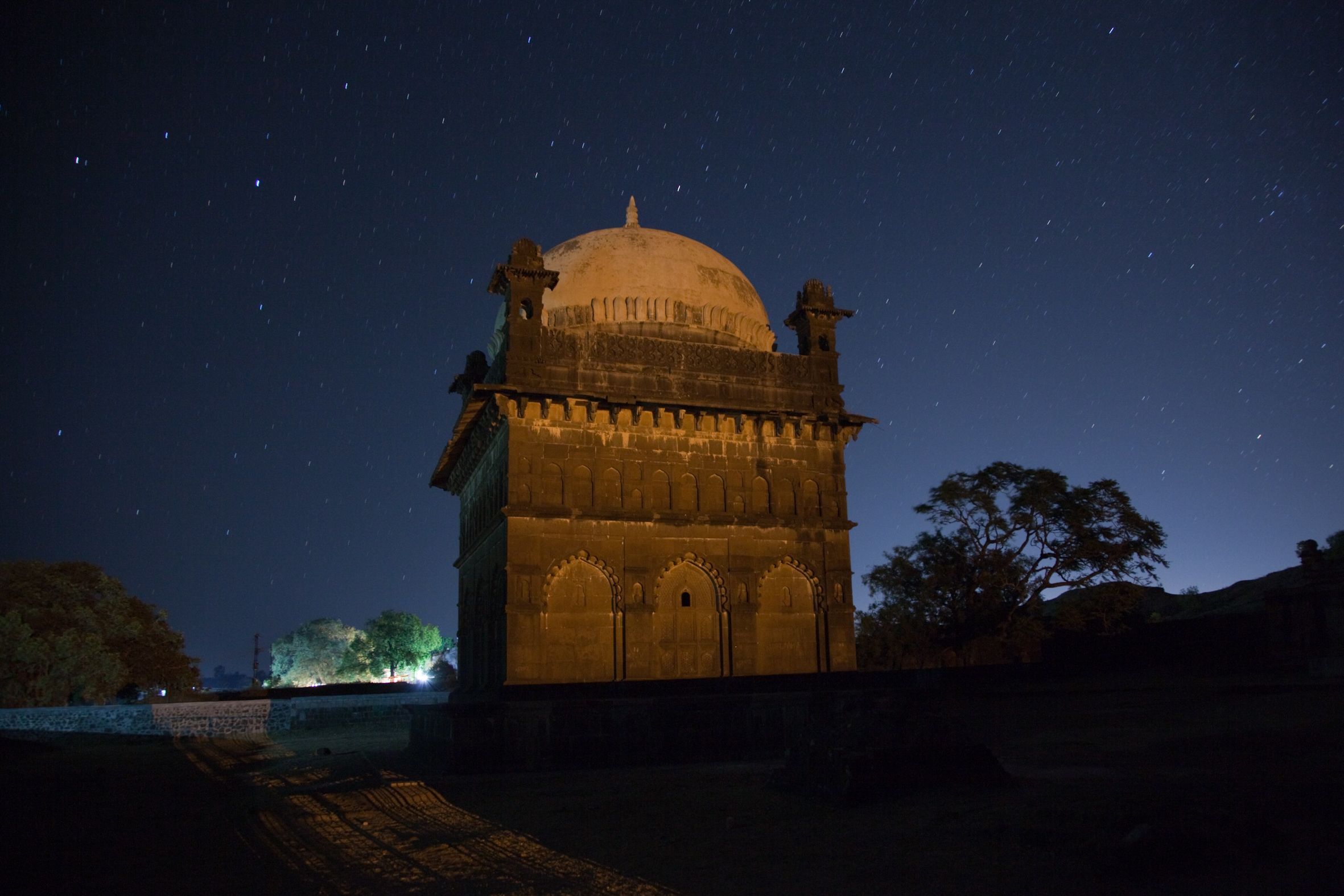
Khuldabad
Aurangzeb ruled the largest empire India had ever seen. He commanded armies that stretched from Kabul to the Deccan, presided over a treasury that made European monarchs envious, and waged war for nearly half a century. When he died in 1707 at the age of 88, he left instructions that his grave be as simple as a poor man's - open to the sky, covered in earth, paid for only by the few rupees he had earned sewing prayer caps. His tomb lies in Khuldabad, a small town in the hills near Aurangabad, Maharashtra, that calls itself the Valley of Saints. It is the humblest royal grave in India, and the contrast between the emperor's power and his burial tells you everything about the man and the place he chose for eternity.
The Abode of Eternity
Khuldabad's name means "Abode of Eternity," and the town earned it long before Aurangzeb arrived. In the 14th century, Sufi saints from the Chishti order migrated south from Delhi and chose this hillside settlement as their home. Shaikh Burhan ud-din Gharib Chishti, a disciple of the great Nizamuddin Auliya, established his khanqah here around 1340. Shaikh Zain-ud-din Shirazi followed. The dargah of Zar Zari Zar Baksh, said to possess a robe of the Prophet Muhammad, became a pilgrimage site that drew believers from across the subcontinent. Within a generation, the small walled town had become one of the holiest Muslim cities in the Deccan, its narrow streets lined with tombs, shrines, and hospices. The Sufis chose Khuldabad for its remoteness and quiet - qualities it retains today, even as the nearby city of Aurangabad has sprawled into a metropolis.
An Emperor's Simple Grave
Aurangzeb spent his final decades in the Deccan, waging an exhausting campaign against the Marathas that consumed his treasury and his health. He died at his military camp in Bhingar near Ahmednagar on March 3, 1707, and was buried the same day in Khuldabad, within the courtyard of the dargah of Shaikh Zain-ud-din Shirazi, as he had wished. The grave is startlingly modest: an open-air rectangle of earth, sprinkled with basil, surrounded by a low marble screen added later by the Nizam of Hyderabad. No dome rises above it. No jewels adorn it. Aurangzeb's instructions were explicit - he wanted nothing that smacked of the Mughal grandeur he had wielded in life. His father Shah Jahan built the Taj Mahal for Aurangzeb's mother; Aurangzeb's own son Azam Shah built the Bibi Ka Maqbara in Aurangabad for his mother. Between those two monuments of love and excess, Aurangzeb chose bare earth. The austerity was theological conviction, not false modesty.
Generals and Nizams
Aurangzeb is not the only powerful figure resting in Khuldabad. Nearby lies the tomb of Asif Jah I, the general who served as Aurangzeb's trusted commander and later became the first Nizam of Hyderabad, founding a dynasty that would rule until 1948. The town also holds the tomb of Malik Ambar, the Ethiopian-born regent of the Ahmadnagar Sultanate who became one of the most formidable military leaders of 17th-century India. Born into slavery in Ethiopia, sold through markets in Yemen and Baghdad, Ambar rose through military ability to command armies and effectively govern a sultanate. His guerrilla tactics against the Mughals frustrated three emperors and anticipated the strategies the Marathas would later use to even greater effect. That a town of saints became the final resting place for such warriors is no contradiction - in the Islamic tradition of the Deccan, spiritual authority and temporal power were never far apart.
Between Hindu and Muslim
Khuldabad sits barely five kilometers from the Ellora Caves, one of the great Hindu, Buddhist, and Jain temple complexes of India, and within easy reach of the ancient fortress of Daulatabad. This proximity is not accidental. The Deccan Plateau has been a crossroads of faiths for millennia, and Khuldabad reflects that layering. The Bhadra Maruti Temple, dedicated to Hanuman and believed to be the only temple in India where the deity reclines, stands within the same walled town as the Sufi dargahs. Hindu pilgrims visit alongside Muslim ones. During the annual Urs festival honoring the Sufi saints, the town fills with devotees of both faiths, the celebration blending Sufi qawwali music with the rhythms of Deccani culture. Khuldabad is small enough to walk in an hour, but its spiritual geography spans centuries and traditions.
From the Air
Located at 20.054N, 75.196E in the hills near Aurangabad, Maharashtra, India. Khuldabad sits at approximately 620m elevation on the Deccan Plateau, about 5km from the Ellora Caves. The walled town is compact and visible from altitude as a small settlement nestled in the Sahyadri Hills. Nearest airport is Chhatrapati Sambhaji Nagar Airport (VAAU/IXU), approximately 26km to the southeast. From the air, look for the medieval town walls and the green-domed shrines clustered within. The fortress of Daulatabad (Devagiri) with its distinctive conical hill is visible approximately 14km to the south and serves as a useful landmark. Best visibility October through February.