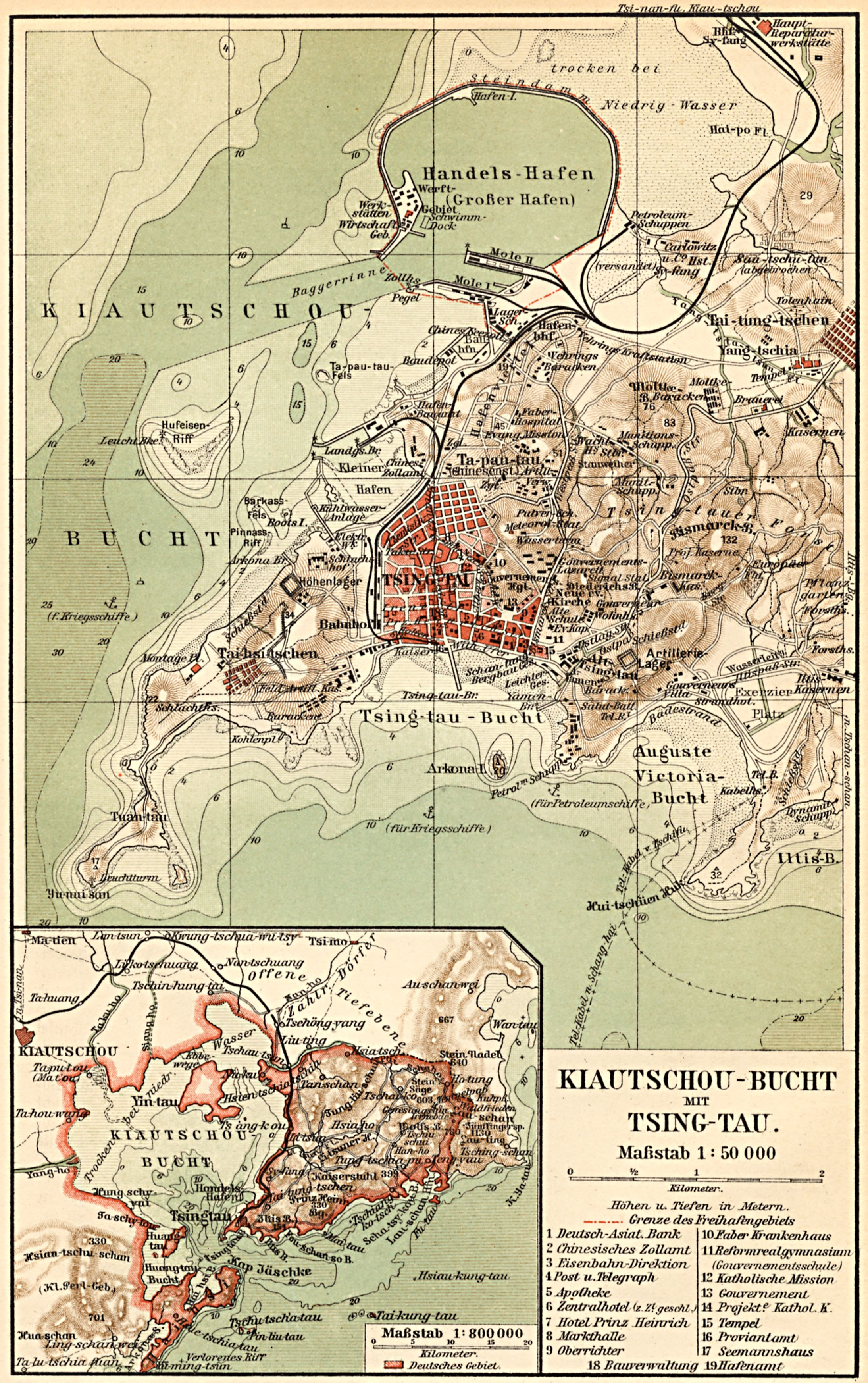
Kiautschou Bay Leased Territory
"May incidents be exploited in pursuit of further goals?" Admiral Otto von Diederichs wired this question to Berlin on November 7, 1897, after learning that two German missionaries had been murdered in southern Shandong. Kaiser Wilhelm II did not counsel caution. "Proceed immediately to Kiautschou with entire squadron," came the reply. Diederichs had three ships and 717 men. The Chinese garrison vastly outnumbered him. It did not matter. By 8:15 on the morning of November 14, the admiral had seized the territory, disabled the telegraph line, and occupied the forts. When Berlin cabled back that his orders had been canceled, Diederichs responded with one of the great bluffs in colonial history: "Proclamation already published. Revocation not possible." The Kaiser promoted him to vice admiral.
Building a Model Colony
Germany invested upwards of $100 million in transforming the fishing village of Tsingtau into a showcase of colonial ambition. Wide streets, solid housing, electrification, a sewer system, and safe drinking water appeared in a city that had none of these things before -- amenities that were rare across much of Asia at the time. The territory achieved the highest density of schools and highest per capita student enrollment in all of China, funded by the Berlin treasury and by Protestant and Catholic missions. The completion of the Tsingtau-Jinan railway in 1910 connected the colony to the Trans-Siberian Railway, making it theoretically possible to travel by train from the shores of Jiaozhou Bay to Berlin. Sun Yat-sen visited in 1912 and declared the city "a true model for China's future." Germany had set out to impress, and even its rivals acknowledged the results.
The Single Tax Experiment
Perhaps the most remarkable aspect of the Kiautschou colony was its taxation system. Having been burned by land speculation in its African territories, Germany implemented a radical Georgist policy: the territory's sole source of revenue was a six percent land value tax. No income tax, no tariffs, no sales tax -- just the value of the land itself. The experiment worked. Speculation vanished, development proceeded rapidly, and the colony achieved financial stability that eluded Germany's other overseas possessions. It remains the only government in history to rely exclusively on a single land value tax, and economists still cite Kiautschou as a case study in the viability of Georgist principles. The colony even issued its own currency through the Deutsch-Asiatische Bank, with banknotes printed in German, English, and Chinese.
Siege and Surrender
The experiment ended on August 15, 1914, when Japan delivered an ultimatum demanding Germany relinquish Kiautschou. Germany refused. Japan declared war on August 23, and its navy bombarded the territory the same day. The Siege of Tsingtao, the only major land battle in the Asian-Pacific theater of World War I, pitted 23,000 Japanese soldiers and 1,500 British troops against a German garrison of 3,625 men. The colony fell on November 7, 1914, after a defense that Kaiser Wilhelm II had personally prioritized. Germany's sixteen-year experiment in Asian colonialism was over. The territory would not return to Chinese hands until December 10, 1922, following years of diplomatic wrangling over the Shandong Problem.
The Legacy in Stone and Beer
Today Qingdao's German architectural heritage remains visible in the red-roofed villas, stone churches, and tree-lined boulevards of the old city. But Germany's most enduring legacy may be liquid. The Tsingtao Brewery, founded in 1903 by German and British settlers, survives as one of China's most recognizable brands, its name still carrying the colonial-era spelling of the city. A German pidgin known as Kiautschou German, mixing High German, Low German, English, and Chinese, briefly flourished in the territory's streets before vanishing with the colony itself. After 1911, wealthy Chinese and politically connected former officials settled in the leased territory for its orderly environment, an irony not lost on those who noted that Chinese citizens were fleeing to a German colony for safety and stability.
From the Air
Located at 36.123N, 120.246E, centered on Jiaozhou Bay on the southeastern coast of the Shandong Peninsula. The former territory covered 552 square kilometers. The bay, the city of Qingdao's distinctive European-style old town, and the Jiaozhou Bay Bridge are all visible from altitude. Nearest airport is Qingdao Jiaodong International Airport (ZSQD). At 8,000-12,000 feet, the contrast between the German-planned old city and modern development is apparent.