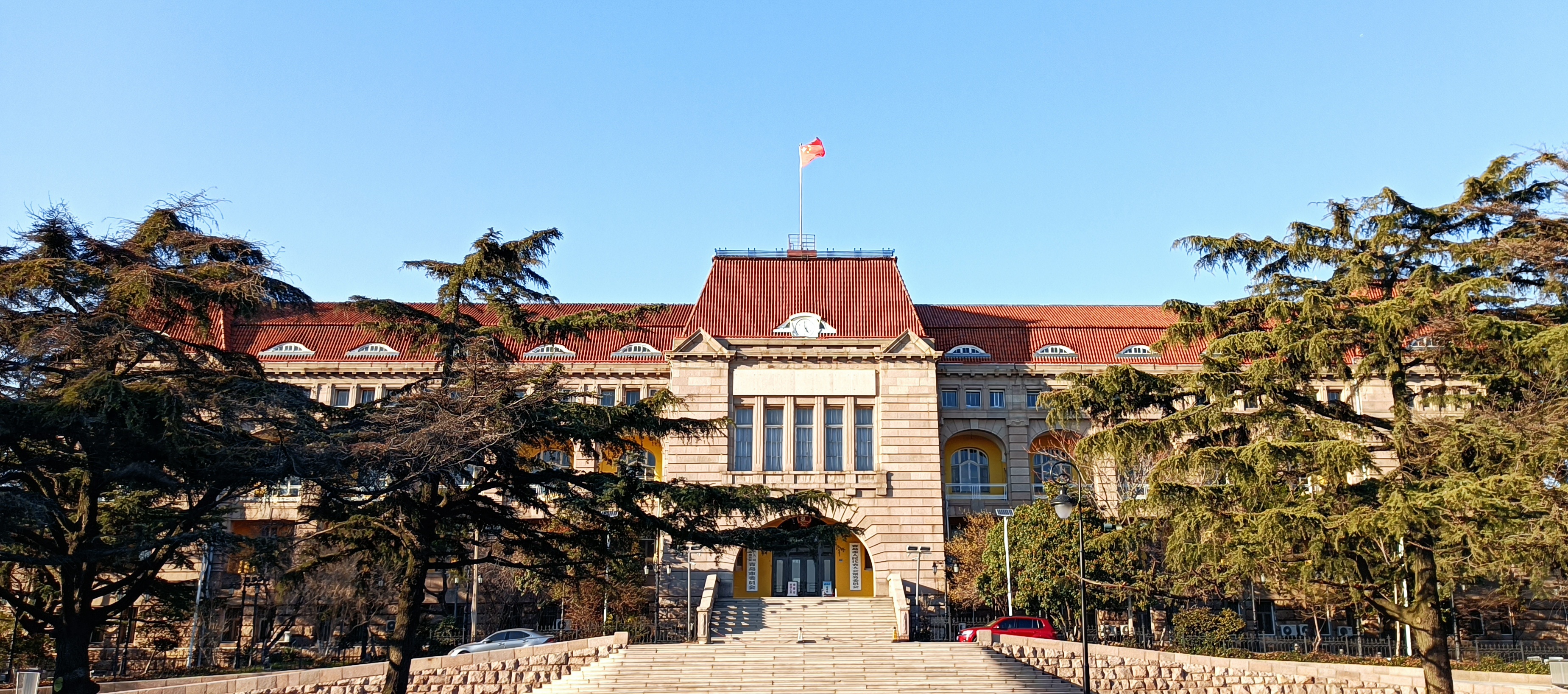
Kiautschou Governor's Hall
Few buildings have changed masters as often as the Governor's Hall in Qingdao. Designed by German architect Friedrich Mahlke and completed in 1906, the 7,500-square-meter structure was built to project imperial authority over the Kiautschou Bay territory. It has since served as the headquarters for Japanese occupiers, Chinese nationalists, Japanese occupiers again, and finally the People's Republic of China. The building survived artillery strikes during the Siege of Tsingtao in 1914, and photographs from that year show two shell holes in its western wall -- damage that failed to diminish either its grandeur or its usefulness to the next power that claimed it.
Mahlke's Monument
Friedrich Mahlke began designing the building in the early 1900s, and construction stretched from 1904 to 1906. The finished structure was officially handed to the colonial administration on April 2, 1906, under the name Gouverneurspalast, the Governor's Palace. At 7,500 square meters, it was substantial enough to house both the naval and civil government offices of the Kiautschou territory. Mahlke gave the building a European institutional gravity appropriate to its role: this was the seat of power for a territory run not by the German Colonial Office but by the Imperial Naval Office, reflecting the strategic naval importance that had justified the colony's existence in the first place. All five governors of Kiautschou were senior naval officers, and the building's dual military-civilian function was reflected in its imposing scale.
Five Flags in Forty Years
The Siege of Tsingtao in 1914 ended Germany's sixteen years in the building. Japanese forces took it as their occupation headquarters, a role it served until 1922, when China regained sovereignty over Shandong. The reprieve was temporary. When Japan invaded again in 1938, the Governor's Hall once more became the seat of an occupation regime, this time for seven years. After Japan's surrender in 1945, the Kuomintang government moved in. When the People's Liberation Army entered Qingdao in June 1949, the building transitioned to Communist Chinese administration without missing a beat. It served as Qingdao's town hall for the next four decades, finally relinquishing its governmental function in 1992. Each occupant found the building's rooms capacious enough, its construction solid enough, and its location commanding enough to repurpose rather than replace.
The Architecture of Persistence
What makes the Governor's Hall remarkable is not its beauty -- it is a functional government building, not a cathedral -- but its durability. The structure has outlasted every regime that has occupied it. German imperial ambitions ended in 1914; the building endured. Japanese occupation collapsed in 1922 and again in 1945; the building endured. The Kuomintang fled to Taiwan in 1949; the building endured. Even when Qingdao's municipal government outgrew it in 1992, the structure itself remained intact. The shell damage from 1914 was repaired long ago, but historic photographs preserve the moment when two artillery strikes marked the building's western wall, the only visible scars from a siege that ended an empire's Asian ambitions. Today, the Governor's Hall stands as one of Qingdao's most significant colonial-era landmarks, its stone walls a testament to the principle that good construction outlasts the ideologies of those who commission it.
From the Air
Located at 36.065N, 120.328E in the historic center of Qingdao, within the former German colonial district. The building is a prominent landmark among the red-roofed European-style architecture of the old city. Nearest airport is Qingdao Jiaodong International Airport (ZSQD). The colonial district is visible from 2,000-5,000 feet, with the Governor's Hall identifiable by its large footprint near the waterfront.