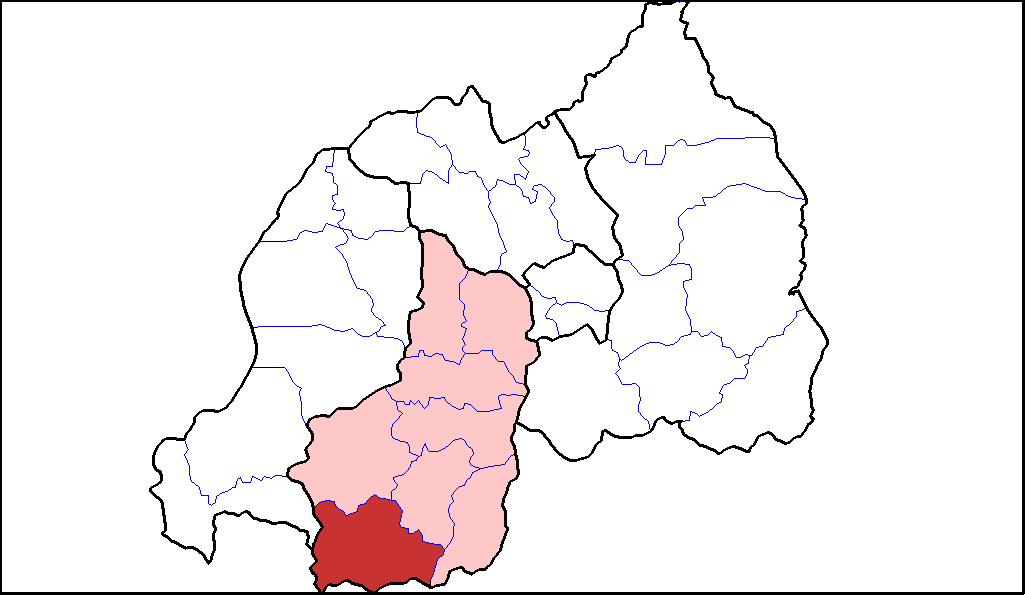
Kibeho Massacre
Less than a year after the 1994 genocide, Rwanda was still a country of camps. Hundreds of thousands of internally displaced people -- many of them Hutu civilians who had fled the advancing Rwandan Patriotic Front -- lived in sprawling settlements under international supervision. The camp at Kibeho, in Gikongoro Prefecture in southern Rwanda, held an estimated 80,000 people or more. The new RPF-led government wanted the camps closed, arguing that they sheltered genocidaires who used displaced civilians as human shields. In April 1995, soldiers of the Rwandan Patriotic Army moved to force the closure. What began as a tense standoff ended in mass killing. The official government count was 338 dead. Australian military medics on the ground estimated the true number at over 4,000. Scholar Gerard Prunier considered 5,000 a conservative figure. As many as 20,000 to 30,000 more may have died in the chaotic aftermath.
The Days Before
The camp at Kibeho had become a political problem the government was determined to solve. Hutu Interior Minister Seth Sendashonga, a member of the RPF coalition government, rushed to Kibeho when shooting first began, then returned to Kigali to organize emergency transport for the displaced. He briefed Prime Minister Faustin Twagiramungu, President Pasteur Bizimungu, and Vice President Paul Kagame, who assured him the situation would stay under control. It did not. Over several days, soldiers fired both into the air and at people, compressing the camp's population into an ever-smaller area while processing continued. Those who agreed to leave were allowed out. Those who stayed -- whether by choice, by fear, or because they had nowhere safe to go -- found the perimeter tightening around them. Australian medic Major Carol Vaughan-Evans later recalled that government forces made it clear that international personnel were unwelcome and insisted they treat only those who had decided to leave.
April 22
On the morning of April 22, 1995, the approximately 80 Zambian UNAMIR peacekeepers at Kibeho discovered that roughly 100 people in the camp had been killed or wounded during the night. Most had been bayoneted or shot at close range -- not the pattern of battlefield casualties, but of deliberate killing. The Australians estimated that 400 to 500 additional bodies remained uncounted, not including those already removed. Journalist Linda Polman, embedded with the Zambian soldiers, witnessed the carnage firsthand. The killing did not follow the logic of a military operation gone wrong. It followed the logic of a force that had decided the camp and its people were the problem, and that eliminating both was the solution.
The Numbers They Tried to Bury
President Bizimungu arrived at Kibeho on the afternoon of April 23. He was told there had been about 300 casualties and accepted the figure without comment. When a Zambian officer attempted to present the much higher count compiled by the Australian unit, Bizimungu showed visible displeasure. Interior Minister Sendashonga asked for an international commission of inquiry but was rebuffed by Kagame. The commission that was eventually formed consisted of members handpicked by the RPF. It met in Kigali for five days, conducted no field visits, and concluded that the killing had been a defensive response to firing from within the camp. The official toll of 338 has never been formally challenged by any government or international body. The UN publicly estimated 2,000 dead. Gerard Prunier, one of the most careful scholars of the region, argued that more than 5,000 people were killed on that single day, and that the forced expulsion of survivors from the camps led to the deaths of 20,000 to 30,000 more through violence, exhaustion, and dehydration in the weeks that followed.
The Fracturing That Followed
Kibeho broke the coalition government that had been formed after the genocide. Sendashonga, increasingly convinced that Hutus were being collectively treated as murderers and killed without trial, became an obstacle to the RPF leadership. He intervened to prevent the suffocation of prisoners packed into crowded cells. He blocked an attempt by Kigali's mayor, Rose Kabuye, to color-code residency permits by ethnic origin. Rwanda's military intelligence directorate leaked a memo linking him to extremist forces. In August 1995, a special security meeting ended when Kagame walked out of the room after being confronted by both Hutu and Tutsi ministers over his appointment of 117 Tutsis among 145 new local officials. Prime Minister Twagiramungu resigned. Parliament fired him. Sendashonga, along with several other ministers, was dismissed the following day. Both men were eventually allowed to leave the country. The government of national unity continued in name, but Kibeho had destroyed it in substance. Scholar Johan Pottier would later call Kibeho a halfway stage in the development of Kagame's doctrine of tight information control -- a rehearsal for the methods that would be deployed in eastern Zaire eighteen months later.
Those Who Stayed to Witness
A small team of Australian Defence Force medics was present throughout the massacre, and their accounts form some of the most detailed testimony of what happened. Four Australians received the Medal for Gallantry for their actions at Kibeho -- the first gallantry medals awarded to Australians since the Vietnam War: Corporal Andrew Miller, Warrant Officer Rod Scott, Lieutenant Thomas Tilbrook, and Major Carol Vaughan-Evans. All accounts describe a team that was deeply distressed by what it witnessed and frustrated by its powerlessness to stop it. They could not prevent the killing, but they treated hundreds of wounded survivors who were evacuated to the UN hospital in Kigali, where Australian clinicians worked around the clock with limited staff and supplies. Paul Jordan, writing in the Australian Army Journal, offered a grim assessment: had Australians not been present as witnesses, the RPA would likely have killed every person in the camp. The presence of foreign eyes did not stop the massacre, but it may have limited it -- and it ensured that the dead, though their numbers remain disputed, were not entirely erased from the record.
From the Air
Located at 2.65S, 29.56E in southern Rwanda's Gikongoro Prefecture, on hilly terrain characteristic of the Rwandan highlands. The area around Kibeho is agricultural, with scattered settlements on green hillsides. Best observed from 5,000-8,000 feet AGL. The terrain is gently undulating with good visibility in dry season. Nearest significant airport: Kamembe Airport (HRZA), approximately 80 nm to the west. Kigali International Airport (HRYR) is approximately 80 nm to the northeast.