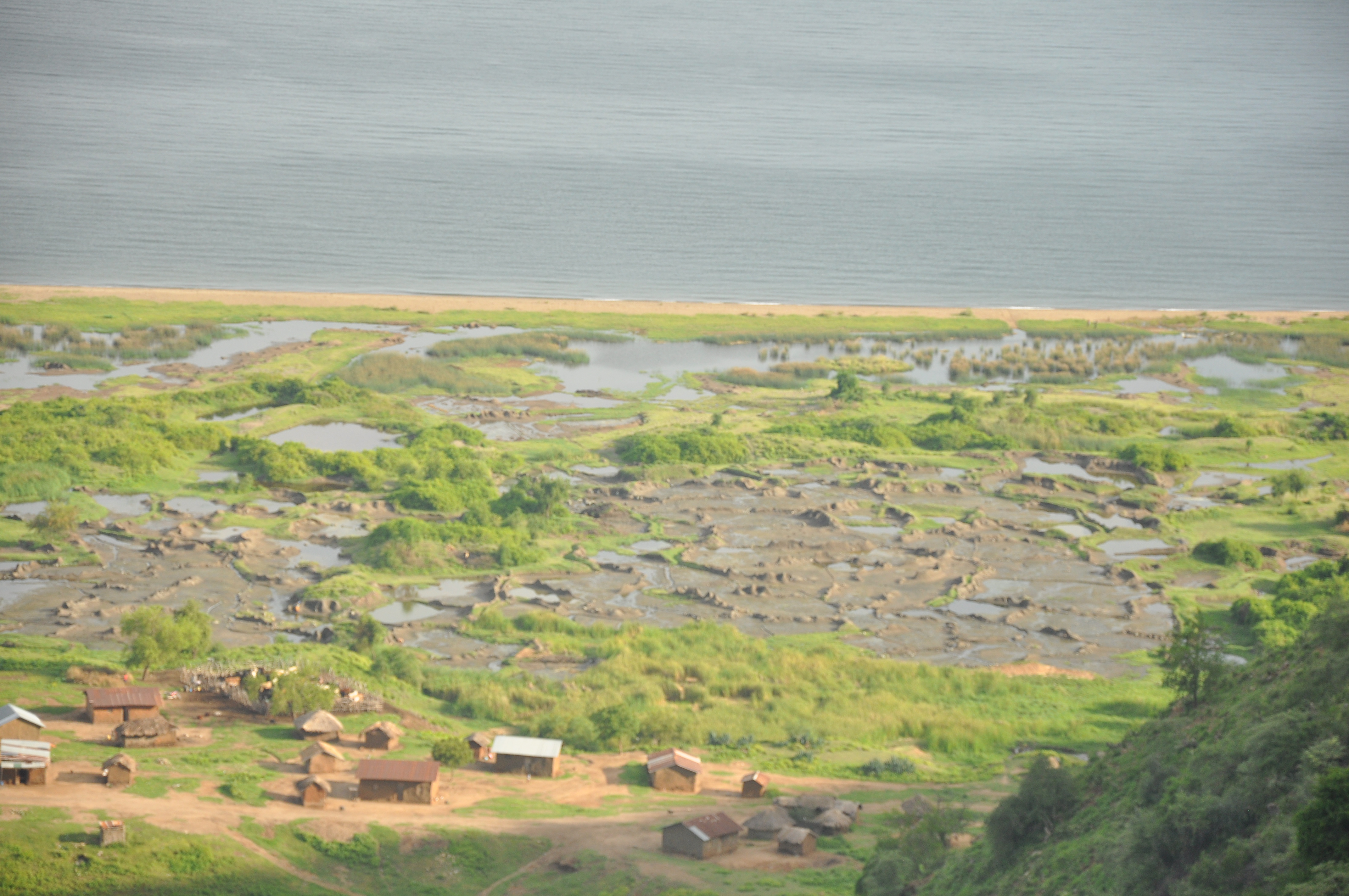
Kibiro
There is no road to Kibiro. To reach this small village on the southeastern shore of Lake Albert, you descend a steep footpath down the escarpment of the Western Rift Valley. The soil is shallow and rocky, the rainfall scarce -- a local rain shadow cast by the adjacent cliffs means Kibiro receives far less rain than the surrounding countryside. Nothing much grows here. The residents cannot produce their own food and must trade for nearly everything they eat. Yet people have lived in Kibiro for a thousand years, drawn and sustained by one remarkable resource: salt.
The Women's Craft
Salt production in Kibiro is exclusively the work of women. The process they use is unlike any other documented salt-extraction method in the world. Hot springs beneath the village saturate the soil with minerals, and the salt workers harvest this saline earth, leach it with water to create brine, then boil the brine over wood fires to evaporate the liquid and crystallize the salt. What makes the technique extraordinary is its sustainability: the same soil is reused repeatedly, re-saturated by the hot springs below. As long as the springs flow and firewood can be gathered, the salt supply is essentially inexhaustible -- though archaeologists have noted that firewood scarcity is a more likely constraint than any depletion of the mineral source. This cycle of extraction and renewal has continued without interruption for centuries, binding the village to its particular patch of lakeshore as firmly as any anchor.
A Millennium in the Earth
Archaeological excavations led by Graham Connah in the early 1990s revealed that Kibiro's occupation deposits are unique in East Africa -- deep, extensive, and well-stratified layers created by iron-using agriculturalists over the past millennium. The cuttings uncovered pottery sherds in staggering quantities, their roulette decoration patterns serving as chronological markers that allow researchers to trace cultural change through the centuries. Animal bones showed that residents relied on fish from Lake Albert supplemented by domesticated cattle, goats, and sheep. Among the most significant finds was a hearth used for salt-boiling, confirming that the industry that defines Kibiro today has been its economic foundation throughout the entire period of occupation. The site's archaeological richness earned it a place on UNESCO's World Heritage Tentative List in September 1997, recognition of its value as a window into precolonial East African life.
Salt and the Kingdom
Kibiro's salt was never merely a local commodity. It was a pillar of the economy of Bunyoro-Kitara, the powerful kingdom that dominated the Great Lakes region from the 16th through the 19th centuries. The Bunyoro shore of Lake Albert had relatively few resources aside from Kibiro's salt, which made the village disproportionately important to the kingdom's trade networks. Salt from Kibiro traveled across the region, exchanged for iron tools, cattle, foodstuffs, barkcloth, and other goods in markets that drew the Alur, Acholi, Langi, Basoga, Banyankore, and other peoples. The village's isolation -- accessible only by footpath, hemmed in by escarpment and lake -- was, paradoxically, its protection. The same geography that made agriculture impossible made Kibiro difficult to conquer or control from outside.
Between Preservation and Loss
Kibiro today is a settlement of relatively scattered dwellings stretching several kilometers along a coastal plain that exists on two levels: a gently sloping, stony terrace against the escarpment base, and a lower, flatter, often swampy area near the lake separated from the water by two beach ridges. The village faces a quiet tension. As the population grows, the digging of domestic pits and construction of new dwellings threatens the very archaeological deposits that make Kibiro historically significant. Connah warned that it seemed inevitable that more and more of the important deposits would be destroyed over time. The irony cuts deep: it is the salt industry that made Kibiro worth studying, but continued habitation driven by that same industry risks erasing the physical record of its own past. For the women who still gather saline earth from gardens fed by hot springs, these academic concerns are distant. Their work continues as it has for generations -- the same motions, the same fires, the same salt crystallizing white against dark soil at the bottom of the rift.
From the Air
Located at 1.67N, 31.25E on the southeastern shore of Lake Albert in the Western Rift Valley, Uganda. The village is visible from altitude as a thin strip of settlement along the lakeshore at the base of the rift escarpment. Lake Albert stretches northward, a long narrow body of water shared between Uganda and the Democratic Republic of Congo. The escarpment rises steeply behind the village. No airstrip at Kibiro itself; nearest airports are Hoima and Pakuba Airfield. Entebbe International Airport (HUEN) is approximately 250 km to the southeast.