The Kick Six: One Second, 109 Yards, and a Seismograph
The seismographs picked it up as far north as Huntsville, 200 miles away. On November 30, 2013, when Chris Davis caught a missed 57-yard field goal attempt one yard deep in his own end zone and ran 109 yards to score the winning touchdown as time expired, the 87,451 people inside Jordan-Hare Stadium in Auburn, Alabama, generated a measurable earthquake. The 2014 ESPY Awards named it both the Best Play and the Best Game of the year in all of North American sports. College football fans later voted it the single greatest play in the sport's history. It happened because a defensive coordinator had a hunch, a coach trusted it, and the number-one team in America tried a field goal from nine yards farther than anyone should have attempted.
The Collision Course
Alabama and Auburn first played football in 1893 and have met every year since 1948, building a rivalry that divides families, offices, and entire towns. They call it the Iron Bowl. Entering the 2013 game, Alabama was ranked number one in the country, undefeated at 11-0, the two-time defending national champion riding a dynasty under Nick Saban. They had won three of the previous four national titles. Auburn, by contrast, had gone 3-9 the year before - their worst season in 60 years, capped by a 49-0 humiliation to Alabama. New head coach Gus Malzahn had rebuilt the team through a season of improbable comebacks, including a tipped Hail Mary pass against Georgia two weeks earlier that became known as the "Prayer at Jordan-Hare." Auburn entered ranked number four. It was the highest-ranked Iron Bowl in the rivalry's history, and the first in which both teams were playing for a spot in the SEC Championship Game.
The Setup
Nearly everyone expected Alabama to win. ESPN's entire College GameDay panel picked the Crimson Tide. The Anniston Star published seven reasons Auburn could not compete. Alabama was favored by 10 points. Only Charles Barkley, the Auburn alumnus and NBA personality, publicly picked the Tigers on the GameDay broadcast. The game itself was tight and tense. Alabama's kicker Cade Foster had already missed two field goals. With the score tied 28-28 and one second remaining in the fourth quarter, Alabama lined up for a 57-yard field goal attempt - an extraordinarily long try that would require everything to go right. Auburn's defensive coordinator, Ellis Johnson, doubted the kick would reach the uprights and suggested placing a fast player in the end zone to return it if it fell short. Malzahn sent Chris Davis, Auburn's punt returner, to stand in the back of the end zone.
109 Yards
Adam Griffith's kick fell short. Davis caught it at the back of the end zone, a yard deep, and hesitated for half a breath. Then he started running. He cut left along the sideline, found a wall of blockers, and accelerated through the chaos. CBS broadcaster Verne Lundquist, one of the most experienced voices in sports, could barely keep up: his call peaked with the simple exclamation that captured 87,000 people losing their minds. On the Auburn radio network, Rod Bramblett delivered a call so passionate it went viral within hours, earning him Sports Illustrated's Sports Broadcaster of the Year and what the New York Times called "the Call of a Lifetime." Gary Danielson, Lundquist's broadcast partner, compared the upset to the Miracle on Ice. In a 2020 interview, Lundquist called it the greatest sporting moment he had ever witnessed.
What Came After
Auburn went on to beat Missouri 59-42 in the SEC Championship Game and advanced to the BCS National Championship, where they lost to Florida State 34-31, ending the SEC's streak of seven consecutive national titles. Alabama fell to Oklahoma 45-31 in the Sugar Bowl. Gus Malzahn won SEC Coach of the Year and a six-year contract extension. The name for the play settled gradually. Eighteen minutes after the game ended, a Birmingham News reporter posted an article titled "Kick Bama Kick" with a poll for readers to choose a name. In the years since, "Kick Six" - a play on "pick six," the term for an interception returned for a touchdown - became the accepted shorthand. The term has since entered football's general vocabulary, used to describe any missed field goal returned for a score, including a 2015 NFL play by the Baltimore Ravens.
Jordan-Hare Stadium
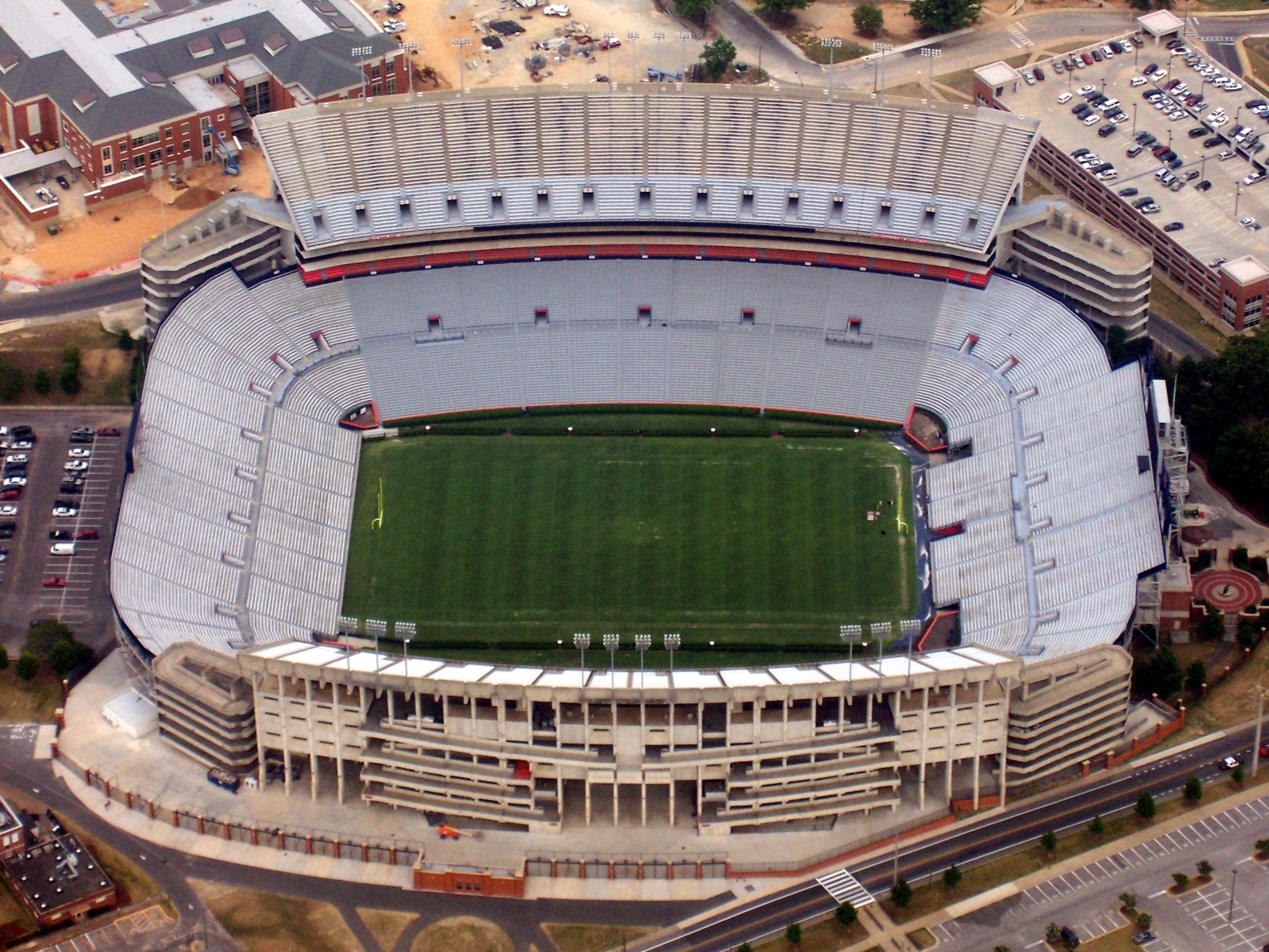
The stadium where it happened sits on the campus of Auburn University and holds 87,451 fans. It was built in 1939 and has been expanded multiple times to its current capacity. For one second on November 30, 2013, those 87,451 voices produced enough collective energy to register on seismographs across the state, echoing the phenomenon of the 1988 Auburn-LSU "Earthquake Game" played at the same venue. Today the Kick Six is commemorated in Auburn's athletics history and in the broader culture of college football. The winner of each of the previous four Iron Bowls - 2009, 2010, 2011, and 2012 - had gone on to win the national championship. The 2013 Iron Bowl broke that pattern, but it gave the sport something arguably more valuable: a single play that justified every cliche about why people watch.
From the Air
Jordan-Hare Stadium is located at 32.60°N, 85.49°W on the campus of Auburn University in Auburn, Alabama. From altitude, the stadium is the dominant structure on campus - an oval bowl visible from several thousand feet. Auburn University's campus surrounds it to the north and west. The town of Auburn is about 55 miles east of Montgomery. Nearest airports include Auburn University Regional Airport (KAUO), just south of the city, and Columbus Metropolitan Airport (KCSG) about 35 miles southeast across the Georgia border. Best viewed at 3,000-5,000 feet AGL to see the stadium in context with the campus and the town that shook on November 30, 2013.