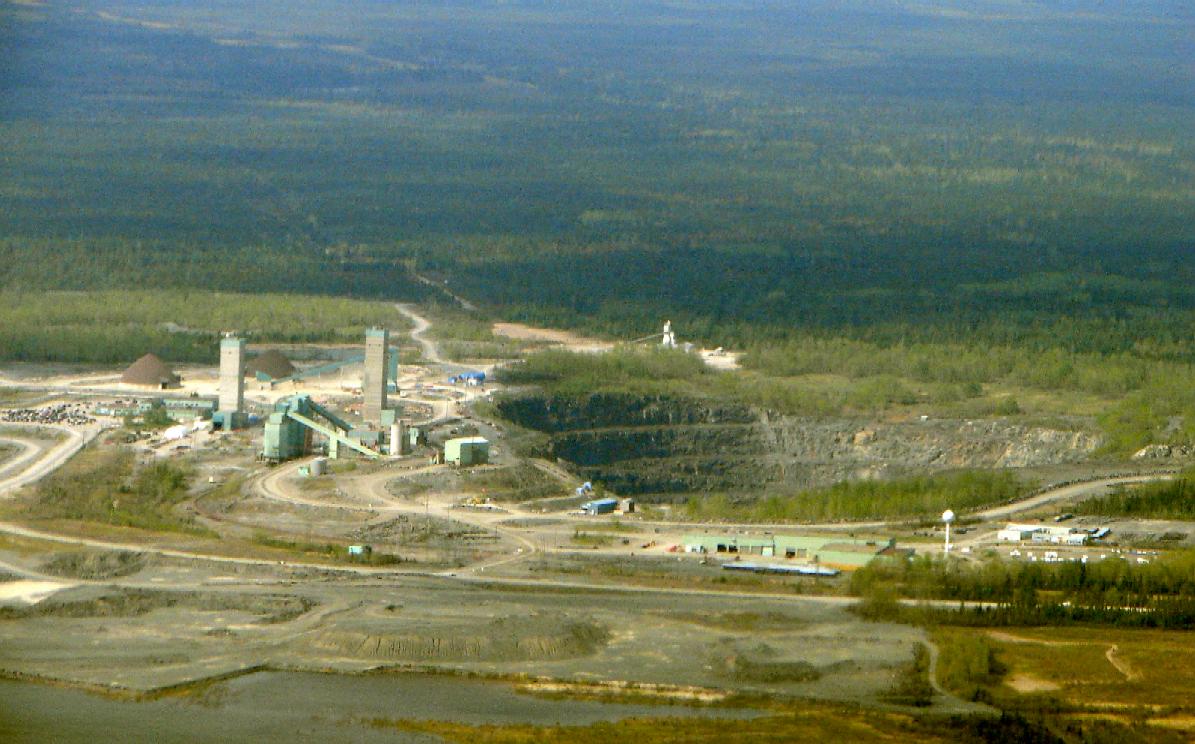
Kidd Mine
Two billion years ago, water seeped into fractures in the rock beneath what is now northern Ontario and stopped moving. It sat there through the assembly and breakup of supercontinents, through ice ages and mass extinctions, through the entire evolution of complex life on Earth. In 2016, researchers at the Kidd Mine north of Timmins announced they had found this water still flowing from fissures nearly three kilometers underground -- the oldest known water on the planet. The mine that made the discovery possible is itself a record-holder: at 3,014 meters below the surface, Kidd Mine is the deepest base metal mine in the world, and the bottom of its No. 4 shaft sits 2,733 meters below sea level, making it the deepest accessible non-marine point on Earth. What began as a copper-zinc prospect discovered by an aerial survey in 1959 became one of the most scientifically significant holes humanity has ever dug.
The Anomaly at Kidd-55
In March 1959, an aerial geophysical survey conducted by Texas Gulf Sulphur Company detected an electromagnetic anomaly in a segment of the Abitibi greenstone belt designated Kidd-55. Ground investigation did not begin until October 1963, when an electromagnetic survey confirmed the target. A drill rig started coring in November, boring 655 feet into rock that had formed 2.7 billion years ago on an ancient seafloor. The core samples, confirmed by the Union Assay Office in Salt Lake City, showed an average copper content of 1.15 percent, zinc content of 8.64 percent, and 3.94 ounces of silver per ton. A second hole was drilled in March 1964, followed by two more in early April. Seven drill holes revealed an ore body 800 feet long, 300 feet wide, and 800 feet deep. The Kidd deposit was, and remains, one of the largest volcanogenic massive sulfide ore deposits in the world.
The Scandal That Changed Wall Street
What happened next at Kidd-55 changed not geology but finance. Between the initial discovery and the formal announcement on April 16, 1964, officers of Texas Gulf Sulphur quietly bought company stock and stock options, knowing full well what the drill cores meant. The ore body was estimated to be worth $2 billion. The Securities and Exchange Commission sued, and the resulting case -- SEC v. Texas Gulf Sulphur Co. -- became the first time a federal court held that insider trading violated securities law. The Second Circuit Court of Appeals established the "disclose or abstain" rule: anyone with material non-public information must either share it with the market or refrain from trading. The decision stood for a decade as the preeminent insider trading precedent in the United States. A mine in the Ontario bush, discovered by geologists looking for copper and zinc, had reshaped the rules governing every stock exchange in America.
Descending Into Deep Time
The mine began ore production in 1966 as an open pit and gradually transitioned underground. Ownership changed hands repeatedly: Texas Gulf Sulphur to Canada Development Corporation in 1981, to Falconbridge in 1986, to Xstrata in 2006, and finally to Glencore when it merged with Xstrata in 2013. Through each transition, the mine kept going deeper. The No. 4 shaft descends to 3,014 meters below the surface. At that depth, the rock temperature approaches 50 degrees Celsius and the pressure is immense. Approximately 850 employees and contractors work the mine and the Kidd Metallurgical Site, which processes ore into concentrate. In 2008, the company invested $120 million to deepen the mine further. The Kidd deposit sits within the same 2.7-billion-year-old Abitibi greenstone belt that drives gold mining across the region, but here the ancient volcanic processes concentrated copper, zinc, and silver instead.
Water Older Than Memory
The discovery that captured global attention had nothing to do with metals. In 2013, researchers from the University of Toronto published a paper in the journal Nature reporting that water flowing from rock fractures deep in the mine was 1.5 billion years old. In 2016, they found even older water: samples dated to approximately two billion years. The water had been trapped in rock fissures since the Paleoproterozoic era, sealed by the same geological stability that preserved the ore body. Dissolved gases and sulfates in the water told a story of their own: sulfur-reducing microorganisms had once lived in this water, surviving on chemical energy long after it was cut off from sunlight and the surface. A billion-year-old water sample from the mine was added to the collection at Ingenium, Canada's national science and technology museum in Ottawa, on November 25, 2020. The Kidd Mine had become a window into conditions that might support life on other planets -- a place where biology persisted in isolation for geological ages.
From the Air
Located at 48.69°N, 81.37°W, approximately 24 kilometers north of Timmins, Ontario. The mine site is visible from altitude as a cleared industrial area surrounded by boreal forest, with the large open pit from early mining operations still visible. The Kidd Metallurgical Site is located southeast of the mine. Timmins/Victor M. Power Airport (CYTS) is the nearest major airport, approximately 25 km to the south. Best viewed at 3,000-6,000 feet AGL. The surrounding terrain is typical Canadian Shield: flat to gently rolling, dense boreal forest interspersed with lakes and wetlands. The mine infrastructure contrasts sharply with the surrounding wilderness.