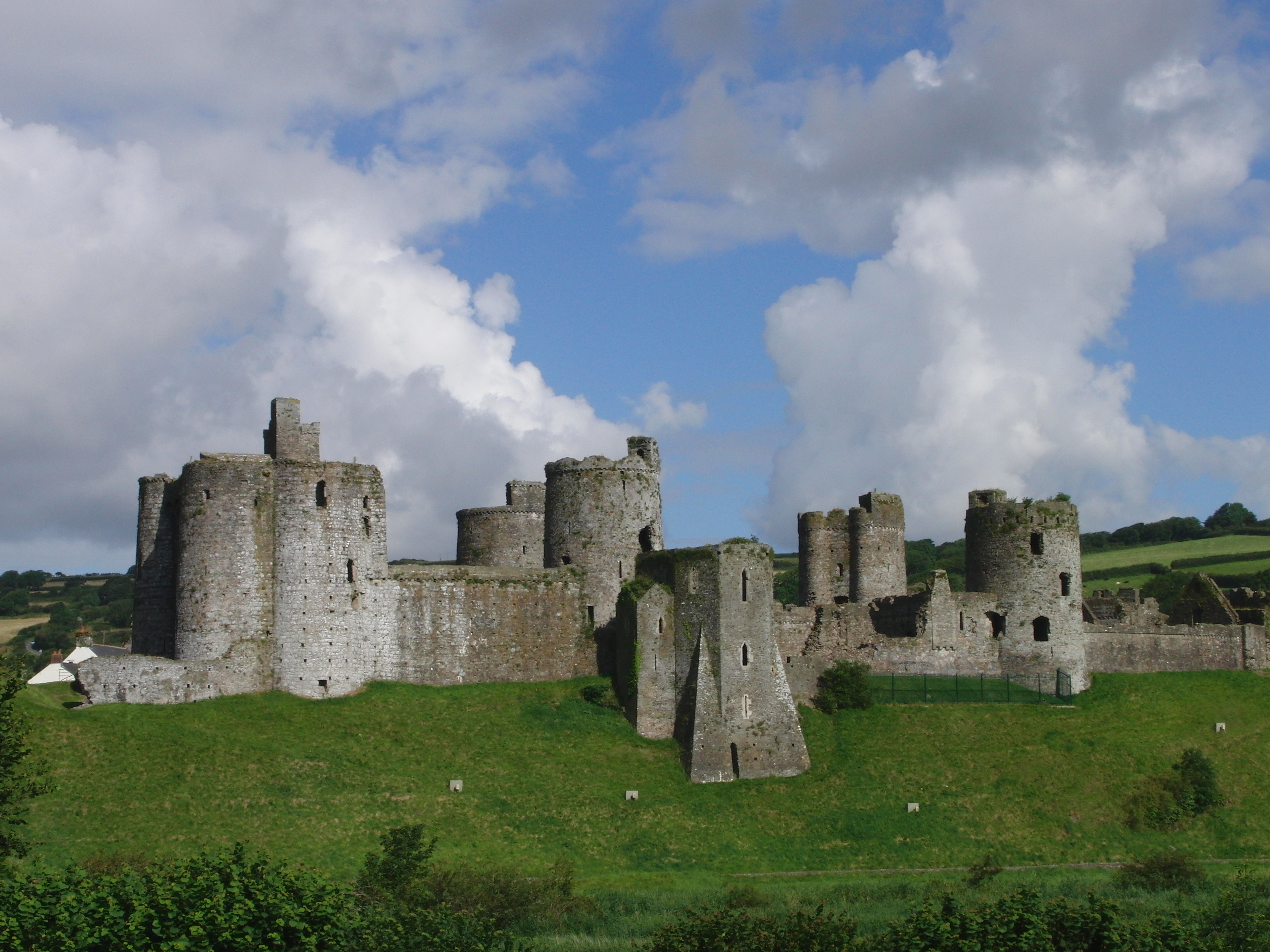
Kidwelly Castle
Before the coconut shells, before the killer rabbit, before the French soldiers hurling insults from the battlements, the camera simply held on a castle emerging from the morning mist. That opening image of Monty Python and the Holy Grail -- the one that set the tone for one of cinema's most beloved comedies -- was filmed at Kidwelly Castle in Carmarthenshire, a fortress whose real history involves considerably more bloodshed than the film's fictional variety.
Fortress on the Gwendraeth
Kidwelly dates from the early twelfth century, when Roger, Bishop of Salisbury, was entrusted as lord of the area and raised a castle overlooking the River Gwendraeth. Built as a defence against the Welsh, it was a position that required defending almost immediately. The castle fell to Welsh forces several times during the twelfth century. In 1159, the Prince of Wales later known as Lord Rhys captured Kidwelly and was recognised by Henry II as ruler of the region. After his death, the castle passed back to the Anglo-Normans, only to be captured and razed by Llywelyn the Great in 1231. Each time it fell, someone rebuilt it. Each time it was rebuilt, the walls grew thicker.
Glyndwr at the Gates
The castle's most dramatic test came in August 1403, when Owain Glyndwr -- the last native Welshman to hold the title Prince of Wales -- besieged Kidwelly with an army reinforced by French and Breton soldiers. Glyndwr's forces captured the town itself, but the castle held firm behind its concentric defences. In September 1403, a Norman relief army broke the siege and forced Glyndwr's retreat. The castle's design had proved its worth: a square inner bailey defended by four round towers, overlooked by a semi-circular outer curtain wall on the landward side, with a massive gatehouse positioned next to the river. The River Gwendraeth prevents the plan from being truly concentric, but a jutting tower protects the riverside walls, and the overall design is formidable.
Walls That Taught Themselves
What makes Kidwelly architecturally distinctive is a feature that was rare in English castles of its era: a stairway built against the outer curtain wall, rising from the level of the ward. Most castle builders of the period preferred internal staircases or those tucked into towers; Kidwelly's exposed stair suggests a design philosophy that prioritised rapid access to the wall-walk over concealment. The defensive approach here relied less on clever engineering than on brute strength -- thick walls, solid towers, and the natural barrier of the river. The castle is relatively well preserved today, managed by Cadw, the Welsh government's historic environment service. Walking the circuit of its walls, you can still trace the logic of its builders: every angle calculated to deny an attacker cover, every tower positioned to provide overlapping fields of fire.
From Battlements to Punchlines
Kidwelly earned its place in popular culture in 1975, when the Monty Python team chose it for the opening sequence of The Holy Grail. The castle appears in the very first scene after the titles, its towers materialising through fog in a shot that manages to be both genuinely atmospheric and a setup for the absurdity that follows. It later appeared as Clun Castle in the 1986 Robin of Sherwood episode 'Herne's Son.' The irony is that Kidwelly's actual medieval history -- a castle repeatedly captured, burned, rebuilt, and besieged by French-backed rebels -- is wilder than anything the Pythons invented. No killer rabbit, perhaps, but Lord Rhys and Owain Glyndwr were considerably more dangerous.
From the Air
Located at 51.739N, 4.306W overlooking the River Gwendraeth in Carmarthenshire, Wales. The castle's concentric layout is clearly visible from the air. Pembrey Airport (EGFP) is approximately 3 nm south. Swansea Airport (EGFH) is roughly 15 nm southeast. Best viewed from the south or east at 1,000-1,500 ft to appreciate the river and castle relationship.