Kifune Shrine
When the emperor needed rain, he sent a black horse to Kifune. When he needed clear skies, a white horse. For over a thousand years, this small shrine tucked into a forested valley north of Kyoto has been the place where Japan's rulers negotiated with the forces of water. The tradition of offering live horses to the deity eventually proved impractical, and wooden plaques painted with horse images took their place. Those plaques became ema, the votive tablets found at every Shinto shrine in Japan today. Kifune Shrine is where the practice began, which means that anyone who has ever scribbled a wish on a wooden board at a Japanese shrine owes a quiet debt to this mountain stream and the god who lives beside it.
The God Who Commands Rain
Kifune Shrine enshrines Takaokami-no-kami, the deity who controls water. According to Japanese mythology, when the creator god Izanagi slew the fire god Kagutsuchi with his sword, the body split into three pieces. One became the god of thunder. One became Oyamatsumi, the mountain deity. The third became Takaokami, a god who summons clouds, calls forth rain, brings sunshine, and makes water spring from the earth. The shrine's founding predates reliable records, but reconstruction is documented as early as the reign of Emperor Tenmu, over 1,300 years ago. By 965, Emperor Murakami had ordered imperial messengers to report important national events to the guardian spirits of 16 select shrines across Japan. Kifune was among them.
Black Horses, White Horses, and the Birth of Ema
During the Heian period, the imperial court formalized its relationship with Kifune's water deity through a strikingly literal form of prayer. When drought threatened the rice harvest, court delegations brought a black horse to the shrine, its dark coat symbolizing rain clouds. When floods or endless downpours endangered the capital, a white horse arrived, embodying the clear sky they sought. Over time, the expense and logistics of transporting and caring for live horses became unmanageable. The court began substituting wooden boards painted with images of horses. These evolved into the ema that are now ubiquitous at shrines across Japan, small wooden plaques on which visitors write prayers and wishes. Kifune Shrine is considered the birthplace of this tradition, a direct line from imperial rain rituals to the millions of personal wishes hanging at shrine fences today.
Fortunes That Appear on Water
Kifune Shrine's most distinctive modern ritual is the mizuura mikuji, water fortune slips. Visitors purchase a blank slip of paper and place it on the surface of a small basin fed by sacred spring water. As the paper absorbs the moisture, characters slowly materialize, revealing the fortune. The experience feels less like reading a prediction and more like watching the water deity write a message in real time. Each slip also carries a QR code that links to translations in English, Chinese, and Korean, along with an audio recording of the fortune. It is a rare example of ancient ritual and modern technology coexisting without either one diminishing the other.
The Curse at the Hour of the Ox
Kifune's connection to water holds a darker dimension. The shrine is associated with the ushi no toki mairi, a curse ritual performed during the hour of the ox, between one and three in the morning. According to legend, it was from Kifune's resident deity that Hashihime, the Princess of the Uji Bridge, learned the ritual to transform herself into an oni demon and exact vengeance on those who had wronged her. She wore candles fixed to an iron crown on her head and drove nails into a sacred tree. The tale was immortalized in the Noh play Kanawa, meaning "The Iron Crown," one of the most chilling works in the classical repertoire. The shrine itself does not encourage this association, but it clings to the place like mist on the river.
Lanterns, River Dining, and Mountain Quiet
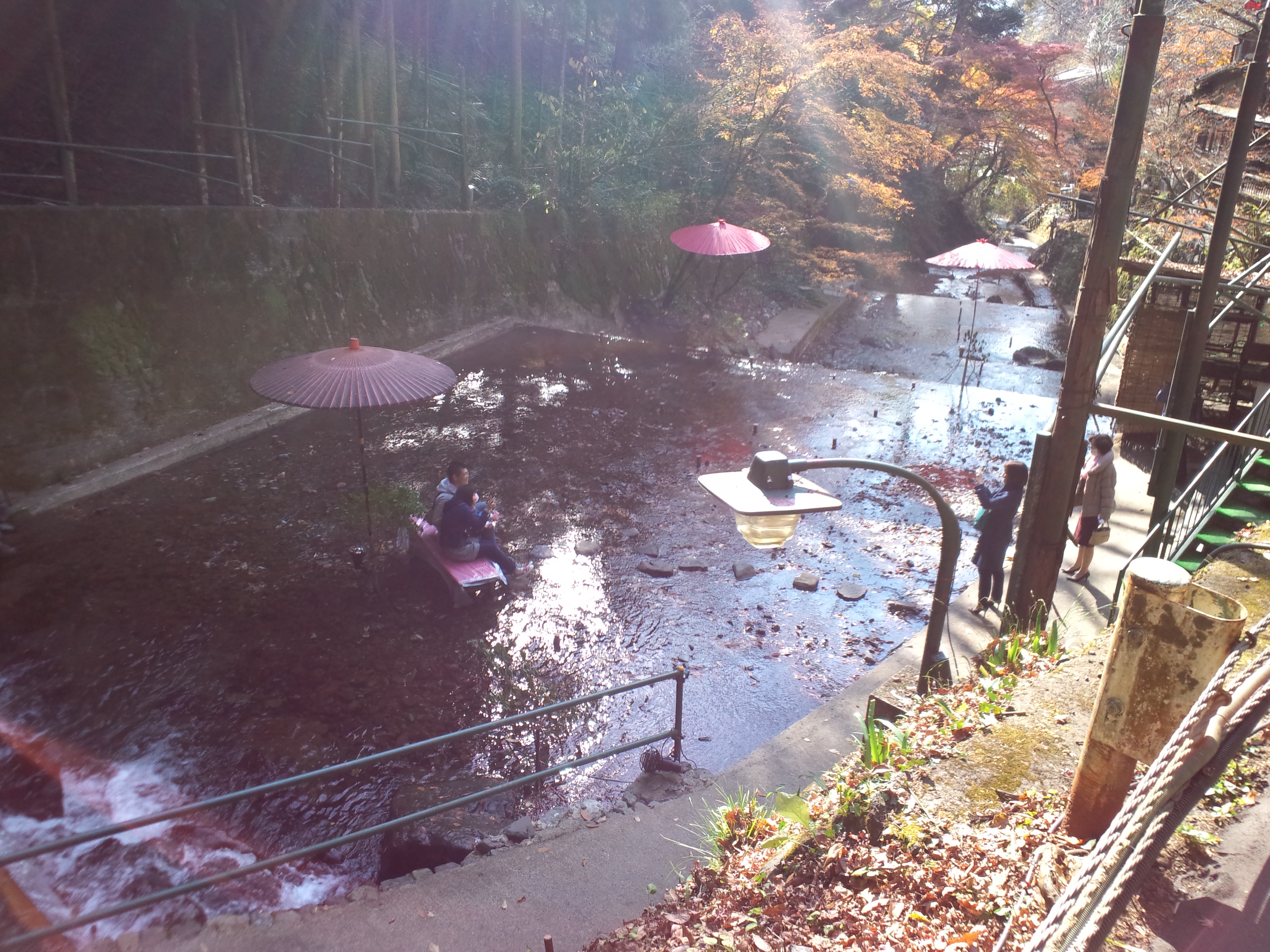
The approach to Kifune Shrine is a steep stone staircase flanked by rows of red lanterns, climbing through a canopy of maples that blaze crimson in autumn and filter green light in summer. The shrine sits along the Kifune River in the village of Kibune, where from May through September, restaurants build kawadoko platforms directly over the rushing water. Diners sit on tatami mats inches above the current, eating kaiseki courses of seasonal fish and mountain vegetables while the river cools the air around them. It is one of Kyoto's most distinctive culinary experiences, and it exists because the same mountain water that feeds the shrine also feeds the village. From 1871 through 1946, Kifune held the rank of a second-tier government-supported shrine, one of the select few deemed essential to the spiritual infrastructure of the nation.
From the Air
Kifune Shrine sits at 35.122N, 135.763E in a narrow mountain valley north of central Kyoto, near the village of Kibune. The shrine is nestled in dense forest along the Kifune River at the base of Mount Kurama. From the air, look for the forested gorge running north-south with the small village settlement along the stream. The red lanterns and torii gates are not visible at altitude, but the valley itself is distinctive. Nearest airports: Osaka Itami (RJOO) approximately 40 km southwest, Kansai International (RJBB) approximately 95 km south. The Kyoto basin stretches to the south with the city grid visible on clear days.