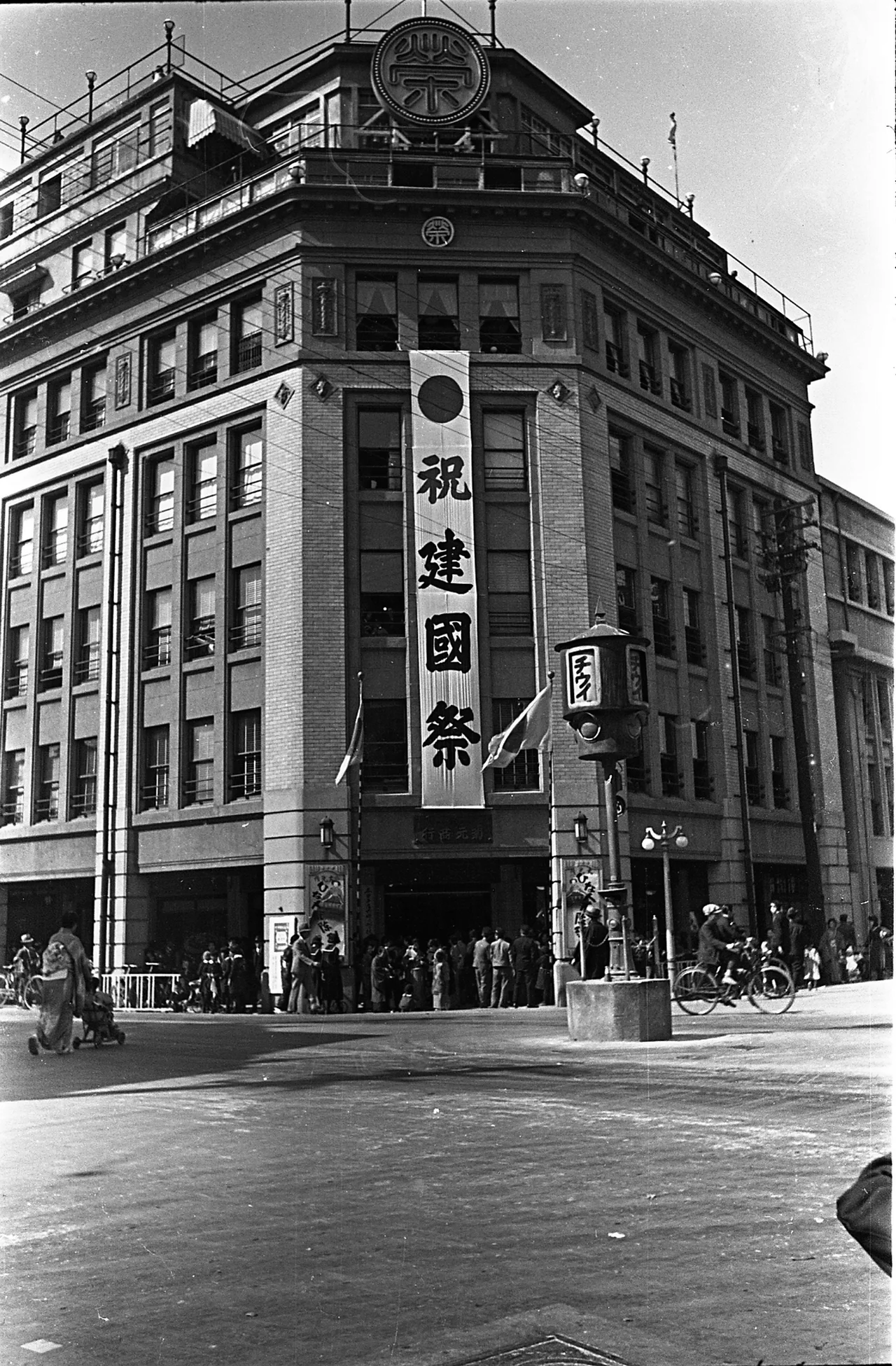

Kikumoto Department Store
A tie sold at Kikumoto Department Store is now in a national museum. That silk neckwear — an artifact of colonial-era fashion in a city then called Taihoku — made it into the collection of the National Museum of Taiwan History as evidence of something specific: that by the early 1930s, Taipei was a modern city with a distinct fashion culture, and that Kikumoto was where that culture was sold. The store opened in 1932 as the first department store in Taiwan, and what it sold mattered less than what it represented. This was a building that organized the desires of a modernizing city under one roof for the first time.
Taiwan's First Department Store
Kikumoto Department Store was established in 1932 in what was then Taihoku, the Japanese colonial name for Taipei. The store was founded by the Shigeta family and quickly distinguished itself in the commercial life of the city. Two years after opening, in December 1934, the Taihoku branch of what is today JTB Corporation was established within its premises — a travel agency setting up inside a department store, which tells you something about the clientele Kikumoto attracted and the kind of sophisticated urban commerce it embodied. The store earned the description 'the window of modernization in Taiwan' for its role in introducing department-store retail culture to the island: the experience of browsing organized merchandise across multiple floors, the particular social ritual of shopping as leisure, the implicit promise that ordinary city life could be modern and stylish.
War, Confiscation, and Many New Names
When World War Two ended in 1945, the Shigeta family lost everything. The Republic of China government confiscated their properties, as it did with many Japanese-owned businesses, and the family was repatriated to Yamaguchi, Japan. Former staff members later formed a group called Juronghui to maintain their connections and meet regularly to share memories of the store — gatherings that continued even after Eiji Shigeta's death. The building itself cycled through identities with the unsettled energy of postwar Taipei. It was relaunched as Shin Tai Department Store on October 24, 1945, then taken over by the government and rebranded as Taiwan Chung Hua Department Store in 1948. Gong Han-Sheng, owner of the Nanyang Department Store, purchased the building in 1968. Nanyang went bankrupt in 1977; Yeh Yi-Ren acquired the property and renamed it Young Young Department Store. Young Young went bankrupt in 1979, and Yeh fled overseas. Six names in roughly three and a half decades.
What Remains and What Is Being Rebuilt
After the cascade of bankruptcies, the building passed to Cathay United Bank. The bank acknowledged that by this point the structure no longer retained its original appearance — decades of renovation, repurposing, and general commercial wear had changed it considerably. But a commitment was made: the facade and arcade, the architectural elements most legible to the street, would be preserved during any future renovation. On July 26, 2024, Cathay United Bank launched a formal reconstruction plan for the Kikumoto Department Store site. Alongside it, an exhibition titled 'Guarding the City Center, Reviving Kikumoto' ran from July 26, 2024 to January 5, 2025, drawing public attention back to the building's origins and significance. The reconstruction represents a recognition that Taipei's first department store deserves to be remembered as more than a succession of failed businesses — that the original building and what it meant to the city has a claim on the present.
A Family That Kept the Memory
Perhaps the most quietly remarkable thread in the Kikumoto story is Juronghui — the organization formed by former staff members after the war. The Shigeta family had been expelled, their property taken, the name of their store erased and replaced. Yet the people who had worked at Kikumoto chose to stay connected to each other and to the memory of the place. They held regular reunions to reminisce, and the group persisted for decades. There is something worth noting in that: the institutional record of Kikumoto is one of confiscation, bankruptcy, and reinvention, but the human record is of loyalty and remembrance. The tie in the national museum and the gatherings of former staff tell the same story from different angles — that this building mattered to the people whose lives it was part of, long after the name above the door had changed.
From the Air
The Kikumoto Department Store site sits at approximately 25.042°N, 121.515°E in central Taipei, near the intersection of Zhonghua Road and Zhongxiao West Road — a dense commercial district just west of Taipei Main Station. From the air at 3,000 feet, the area is identifiable by the large Taipei Main Station rail complex to the east and the elevated highway infrastructure to the west. Taipei Songshan Airport (RCSS) lies approximately 5 km to the northeast; Taoyuan International Airport (RCTP) is roughly 33 km to the southwest. The building is embedded in the urban fabric of the city centre and best observed as part of the broader historic commercial district.
Nearby Stories
- Dapu Incident 9.3 km away
- Shuanglianpi Wetland 18 km away
- Toufen 41 km away
- North Jiangsu Main Irrigation Canal 980 km away
- General Cliff Rock Paintings 1050 km away
- Sinking of MV Sewol 1061 km away
- Yellow Sea 1111 km away
- Twin Forts of Romblon 1358 km away