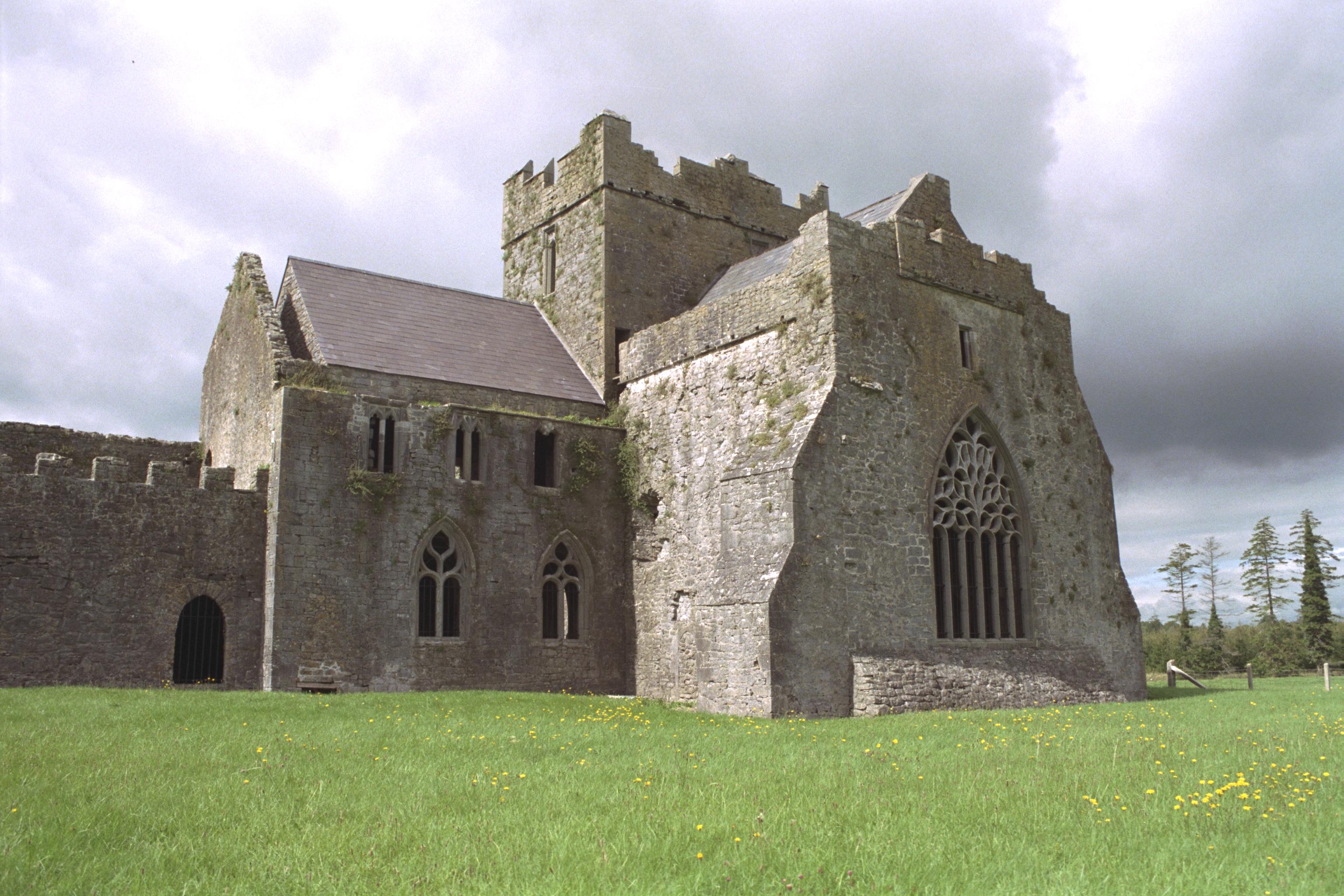
Kilcooly Abbey
Carved into the archway of the sacristy at Kilcooly Abbey, a mermaid holds a mirror and gazes at her reflection. She was placed there to represent vanity -- a warning to monks entering the most sacred part of their church. Eight centuries later, she remains one of the most striking pieces of medieval sculpture in Ireland, her stone features still sharp in a ruin where the roof has long since fallen and a tree now grows in the center of the cloister garth.
The King Who Built Three Abbeys
Kilcooly owes its existence to Donal Mor O'Brien, King of Thomond, who in 1182 granted lands near the village of Gortnahoe in County Tipperary to the Cistercian order. The abbey was built around 1200, dedicated to the Virgin Mary and Saint Benedict, and shares its architectural DNA with two sister houses: Jerpoint Abbey in County Kilkenny and Holy Cross Abbey further up the River Suir. All three were products of the same royal patron and the same monastic tradition -- the austere, self-sufficient Cistercian model that favored remote locations and simple elegance. After the Reformation and the dissolution of the monasteries, Kilcooly passed to the Earl of Ormond, then to the English-born judge Sir Jerome Alexander in the 1630s, and eventually through marriage to the Barker baronets of Bocking Hall, the last of whom died in 1818.
The Knight and the Mermaid
The abbey's stone carvings are its greatest treasure. In the chancel lies the tomb of the knight Piers Fitz Oge Butler, who died in 1526. Ten apostles are carved along the side of his tomb, the work of the master sculptor Rory O Tunney, who is also celebrated for his carvings at Jerpoint Abbey. Atop the tomb, Butler's stone effigy lies in full armor, a dog curled faithfully at his feet. The sacristy archway where the mermaid presides is equally rich: alongside her are scenes of the crucifixion and two Butler family shields. Architectural historian Roger Stalley suspects this ornate screen wall may represent the entrance to a private Butler chapel, the family's wealth and piety literally carved into the fabric of the building.
What the Monks Left Behind
Remarkably, Kilcooly's monastic layout can still be read. The nave of the church remains roofed, though the rest opens to the sky. The cloister columns are almost entirely gone -- only one survives -- but the pebbled walkway still traces their path around the grassy square. The chapter house and parlour stand beside the cloister, their doorways intact. The calefactory, the warming room where monks were permitted their only source of heat, survives without its roof. The refectory, the monks' dining hall, still has its spiral staircase, though it has been barred for safety. Outside the main complex, a beehive-shaped structure may have been a dove-cote -- a three-foot hole in its ceiling would have let the birds come and go. The infirmary also survives in fair condition.
Excalibur and the Quiet Afternoon
In 1981, director John Boorman filmed scenes for Excalibur at Kilcooly -- the same production that also used nearby Cahir Castle. The abbey's combination of atmospheric ruin and photogenic stonework made it a natural choice for Arthurian legend. Today, Kilcooly sits within the grounds of the Kilcooley Estate, open to the public but far from the tourist crowds that descend on better-known sites. A mysterious pyramid structure stands on the abbey grounds, its purpose unclear. From the air, the abbey reads as a compact cluster of grey walls within green fields, the roofed nave contrasting with the open skeleton of the cloister and transept. It is the kind of place where you might spend an afternoon alone with the mermaid and the sleeping knight, hearing nothing but wind through the stone.
From the Air
Located at 52.67N, 7.57W in County Tipperary, near the village of Gortnahoe. The abbey complex appears as grey stone ruins within the green grounds of the Kilcooley Estate. Nearest airports: Waterford (EIWF) approximately 55 km southeast, Kilkenny heliport nearby. Best viewed below 2,500 ft AGL. Sister abbey Jerpoint is approximately 20 km to the east.