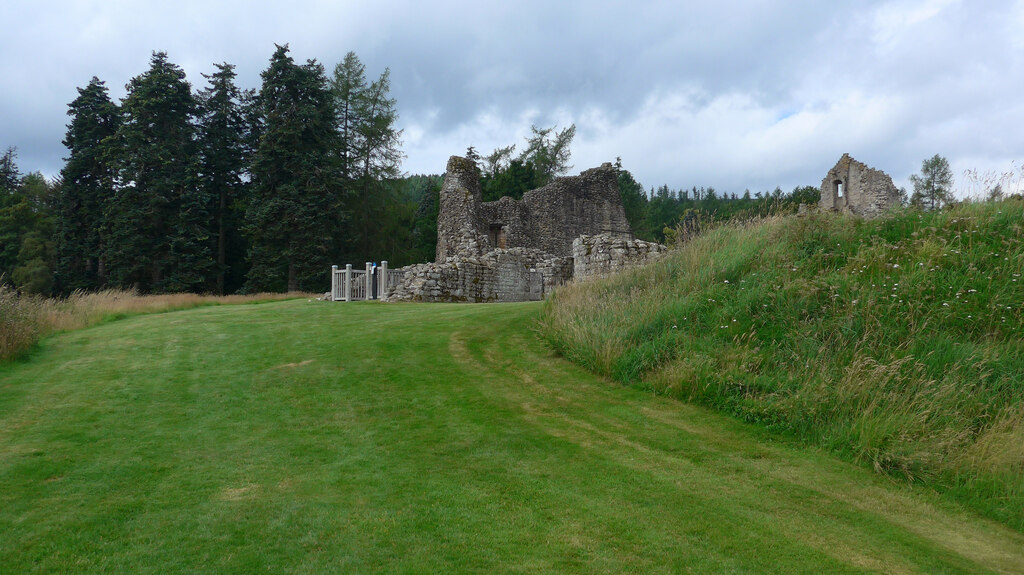
Kildrummy Castle
In 1538, John Strachan, the young laird of Lenturk, raided Kildrummy Castle. He took the furnishings and fixtures, brought a blacksmith to strip the ironwork from every window and door, and had some of the metal turned into horseshoes and ploughshares at the nearby village of Glenbuchat. It is a perfect summary of what happened to medieval Scotland's great castles: the grand reduced to the practical, the fortress dismantled to shoe a horse. Kildrummy, near the village of the same name in Aberdeenshire, was once one of the most formidable castles in eastern Scotland -- the seat of the Earls of Mar, besieged by English kings and Scottish rebels, a stronghold that changed hands through treachery, marriage, murder, and Act of Parliament.
A Castle Shaped Like a Shield
Built probably in the mid-13th century under Gilbert de Moravia, Kildrummy Castle occupied a site chosen for its command of the ancient trackways crossing the Grampian Mounth -- the mountain passes linking the Scottish lowlands to the northeast. The castle is shield-shaped in plan, with one flat side overlooking a steep ravine and the opposite side narrowing to a point once defended by a massive twin-towered gatehouse. Independent towers punctuated the curtain wall, including the Snow Tower, a keep taller than the others, built in the French style reminiscent of Bothwell Castle. A dry moat and the natural ravine provided additional defence. The architectural ambition was unmistakable: this was a castle designed to project the power of one of Scotland's most important earldoms.
Betrayal and the Bruce Women
Kildrummy's most dramatic siege came in 1306, during the Wars of Scottish Independence. Robert the Bruce, newly crowned and in desperate straits, sent his wife, daughter, sisters, and brother Nigel Bruce to Kildrummy for safety while he fled west. The castle held out through August and September before falling -- tradition says through treachery, when a blacksmith set fire to the grain stores. Nigel Bruce was captured and executed. The Bruce women were taken prisoner. The second great siege came in 1335, when David of Strathbogie attacked. This time it was Christina Bruce -- Robert's sister, now married to Sir Andrew Murray -- who commanded the defence. She held the garrison until her husband arrived with a relief force. The contrast between the two sieges spans the arc of the Bruce cause: from disaster to defiance.
Murder, Marriage, and the Crown
The castle passed through a succession of keepers and owners whose methods ranged from administrative to violent. In 1403, Alexander Stewart murdered Sir Malcolm Drummond and seized his widow, Isabel Douglas, Countess of Mar, along with her title and Kildrummy itself. James I took the castle for the Crown in 1435. Henry Kinghorn served as keeper for James III in 1468, spending one hundred pounds Scots on repairs. James IV granted the castle and lands to Alexander Elphinstone, 1st Lord Elphinstone, and his wife Elizabeth Barlow in 1507. The Elphinstones yielded to the Erskines, who held the castle until the Earl of Mar led the disastrous 1715 Jacobite rising and Kildrummy was forfeited and abandoned. Each change of ownership left its mark on the fabric of the building -- or, more often, on the gaps where fabric had been removed.
Gardens in the Quarry
The castle was given into the care of the Ministry of Works in 1951 and is now managed by Historic Environment Scotland. Archaeological excavations in 1925 uncovered decorative stone flooring and evidence of the battles that had raged within its walls. Most of the foundations and lower-storey walls survive, enough to trace the shield-shaped plan and imagine the scale of what stood here. The gardens, laid out in the old quarry that once supplied the castle's building stone, are included in the Inventory of Gardens and Designed Landscapes in Scotland. A hotel built on the old estate overlooks the ruins. Standing at the gatehouse end of the shield, looking across the ravine, you can see why this site was chosen: it commands the land in every direction, the mountain passes clearly visible, the approaches exposed. The horseshoes that John Strachan made from the window iron have long since worn away. The castle, even ruined, has proved more durable than the things it was taken apart to make.
From the Air
Located at 57.23N, 2.90W near the village of Kildrummy in Aberdeenshire. The castle ruins are on elevated ground overlooking a ravine, with the shield-shaped plan visible from altitude. Aberdeen Airport (EGPD) is approximately 35 miles east. Best viewed at 2,000-3,000 ft AGL. The Grampian Mountains rise to the south and west.