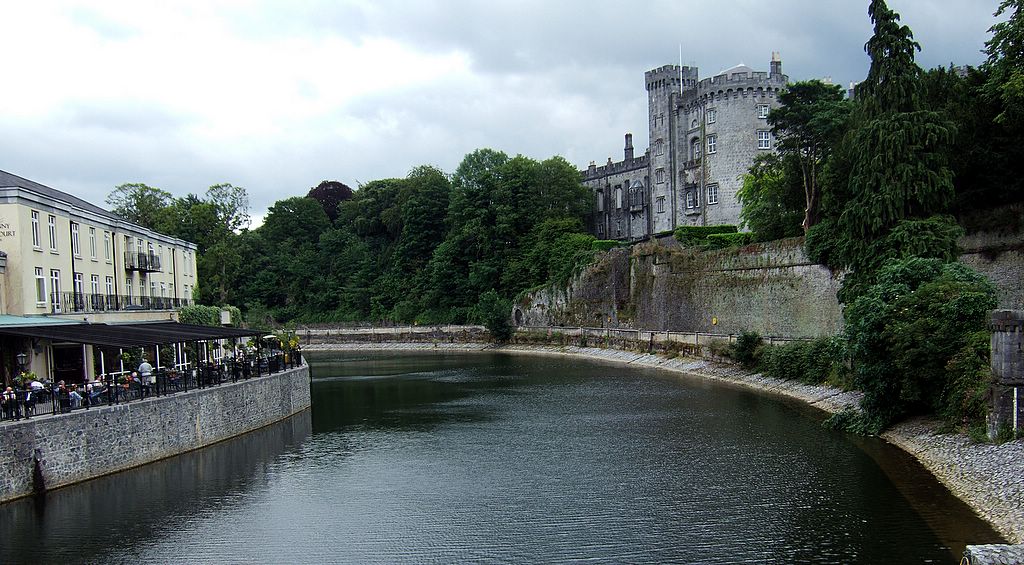
Kilkenny Castle
Fifty pounds. That was the price Arthur Butler, 6th Marquess of Ormonde, asked for in 1967 when he sold Kilkenny Castle to the Castle Restoration Committee -- a symbolic sum for a fortress that had been in the Butler family since 1391. The Butlers had spent centuries acquiring and defending this castle. By the end, they could not afford to heat it. At a handover ceremony, Mick Jagger and Marianne Faithfull turned up uninvited. "We just came to loon about," Jagger told reporters. The castle now belongs to the people of Kilkenny.
Strongbow's Foundation
Richard de Clare, the Anglo-Norman lord known as Strongbow, built the first castle here in the 12th century, probably as a wooden structure on a site that may already have housed the residence of the Mac Giolla Phadraig kings of Osraighe. By 1260, a stone castle had risen to control the fording-point of the River Nore and the junction of several routeways, its four massive circular corner towers and deep ditch marking it as a symbol of Norman occupation. William Marshal, who married Strongbow's daughter and heiress Isabel in 1189, expanded the fortification substantially. His great gatehouse, uncovered by excavations in 2019, dates from the early 1200s. In 1391, the crown sold the castle to the Butler family, beginning a connection that would last nearly six centuries.
Anne Boleyn's Grandmother
Among the many Butlers who called Kilkenny home, Lady Margaret Butler stands out for her extraordinary place in English history. Born in the castle around 1454 or 1465, the daughter of Thomas Butler, 7th Earl of Ormond, she married Sir William Boleyn and became the paternal grandmother of Anne Boleyn -- the second wife of Henry VIII and mother of Elizabeth I. The castle also played a central role in the Irish Confederate Wars: from 1642 to 1648, Confederate Ireland's parliament, known as the Supreme Council, met within its walls, making Kilkenny the de facto capital of the Catholic rebel movement. The castle's owner, the 1st Duke of Ormonde, was a Protestant royalist based in Dublin at the time. In 1650, Cromwell besieged Kilkenny, damaging the east wall and northeast tower.
The Slow Decline
By the 18th century the castle had grown shabby, reflecting the Butler family's declining fortunes. The 1911 census recorded seventeen servants residing at the castle, including a valet, two footmen, a chauffeur, a cook, four housemaids, and two dairy maids. But appearances were deceiving. Records survive of Lady Ormonde startling a dinner guest by confiding, "We are very poor." The 3rd Marquess died in 1919 owing death duties of 166,000 pounds. During the Irish Civil War of 1922, Republicans were besieged inside the castle by Free State forces. The Ormondes -- along with their pet Pekinese -- stayed put in their bedroom above the great gate while a machine gun sat outside their door. The family finally left in 1935, investment income reduced from 22,000 pounds in the 1880s to just 850 pounds by 1950.
A Castle for Kilkenny
Extensive restoration through the late 20th century brought the castle back to life. The Office of Public Works now manages the grounds and parkland, which are open to the public. University graduates receive their degrees in ceremonies held in the castle. The Butler Gallery, housed in a nearby former almshouse, carries the family name into the present. Archaeological excavations continue to reveal the castle's layered history -- original stone buttressing, a garderobe, a postern gate, and sections of the medieval ditch are now visible on the Parade. One curious record completes the castle's story: Ireland's highest officially recognized air temperature, 33.3 degrees Celsius, was measured at Kilkenny Castle on June 26, 1887. From the air, the castle occupies a commanding position on the River Nore, its restored towers and manicured gardens unmistakable against the medieval streetscape of Kilkenny city.
From the Air
Located at 52.65N, 7.25W in Kilkenny city, commanding the River Nore. The castle's restored towers and parkland are clearly visible in the city center. Nearest airports: Waterford (EIWF) approximately 50 km south, Dublin (EIDW) approximately 130 km northeast. Best viewed below 3,000 ft AGL. Kilkenny's medieval city layout provides excellent visual context.