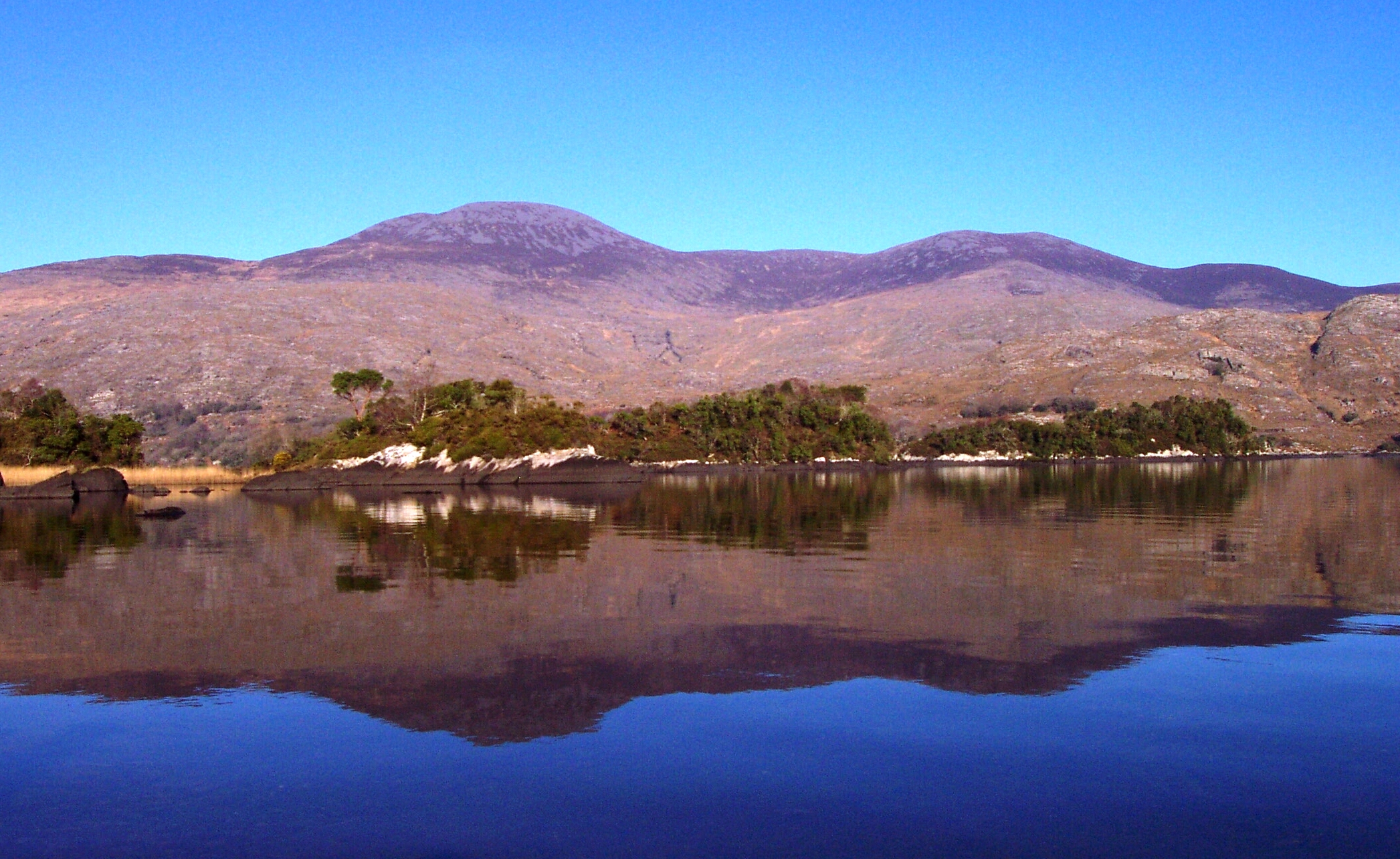
Killarney National Park
An American named William Bowers Bourn bought the Muckross Estate in 1910 as a wedding present for his daughter Maud. Over the next two decades, the family spent 110,000 pounds building sunken gardens, stream gardens, and rock gardens on an outcrop of limestone. When the money and the enthusiasm ran out, they donated the entire estate to the Irish Free State. That gift, in 1932, created Ireland's first national park. Killarney National Park has since expanded to over 102 square kilometres of lakes, oakwoods, yew forests, and mountain peaks in County Kerry, and the wedding present turned out to be one of the most important conservation decisions in Irish history.
Where Sandstone Meets Limestone
A major geological boundary runs through the park, where Devonian Old Red Sandstone meets Carboniferous limestone. This collision of bedrock produces the park's remarkable ecological variety. The sandstone dominates the uplands, shaping the mountains and ridges. The limestone appears along the low eastern shore of Lough Leane, the largest of Killarney's three lakes at 19 square kilometres, creating the alkaline conditions that support some of the park's rarest habitats. The climate is mild and wet -- mean temperatures range from about 6 degrees Celsius in January to 15 in July -- with frequent light showers that keep the woodlands damp and green year-round. Humans have lived here since at least the Bronze Age, some 4,000 years ago. Archaeologists have found evidence of copper mining on Ross Island dating to this period, along with a well-preserved stone circle at Lissivigeen.
The Last Native Forest
Killarney contains the most extensive covering of native forest remaining in Ireland, and within it lies one of Europe's rarest habitats: pure yew woodland. The Reenadinna yew wood, rooted in fissures of bare limestone along the shore of Muckross Lake, is one of only three pure yew woodlands in Europe and the only significant example in Ireland. It has priority habitat status under the EU Habitats Directive. The park's oak woods are equally important -- sessile oaks that have stood here for centuries, sheltering an understorey of ferns, mosses, and liverworts in conditions so consistently damp that the forest feels almost subtropical. Among the unusual plants found here are arbutus, more commonly associated with the Mediterranean, and blue-eyed grass and pipewort, species whose nearest relatives grow in North America.
Deer, Shad, and Invaders
The park's red deer herd is the only one on mainland Ireland, a population that has been continuously present for 4,000 years, since deer returned to the island after the last ice age. The herd has recovered from fewer than 100 individuals in 1970, now found mostly on Mangerton and Torc mountains. In the lakes below, the Killarney shad -- a land-locked subspecies of twaite shad found nowhere else on Earth -- feeds on plankton in deep water, so rarely caught that many anglers do not know it exists. But not everything in the park is ancient or welcome. Rhododendron ponticum, introduced in the 19th century, has colonized over 6.5 square kilometres, forming impenetrable thickets that block all light from the forest floor and prevent native species from regenerating. The park's oak woods face long-term danger unless the rhododendron can be controlled.
Muckross and the Lakes
The Victorian mansion of Muckross House, set against the backdrop of Mangerton and Torc mountains on the eastern shore of Muckross Lake, draws more than 250,000 visitors a year. Its gardens are famous for collections of rhododendrons and azaleas -- a deliberate irony in a park where the same plants are an invasive menace in the wild. The Muckross Traditional Farms recreate Irish rural life in the 1930s, before electrification changed everything. Beyond the house, the park offers Torc Waterfall, the ruins of 15th-century Muckross Abbey, Ross Castle on Lough Leane, and the Old Kenmare Road -- a walking trail with views across the lakes to the mountains. Jaunting cars, the horse-drawn carriages that have been carrying visitors through the park for generations, remain the most atmospheric way to travel between landmarks.
A Biosphere Under Pressure
UNESCO designated Killarney a Biosphere Reserve in 1981, recognizing the quality and diversity of its habitats. The park also forms part of a Special Area of Conservation and a Special Protection Area. But the pressures are real. Lough Leane has become eutrophic from agricultural and domestic phosphate pollution, producing algal blooms that have not yet severely damaged the ecosystem but could if the nutrient loading continues. Fires, often caused by human activity, occur with uncomfortable frequency -- despite the wet climate, they spread rapidly through open woodland. The tension between conservation and access runs through the park's history like the geological fault between its sandstone and limestone. The wedding present Maud Bourn received in 1910 is still being unwrapped.
From the Air
Killarney National Park is centred at approximately 52.02N, 9.51W in County Kerry, southwest Ireland. Kerry Airport (EIKY) is about 15 km to the north. Cork Airport (EICK) is approximately 85 km to the east. From altitude, the three Lakes of Killarney (Lough Leane, Muckross Lake, and Upper Lake) are the most prominent features, set against the backdrop of MacGillycuddy's Reeks to the west. The town of Killarney sits on the park's northeast edge. Torc Mountain and Mangerton Mountain define the park's southern boundary.