Killarney Provincial Park
A.Y. Jackson picked up his pen instead of his brush and wrote the most important letter of his career. The Group of Seven painter had just learned that loggers were coming for Trout Lake, one of the jewels tucked among the white quartzite ridges north of Georgian Bay. His letter to Ontario's Minister of Lands and Forests in the 1930s did something no canvas could: it stopped the chainsaws. The lake was placed in the care of the Ontario Society of Artists and renamed O.S.A. Lake, and Jackson's act of artistic protest planted the seed for what would become Killarney Provincial Park -- a wilderness that owes its survival not to politicians or planners, but to painters.
White Bones of the Earth
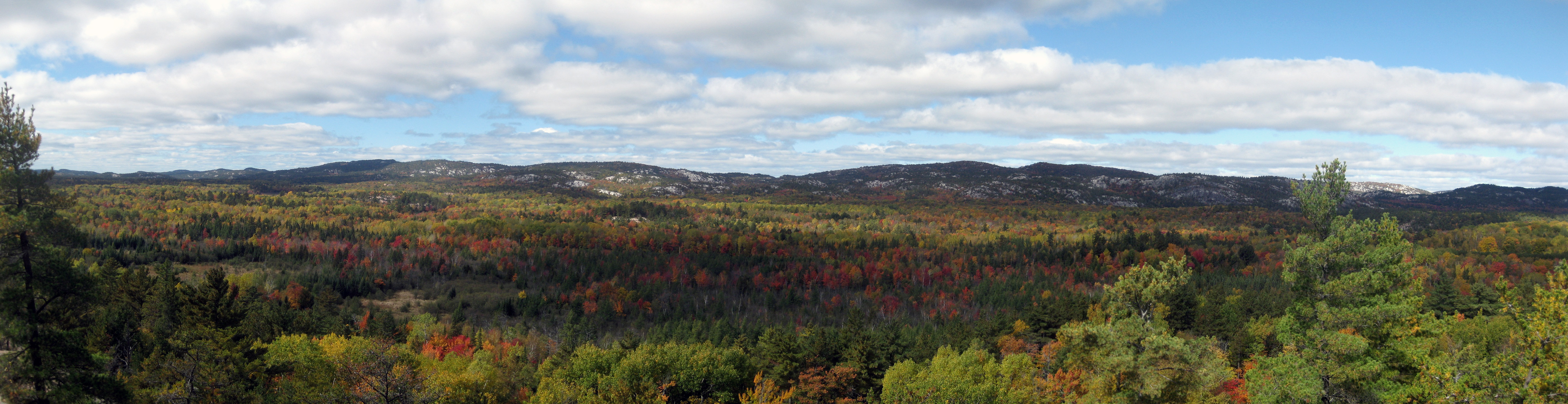
The La Cloche Mountains are among the oldest on Earth, and they look it -- not in the towering, jagged way of younger ranges, but in the smooth, rounded, almost skeletal way of rock that has been worn down over billions of years. These are quartzite ridges, blazing white against the dark green of boreal forest, reflecting light so intensely that from a distance they can appear snow-covered even in midsummer. The contrast is stunning: white peaks and cliffs rising above pine and hardwood forests, with boggy lowlands filling the spaces between. The quartzite itself is weather-resistant but nutrient-poor, producing shallow, infertile soils where only the hardiest plants take root. Where patches of diabase or limestone break through, richer soils support pockets of lush vegetation -- green oases amid the stony terrain. It is this interplay of rock and forest, barren ridge and fertile hollow, that gives Killarney its distinctive character.
Canvases and Conservation
Jackson was not the only Group of Seven member drawn to these hills. Franklin Carmichael, Arthur Lismer, and A.J. Casson all painted here, captivated by the play of light on quartzite and water. Their canvases transformed Killarney from a remote stretch of Canadian Shield into one of the most celebrated landscapes in Canadian art. That fame became armor. When the park area was set aside as a wilderness preserve in 1959, it was the accumulated cultural weight of those paintings that made the case. Highway 637 opened in 1962, connecting Georgian Bay's north shore to the Trans-Canada Highway. Then in 1964, with the Group of Seven still lobbying, a stretch of Georgian Bay shoreline was added as a wilderness reserve, and Killarney formally became a provincial park. On Jackson's 90th birthday, the province named a lake after him -- a fitting tribute to the man whose pen had done what his brush alone could not.
Acid and Recovery
The park's proximity to Sudbury, one of the world's largest mining centers, nearly undid everything the artists had fought to protect. From the 1940s through the 1970s, nickel smelters pumped sulphur into the atmosphere, and the acid rain that resulted fell hardest on Killarney's quartzite terrain. Quartzite has almost no buffering capacity -- it cannot neutralize acid the way limestone can. Lakes turned crystal clear, which sounds beautiful until you understand what it means: the water was so acidic that algae, aquatic plants, and fish simply died. Some lakes became biological deserts. Legislation in the 1970s forced the mining industry to clean up, and sulphur emissions dropped by over 90 percent. Recovery has been slow and uneven. Some lakes have returned to pre-pollution levels, their fish populations gradually rebuilding. Others are still on the mend, their ecosystems working through decades of chemical damage one season at a time. More recently, the spiny water flea, an invasive species, has arrived to pose a new threat to native aquatic life.
Wild Solitude
Killarney is primarily a wilderness park, and it means it. There is a single campground at the George Lake entrance, six heated yurts, and precious little else in the way of built infrastructure. The park sits in the Eastern forest-boreal transition zone, which gives it an unusually diverse mix of plant and animal life. Moose, black bears, wolves, lynx, bobcats, and martens roam the forests. Over 100 species of birds breed or nest within its boundaries, and more than 20 species of reptiles and amphibians find habitat here. The backcountry is accessed by canoe, with well-maintained portages linking lake to lake through the interior. At night, the skies are dark enough that in 2018 the Royal Astronomical Society of Canada designated Killarney a Dark-Sky Preserve -- the first Ontario park to earn the title. The park observatory, opened in 2018 with a 16-inch automated telescope, lets visitors study constellations undiminished by light pollution.
Neighbors and Next Chapters
In 2006, the province created the adjacent Killarney Lakelands and Headwaters Provincial Park, expanding protection beyond the original boundaries. In 2015, the Wiikwemkoong First Nation on Manitoulin Island established Point Grondine Park on their own unoccupied heritage territory nearby, adding Indigenous stewardship to the conservation story. The landscape that A.Y. Jackson fought to save now extends outward in every direction, a patchwork of protected areas where quartzite ridges, boreal forest, and Georgian Bay shoreline remain as wild as when the painters first set up their easels.
From the Air
Located at 46.12N, 81.42W on the north shore of Georgian Bay, approximately 65 km southwest of Sudbury. The white La Cloche quartzite ridges are a distinctive visual landmark from altitude, appearing as pale bands against the dark green boreal forest. George Lake campground is at the eastern entrance via Highway 637. Nearest airports: Sudbury/Greater Sudbury Airport (CYSB) approximately 65 km northeast; Parry Sound Area Municipal Airport (CNK4) approximately 100 km southeast. The park spans the transition zone between Georgian Bay's shoreline and the Canadian Shield interior. Best viewed at 3,000-5,000 feet for ridge detail. Clear weather recommended -- the quartzite reflections are most visible in direct sunlight.