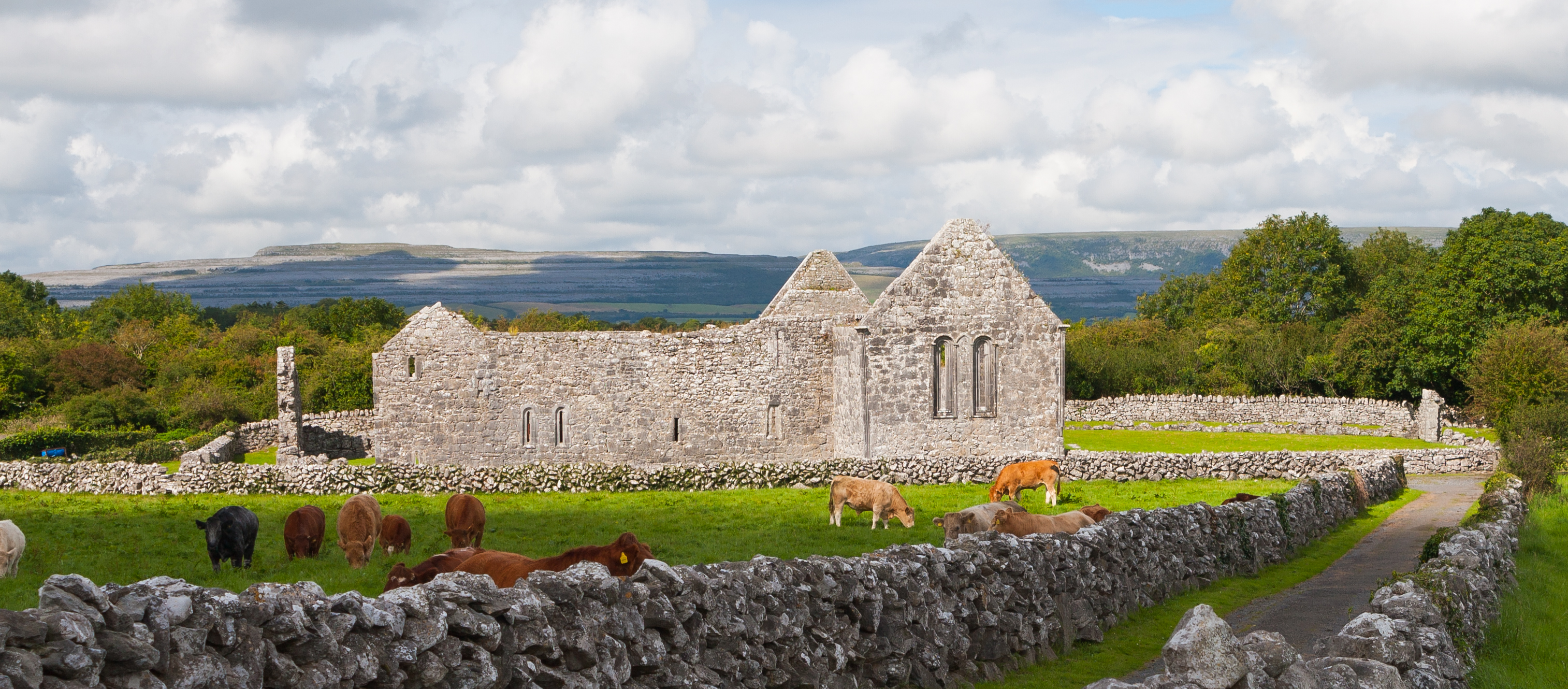
Kilmacduagh Monastery
The round tower leans. Not dramatically, not dangerously, but enough that you notice -- enough that it has been leaning for centuries and shows no intention of falling. At over 34 metres, Kilmacduagh's round tower is the tallest in Ireland, and its gentle tilt has become as much a part of its identity as the monastery it once served. Standing among these ruins near the town of Gort in County Galway, you are looking at a place that has been holy ground since the early 600s, when a king's cousin gave up his claim to power and chose prayer instead.
A Saint and His Cousin the King
The name tells the founding story: Kilmacduagh translates as "church of Duagh's son." That son was Saint Colman, a 7th-century monk who established a monastery here on land granted by his cousin, King Guaire Aidne mac Colmain of Connacht. Guaire himself kept a fortified dwelling nearby -- what is today the site of Dunguaire Castle on the shores of Galway Bay. The exact year of the monastery's founding remains uncertain, as is common with dates from this period, but the early 7th century is the most widely accepted estimate. Colman served as both abbot and bishop until his death. Of his successors, records are thin: only one, Indrect, who died in 814, appears by name in the Irish annals before the arrival of the Anglo-Normans.
The Seven Churches
The ruins are sometimes called "the seven churches," though not all of the buildings were churches and none dates back to Colman's original foundation. What survives is a layered collection of medieval structures: a cathedral, a round tower, several smaller churches, and the remains of a monastic enclosure that accumulated over centuries. The cathedral itself was substantially altered in the 13th century, with Bishop Maurice Ileyan, who died in 1283, associated with the addition of the east range. Among the monastery's treasures was Saint Colman's girdle, said to be studded with gems, and his crozier. The O'Shaughnessy family held these relics for centuries before the girdle was eventually lost. Local tradition holds an additional distinction for this place: within the Diocese of Kilmacduagh, it is said, no one will ever die from a lightning strike.
Conquest and Collapse
Kilmacduagh did not escape the upheavals that swept through medieval Ireland. In 1199, the monastery found itself at the center of a clash between Anglo-Norman forces and the Connacht Irish. John de Courcy marched from Ulster with English allies to assist Cathal Crovderg O'Conor, but Cathal Carragh and the Connacians met them in battle. The defeat was devastating -- of five Anglo-Norman battalions, only two survived, and the remnants were chased to Rindown on Lough Ree, where many drowned attempting to escape by boat. During the Reformation, the monastery's lands were granted to the Earl of Clanricarde, and the diocese gradually diminished in importance. Today it is incorporated into the broader diocesan structure of Galway in the Catholic church and Tuam and Limerick in the Church of Ireland.
Still Standing, Still Leaning
Restoration work in the 19th century, overseen by Sir Thomas Deane with financial support from Sir William Henry Gregory of nearby Coole Park, helped stabilize what remained. Gregory's estate at Coole would later become famous as a gathering place for the Irish Literary Revival -- W.B. Yeats, Lady Gregory, and their circle all knew this landscape intimately. The monastery sits in the Burren's eastern fringe, where the limestone karst gives way to softer farmland. From the air, the cluster of grey stone ruins against the green fields reads like a geological outcrop, something that grew from the earth rather than being built upon it. The leaning tower anchors the scene, a pencil-thin exclamation mark that has outlasted empires, survived wars, and refused, stubbornly, to topple.
From the Air
Located at 53.05N, 8.89W in County Galway, approximately 5 km southwest of Gort. The cluster of grey stone ruins and the distinctive leaning round tower are visible against green farmland. Nearest airport: Shannon (EINN), approximately 40 km to the south. Best viewed below 3,000 ft AGL. The Burren landscape to the west provides additional visual interest.