Kilwa Sultanate
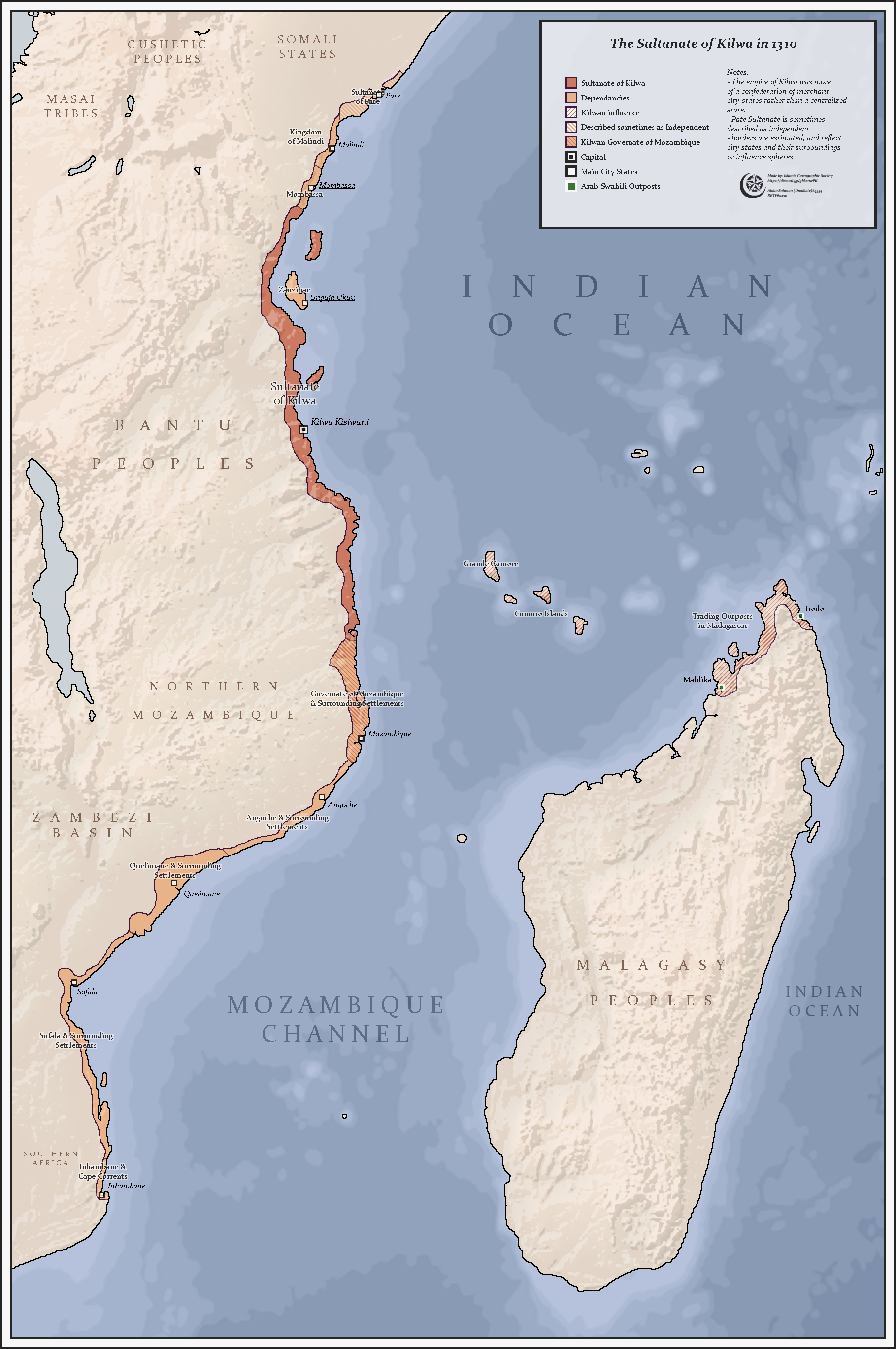
In 1944, on Marchinbar Island in Australia's Wessel Islands, nine coins turned up in the dirt. Four were Dutch duits. Five bore Arabic inscriptions and were eventually identified as currency from the Kilwa Sultanate -- a medieval African empire centered on a small island off the coast of what is now Tanzania, more than 8,000 kilometers away. In 2018, another Kilwa coin surfaced on nearby Elcho Island. How they arrived remains debated. What they demonstrate is the astonishing reach of a sultanate that, at its 15th-century peak, controlled the entire Swahili Coast from Malindi to Cape Correntes and conducted trade across the Indian Ocean to India, Persia, Arabia, and China.
A Prince, a Land Bridge, and Colored Cloth
The founding legend has the quality of myth but is grounded in genetic evidence. Around 960 to 1000 CE, Ali ibn al-Hassan Shirazi -- a Persian prince driven from Shiraz by his brothers, his mother an Abyssinian slave -- sailed from Hormuz and made his way down the East African coast. After falling out with the Somali elite in Mogadishu, he continued south and purchased the island of Kilwa from a Bantu king named Almuli. The price: enough colored cloth to circle the island. When the king tried to reclaim it, the Persians had dug up the tidal land bridge connecting it to the mainland. Kilwa was now an island, and Ali was its ruler. A 2023 genetic study confirmed significant Iranian-origin ancestry in the Y-chromosomal DNA of medieval Swahili Coast inhabitants, validating the Persian-admixture tradition that oral histories had preserved for a millennium.
The Gold That Built an Empire
Kilwa's position was its fortune. Catching the seasonal monsoon winds, its dhows sailed to India in summer and returned in winter. But the real transformation came around 1178 to 1195, when Suleiman Hassan, the 12th ruler of Kilwa, wrested control of the southern port of Sofala from Mogadishu. Sofala was the gateway to the gold and ivory of Great Zimbabwe and Monomatapa, and its revenues funded Kilwa's expansion along the entire coast. By the 15th century, the sultanate claimed overlordship from Malindi and Lamu in the north to Inhambane in the south, plus the island-states of Mombasa, Pemba, Zanzibar, Mafia, Comoro, and Mozambique. It even claimed authority over trading posts on Madagascar, then known by its Arabic name, the Island of the Moon. Portuguese sailors who encountered Kilwan pilots marveled at their navigational instruments -- particularly their latitude staves, which the Europeans considered superior to their own.
Middlemen of the Indian Ocean
The Kilwa Sultanate was a confederation of commercial cities, not a centralized state. Each port had its own elite, its own merchant class, its own trade connections. The sultan appointed governors, but their actual power varied wildly: in some outposts they ruled in his name, while in established cities like Sofala they functioned more as ambassadors. The economy ran on intermediation. Kilwan merchants imported cloth and spices from Arabia, India, and Persia, then exchanged them in the interior for gold, ivory, and agricultural goods from the Bantu highland communities. The sultanate also participated in the slave trade, with enslaved people captured in raids or conflicts and sold to markets across the Arabian Peninsula, Persia, and India. Amid all this global commerce, one product was entirely local: the coconut palm, which provided fruit, timber, thatching, weaving material, and the coir that stitched merchant ships together.
Emirs, Coups, and Constitutional Crisis
Kilwa's decline began from within. In its later years, ambitious ministers -- viziers and emirs -- became the real power behind the throne. Emir Muhammad Kiwabi ruled for nearly two decades through a series of puppet sultans, fighting off his nephew Hassan ibn Suleiman's repeated bids for power. Muhammad eventually established the principle that sultans must come from the royal dynasty, not from ministerial families. It was a fragile consensus. After Muhammad's death, his successor Emir Ibrahim murdered Sultan al-Fudail in 1495 and seized power while claiming to rule in the name of a prince nobody had seen in years. The vassal cities, outraged by the coup, broke away one by one. By the time Portuguese ships appeared on the horizon, the writ of Emir Ibrahim barely extended beyond Kilwa itself.
The Portuguese Hammer
Portuguese scout Pero da Covilha had traveled the sultanate disguised as an Arab merchant in 1489 to 1490, delivering a detailed intelligence report to Lisbon. When Vasco da Gama arrived in 1497, he methodically secured the cooperation of Kilwa's fractured vassals. In 1502, da Gama's armed fleet extorted tribute from Emir Ibrahim. Three years later, Francisco de Almeida landed 500 soldiers and took the island by force, installing a puppet sultan and erecting Fort Santiago. Portuguese mercantilist laws banned non-Portuguese ships from major ports, gutting the merchant class. Street fighting, assassinations, and mass flight followed. The Portuguese held Kilwa for barely a decade before an Arab force recaptured it, but the trading network that had sustained the sultanate for five centuries was shattered. The Swahili word Swahili itself -- meaning 'coast-dwellers' -- endures as the name of the language and culture this melting pot of Persian, Arab, and Bantu peoples created.
From the Air
Located at 8.96S, 39.52E, centered on the island of Kilwa Kisiwani off Tanzania's southern coast. The sultanate's territory stretched the length of the Swahili Coast, but its capital island is best viewed from 2,000-3,000 feet AGL approaching from the east over the Indian Ocean. Coral-stone ruins, including the Great Mosque and Palace of Husuni Kubwa, are visible on the island. Nearest airfield: Kilwa Masoko Airport (HTKI). The Mafia Archipelago, site of the sultanate's earliest satellite settlement, lies to the northeast.