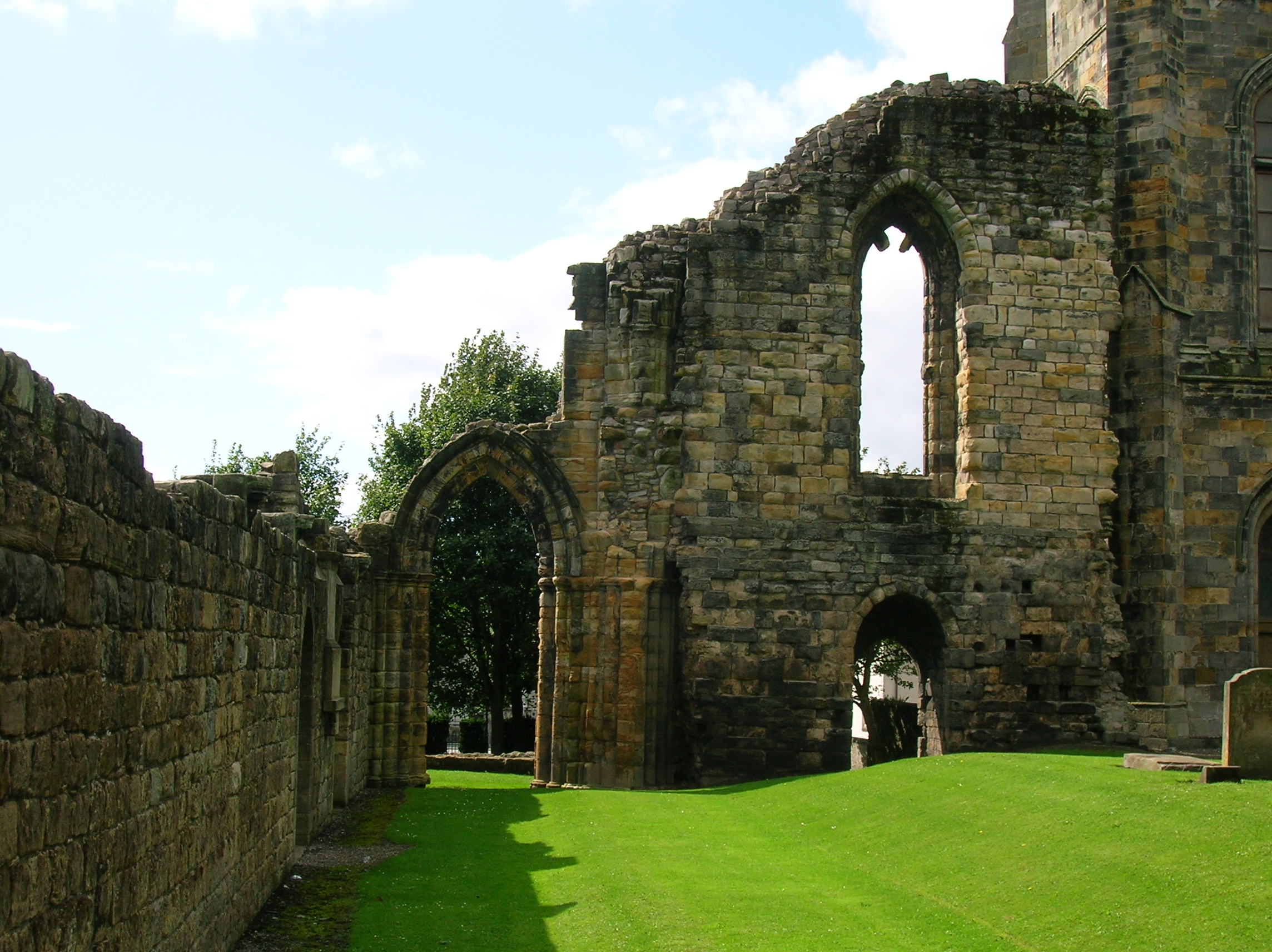
Kilwinning Abbey
Every summer, archers gather in Kilwinning to shoot at a wooden bird perched atop a crumbling abbey tower. The Ancient Society of Kilwinning Archers has held this competition since at least 1488, making it one of the oldest sporting events in the world. But the papingo shoot, as it is known, is only the most visible thread in a tapestry of legend and loss that surrounds this ruined Tironensian monastery in the heart of North Ayrshire.
Monks from Chartres
Kilwinning Abbey was founded sometime between 1162 and 1188, when monks from the Tironensian Benedictine order arrived from Kelso. The order took its name from Tiron in the diocese of Chartres, France, and the new community was dedicated to Saint Winning and the Virgin Mary. The patron was likely Richard de Morville, Lord of Cunninghame and Great Constable of Scotland, though a persistent legend tried to link the abbey's founding to a different Richard de Morville implicated in the murder of Thomas Becket. The dates make that connection impossible, but the story endured for centuries. Situated far from the core of Lowland Scotland, the abbey grew rapidly enough to become one of the wealthiest religious houses in Ayrshire, its lands eventually stretching across the region.
The Vanished Records
What makes Kilwinning unusual among Scottish abbeys is how thoroughly its own history has been erased. The abbey's chartulary -- the bound volume of its charters, grants, and legal documents -- has been lost or destroyed. In 1571, following an attack on the abbey, the records were reportedly carried off by "a furious horseman." Twenty years later, William Melville tried through legal action to recover them from the widow of Alexander Cunninghame, but the documents were never returned. Timothy Pont, mapping Scotland in the 17th century, claimed to have studied the chartulary, but no trace of it survives. This absence leaves Kilwinning's medieval story full of gaps that legend has eagerly filled.
Cradle of Scottish Freemasonry
Among those legends, none is more persistent than the claim that Kilwinning Abbey is the birthplace of Scottish Freemasonry. The argument rests on the presence of skilled stonemasons who would have been required for the abbey's construction, and on the existence of Lodge Mother Kilwinning, which has long claimed to be the oldest Masonic lodge in the world. While the historical evidence is debated, the lodge has operated from Kilwinning since at least the early modern period, and the town's association with the craft remains a point of fierce local pride. The connection between medieval monastic building projects and the later development of organized masonry runs deep in Scottish tradition, and Kilwinning sits at its center.
Ruin and Remembrance
The Reformation struck Kilwinning Abbey hard. By the late 16th century, the buildings were falling into decay, their stone plundered for local construction. What survives today is fragmentary but striking: portions of the south transept wall, a gable of the nave, and the base of the abbey tower, all built from warm Ayrshire sandstone that glows amber in late afternoon light. The abbey clock tower, rebuilt in the 18th century on medieval foundations, still marks the hours in the town center. Around these remnants, Kilwinning has grown and changed, but the ruins remain its anchor, a reminder that this small town was once the site of one of western Scotland's great religious houses.
The Papingo Shoot
The annual papingo shoot, in which archers aim at a wooden parrot mounted on the abbey tower, connects the present to the medieval past in a way that few traditions anywhere in Britain can match. Records of the Ancient Society of Kilwinning Archers date to 1488, and the competition may be older still. The word papingo comes from the Old French for parrot, a reminder of the continental influences that flowed through Scotland's monastic network. Each year the contest draws competitors and spectators to the abbey grounds, where the crack of bowstrings echoes against walls that monks once walked. The tradition survived civil war, reformation, and industrial revolution, proof that some things in Scotland are simply too stubborn to die.
From the Air
Kilwinning Abbey sits at approximately 55.66°N, 4.69°W in North Ayrshire, Scotland. The ruins are visible in the town center near the junction of Main Street and Abbey Road. Nearest airports include Glasgow Prestwick (EGPK, 12 nm south) and Glasgow International (EGPF, 18 nm northeast). The abbey tower is a useful visual landmark from low altitude. The Firth of Clyde lies 3 nm to the west.