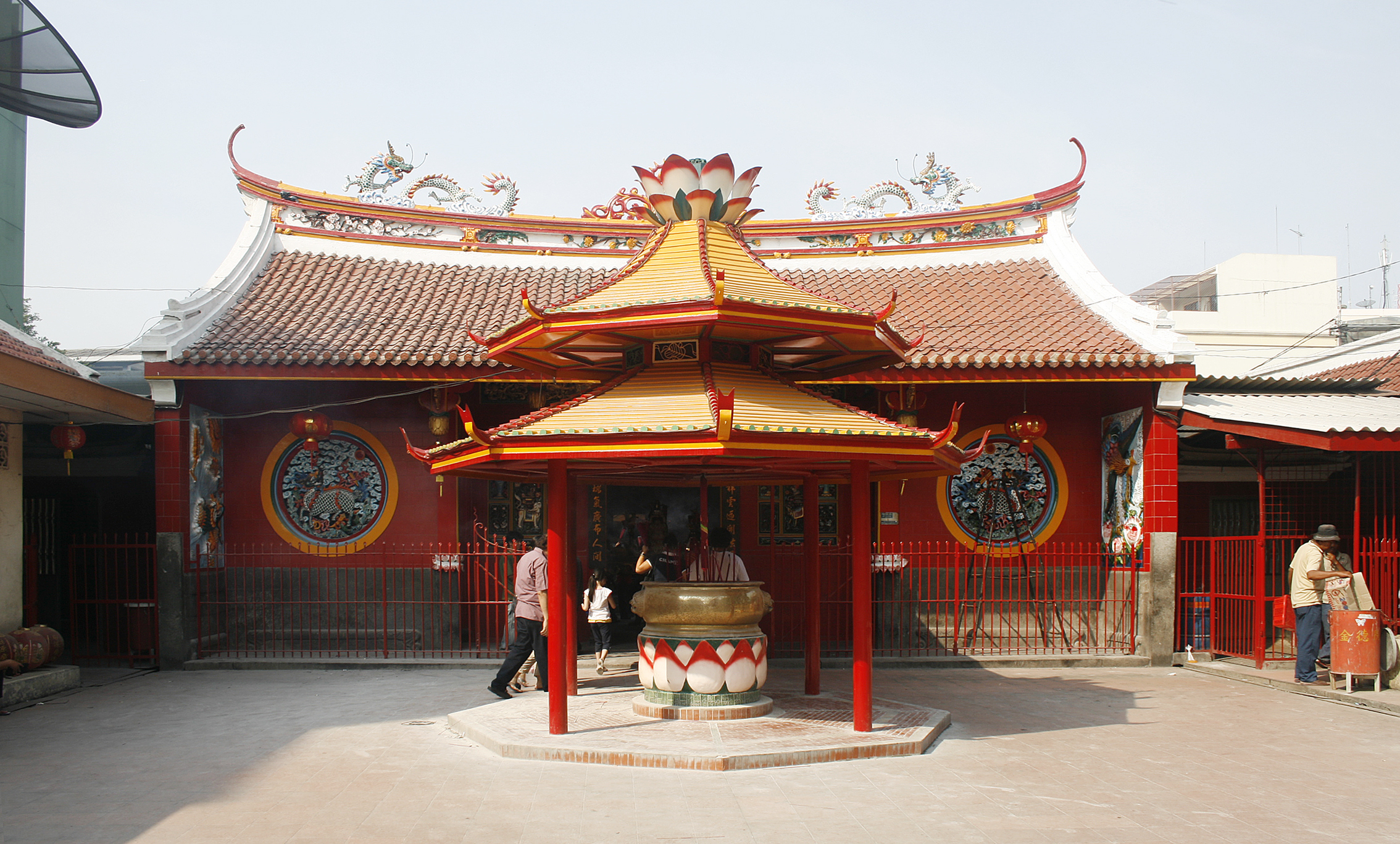
Kim Tek Ie Temple
The word klenteng - used across Indonesia to describe any Chinese temple - traces back to a single building in Jakarta's Chinatown. Kwan Im Teng, the 'Pavilion of Guanyin,' was completed in 1650 in the neighborhood of Glodok, ordered built by Kwee Hoen, the Luitenant der Chinezen, the community's colonial-appointed leader. Over the centuries, the temple has been burned in a massacre, rebuilt under a new name, stripped of its Chinese identity by government decree, and gutted again by fire in 2015. Through it all, incense has continued to rise from its altars. The temple now known as Kim Tek Ie - or, by its officially imposed name, Vihara Dharma Bhakti - remains the oldest Chinese place of worship in Jakarta, and the living origin of a word that became part of the Indonesian language itself.
Born Under Company Rule
In the mid-17th century, Batavia's Chinese community was growing but tightly controlled. The Dutch East India Company appointed ethnic leaders - officieren - to manage each community's affairs, and it was under this system that Kwee Hoen commissioned the temple. Dedicated to Guanyin, the bodhisattva of compassion, the temple served as both spiritual center and community anchor for Chinese settlers navigating life under colonial authority. Its original name, Kwan Im Teng, entered the local vocabulary so thoroughly that klenteng became the generic Indonesian word for any Chinese temple. The building itself was modest by later standards but rich in meaning - a declaration that the Chinese community intended to stay, to worship, and to build something permanent in a city that was not yet their own but was becoming so.
Ashes and Rebuilding
In 1740, Batavia's colonial government turned on its Chinese population. The massacre that followed killed thousands of Chinese residents, and Kwan Im Teng burned to the ground along with much of the Chinese quarter. The scale of the violence was severe enough to prompt a reorganization of how the Dutch governed ethnic communities. Governor-General Gustaaf Willem van Imhoff established the Kong Koan, a semi-autonomous body that gave the Chinese community a formal structure for managing their own religious and social affairs. Under this system, Kapitein der Chinezen Oey Tji Lo led the temple's restoration in 1755. The rebuilt temple received a new name: Kim Tek Ie, rendered in Mandarin as Jin De Yuan. The Kong Koan also took responsibility for maintaining other Chinese temples across Batavia, but Kim Tek Ie remained the most significant - the community's symbolic heart, rebuilt from the ashes of a catastrophe.
A Name Imposed, an Identity Contested
After Indonesian independence, the Kong Koan was dissolved and replaced by the Dewan Wihara Indonesia, a national council that oversaw Buddhist and Chinese religious sites. Management of individual temples shifted to a system of lu-zhu - 'head censers' - typically influential businessmen who organized fundraising and managed ceremonies. Then in 1965, as part of a broader campaign to eliminate foreign-sounding names from Indonesian public life, the government recommended renaming the temple Vihara Dharma Bhakti. The Chinese characters came down. The Hokkien name was officially replaced. It was a small act in a much larger pattern of cultural erasure that affected Chinese Indonesians for decades - restrictions on Chinese-language education, public celebrations, and cultural expression that lasted well into the 1990s. Yet among the community, the temple never stopped being Kim Tek Ie. Official names can be imposed; the names people use among themselves are harder to legislate.
Fire and Festival
On the morning of March 2, 2015, a piece of tarpaulin hanging near ceremonial candles caught fire. The flames spread through the main building, destroying the ornamented roof frame and some forty historic sculptures. For a temple that had already been burned once in its history, the fire felt like a cruel repetition. Restoration efforts followed, but the loss was significant - centuries-old carvings and religious art reduced to ash. Between calamities, the temple has served as Jakarta's center for Chinese-related festivities. The Zhong Yuan Festival, known locally by its Hokkien name Cioko, fills the courtyard annually. The Lantern Festival, Cap go meh, draws crowds from across the city. During the colonial period, Peranakan Chinese opera was performed every Vesak, accompanied by Batavian kroncong music - a blend of Portuguese guitar traditions and Indonesian rhythms that itself testifies to the cultural mixing the temple has witnessed.
The Oldest Altar in Glodok
Glodok remains Jakarta's Chinatown, though the neighborhood has changed enormously since Kwee Hoen's time. The narrow streets are dense with electronics shops, traditional medicine stores, and food stalls serving bakmi and nasi goreng. Kim Tek Ie sits within this commercial bustle, its ornate entrance a sudden shift from the mundane storefronts surrounding it. Step inside and the noise drops. Incense smoke curls past altars dedicated to Guanyin, past offerings of fruit and flowers, past calligraphy that links the present congregation to the temple's 17th-century founders. The building is not grand by the standards of Chinese temples in Singapore or Penang, but its significance is outsized - this is where Indonesian Chinese religious life in Jakarta began, where a word was coined, where a community endured massacre and assimilation policy and kept returning to light incense and pray.
From the Air
Located at 6.14°S, 106.81°E in the Glodok (Chinatown) district of West Jakarta. The temple sits in a dense urban area of low-rise commercial buildings south of the Kali Besar canal and Kota Tua (Old Town). Nearest airport is Soekarno-Hatta International (WIII), about 22 km northwest. From the air at 2,000-3,000 feet, Glodok is identifiable by its tight street grid and older building stock immediately south of the more open Fatahillah Square area. The temple's traditional Chinese roofline is distinctive but small against the urban fabric. Jakarta Bay is visible to the north.