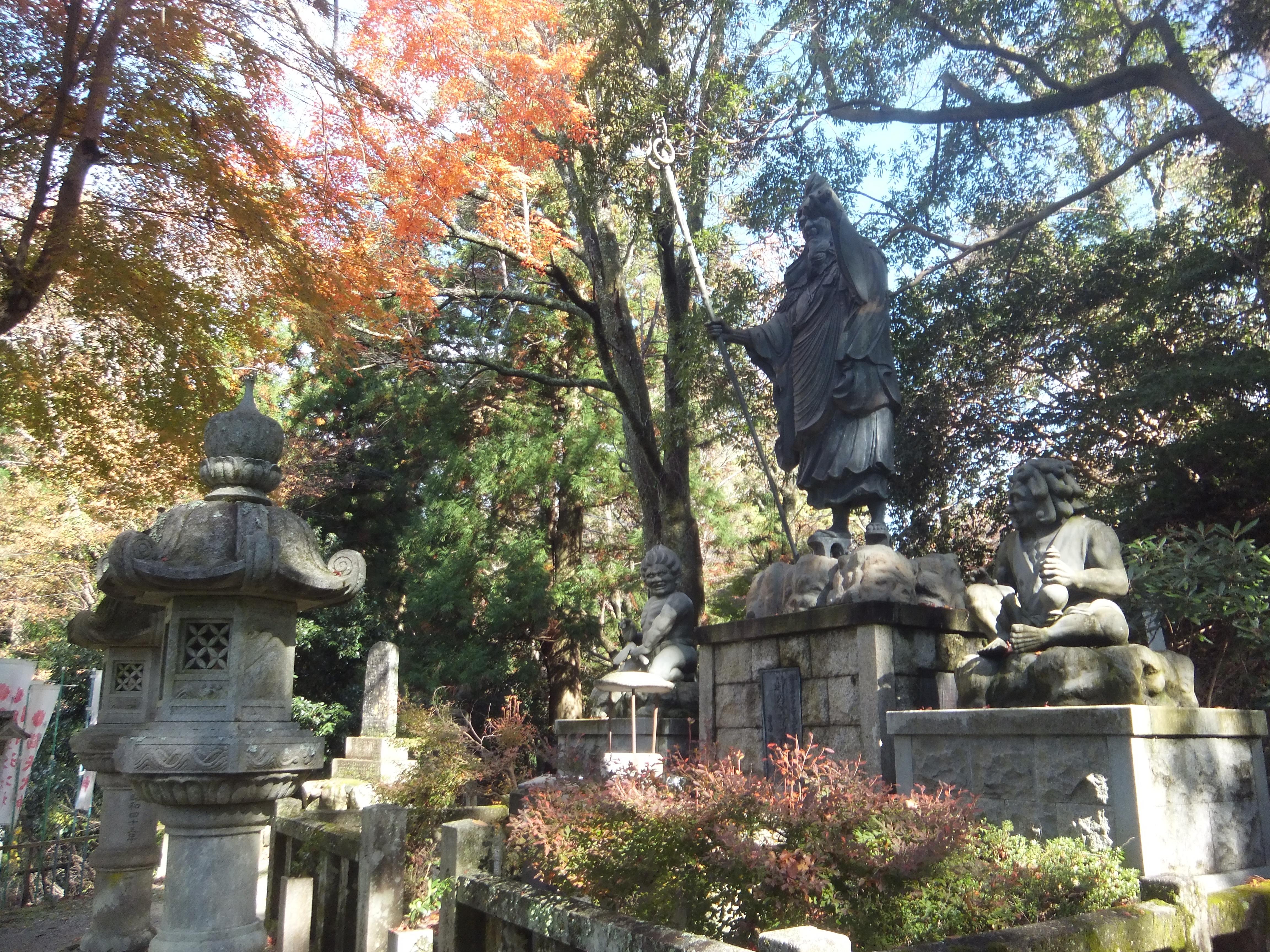
Kimpusen-ji
Inside the Zaō-dō at Kimpusen-ji, three blue-skinned figures tower seven meters above the floor. They are statues of Zaō Gongen, the fierce protector deity of the surrounding sacred mountains, each one representing a different face of the Buddha -- past, present, and future -- merged into a single wrathful form unique to Japan. The hall that shelters them is the second-largest wooden structure in the country, surpassed only by the Great Buddha Hall at Tōdai-ji in Nara, and its thirty-four-meter height dominates the ridgeline of Mount Yoshino. This is the headquarters of Kinpusen-Shugendō, a religion born from the collision of Shinto mountain worship and Buddhist esoteric practice, and the reason thirty thousand cherry trees carpet these slopes each spring. In Shugendō tradition, the cherry is Zaō Gongen's sacred tree, and every planting over the past thirteen centuries has been an act of devotion.
The Mystic and the Mountain
According to tradition, Kimpusen-ji was founded by En no Gyōja at the end of the 7th century. En no Gyōja is the legendary father of Shugendō -- "the path of training and testing" -- a practice that sends its followers into the mountains for grueling physical and spiritual discipline. He is said to have carved the first image of Zaō Gongen from a mountain cherry tree on these slopes, establishing both the deity and the tree as central to the faith. The temple was originally part of a vast complex that stretched from Mount Yoshino south through the Ōmine Mountain Range to Kumano Hongū Taisha, an eighty-kilometer chain of halls, trails, and training grounds collectively known as Kinpusen-ji. The upper temple at Sanjōgatake peak -- now the separate Ōminesan-ji -- was called the "Zaō Hall on the mountaintop," while the hall here at Yoshino was the "Zaō Hall at the foot." They functioned as two halves of a single institution for centuries.
Thirty-Four Meters of Timber and Copper
The Zaō-dō is staggering in scale. At thirty-four meters, it rises above the surrounding cherry groves like a small mountain of its own. The building is a designated National Treasure, one of the largest wooden structures in Japan, its interior dim and fragrant with centuries of incense smoke. The three Zaō Gongen statues inside are themselves 1,300 years old, each measuring up to seven meters tall and painted in the deity's characteristic blue. Their expressions are fierce -- brows furrowed, mouths open, limbs tensed in mid-stride -- embodying the protective wrath that Shugendō practitioners invoke against evil. A Shinto shrine dedicated to Inari Ōkami sits within the temple compound, a reminder that the boundary between Buddhism and Shinto was, for most of Japanese history, more like a suggestion than a wall.
Courts in Exile, Souls at Rest
Kimpusen-ji carries the weight of political history as well as spiritual. During the Nanboku-chō period (1336-1392), when Japan split between rival Northern and Southern imperial courts, Yoshino served as the Southern Court's mountain stronghold. Emperor Go-Daigo and his successors held court in these hills, waging a losing war against the Ashikaga shogunate in Kyoto. In 1963, the temple constructed the Southern Court Mystic Law Hall -- the Nanchō Myōhōden -- to appease the souls of the four Southern Court emperors and the warriors who died in their cause. A statue of Gautama Buddha presides over the hall. Outside, a statue of En no Gyōja stands near the entrance, the founder watching over the building that commemorates a conflict that unfolded seven hundred years after his death.
A Thousand at a Glance
Mount Yoshino is Japan's most celebrated cherry blossom site, and Kimpusen-ji is the reason. The roughly thirty thousand trees that blanket the mountain in four distinct zones -- lower, middle, upper, and far -- exist because of Shugendō. Devotees planted cherry trees for thirteen centuries as offerings to Zaō Gongen, whose original image was carved from their wood. The phenomenon is called "hitome senbon" -- "a thousand trees at a single glance" -- and from the viewpoint at Yoshimizu Shrine, the phrase barely overstates it. The blossoms open in waves from the lower slopes upward over roughly two weeks each April, painting the mountain in successive bands of pale pink. In 2004, the entire area was designated a UNESCO World Heritage Site as part of the Sacred Sites and Pilgrimage Routes in the Kii Mountain Range, recognizing what En no Gyōja's followers built: a landscape where devotion and beauty became the same thing.
From the Air
Located at 34.368°N, 135.858°E on the ridgeline of Mount Yoshino in Nara Prefecture. The Zaō-dō's massive wooden roof is potentially visible from low altitude in clear conditions as the largest structure on the forested mountain ridge. Mount Yoshino is famous for its cherry blossoms in April, when the entire mountainside turns pink -- a striking sight from the air. The Ōmine Mountain Range extends south into the Kii Peninsula interior. Nearest major airports: Kansai International (RJBB) approximately 55nm to the northwest, Nanki-Shirahama (RJBD) approximately 45nm to the south-southwest, Osaka Itami (RJOO) approximately 45nm to the north-northwest. Terrain is steep and heavily forested; mountain waves and turbulence possible in strong westerly winds.