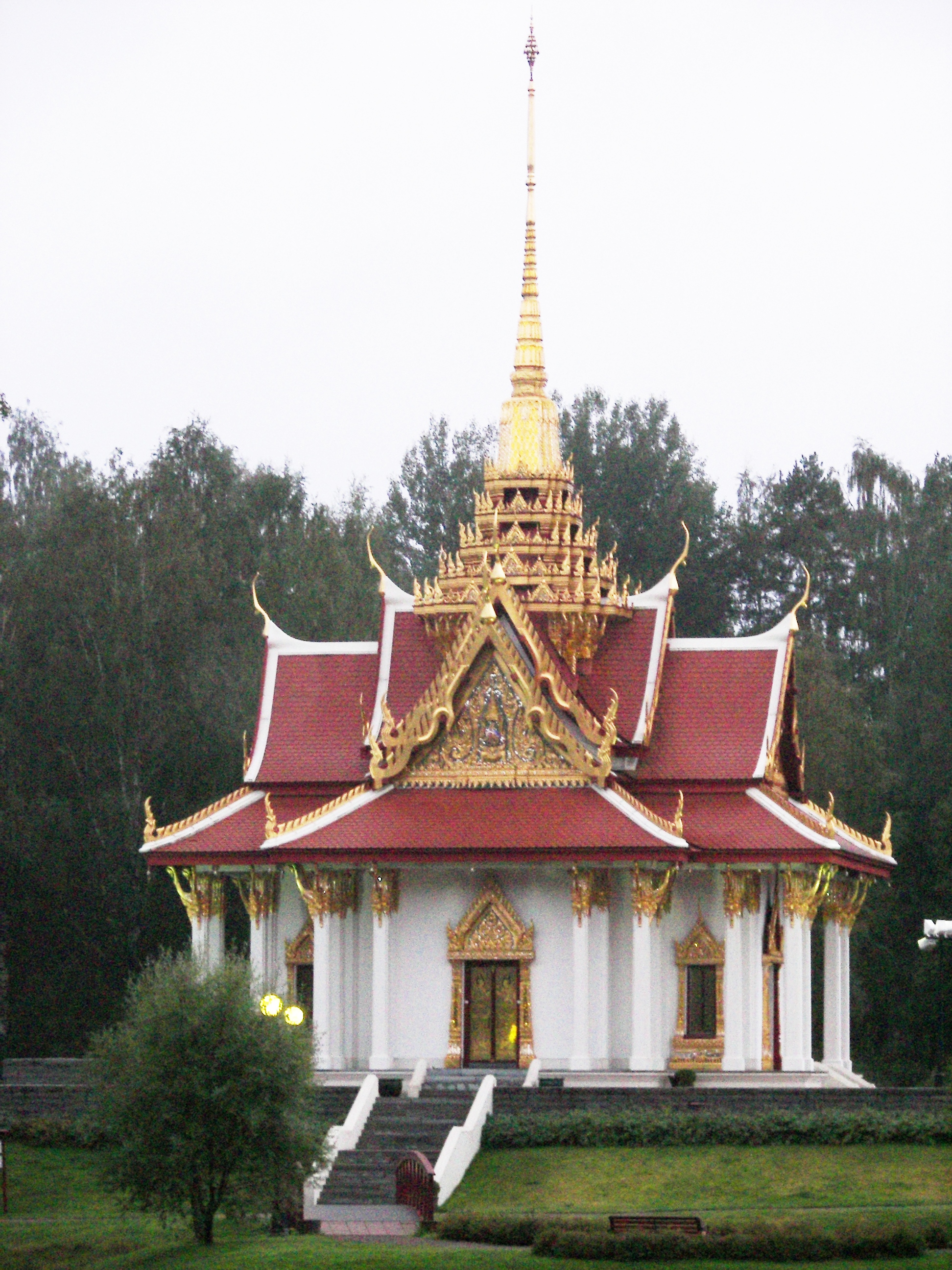
King Chulalongkorn Memorial Building
In the tiny village of Utanede, deep in the forests of Jämtland in central Sweden, a 28-meter Thai royal pavilion glitters with gold leaf. It is exactly the last thing you would expect to find here, which is precisely why it exists. The King Chulalongkorn Memorial Building commemorates one of the more improbable diplomatic encounters of the nineteenth century -- a Siamese king visiting a remote Swedish municipality -- and it stands as proof that some connections between distant cultures require no geographic logic at all.
A King Travels North
In the summer of 1897, King Chulalongkorn of Siam -- known to his people as Rama V and widely revered as a great modernizer -- embarked on a European tour. He visited the General Art and Industrial Exposition of Stockholm on July 13, meeting King Oscar II of Sweden and Norway. But the Siamese king's travels extended beyond the capital. He ventured into the Swedish countryside, reaching the small community of Utanede in Ragunda Municipality. What drew him to this remote corner of Jämtland is part of the story's charm: Chulalongkorn was a curious and restless traveler, and the Swedish landscape held a kind of exotic appeal for a monarch raised in tropical Bangkok. The meeting between two kings -- one from the tropics, one from the subarctic -- became a local legend that Ragunda never forgot.
A Century of Remembering
One hundred years later, the memory of that visit had not faded. In August 1997, construction began on a memorial building in the style of a prasat, a royal Thai pavilion. The project was a collaboration that bridged the same cultural distance Chulalongkorn had crossed a century earlier. When the building was inaugurated on July 19, 1998, the timing was deliberate: the 101st anniversary of the king's visit. The one-year delay from the centennial reflected the scale of what was being built. This was no modest plaque or interpretive sign. The Sala Thai rises 28 meters on a ten-by-ten-meter footprint, its roof supported by 24 white concrete pillars framing four entrances. Gold leaf ornamentation adorns the structure, valued at three million Swedish kronor -- roughly 14 million Thai baht.
Gold Against the Green
The visual effect is startling. The pavilion's elaborate gilded ornamentation and traditional Thai rooflines stand against a backdrop of Swedish conifers and the quiet, muted palette of a Nordic landscape. There is no attempt to blend in, and that is the point. The building declares itself boldly: a piece of Southeast Asian royal architecture planted in Scandinavian soil, a monument to a single afternoon when two very different worlds intersected. For visitors approaching Utanede, the pavilion appears almost dreamlike, its golden surfaces catching northern light that falls at angles Bangkok never sees. The structure honors both Chulalongkorn's legacy as a beloved Thai monarch and the unlikely warmth of his reception in a place so far from home.
Ragunda's Quiet Distinction
Ragunda Municipality is better known locally for Döda fallet, the "Dead Fall" where a lake drained in a single night in 1796. But the Thai pavilion gives Utanede its own claim to distinction -- a quieter, more whimsical one. The building draws Thai visitors to a part of Sweden that few tourists of any nationality ever reach. It represents a thread of international memory preserved across a century by a small community that could have easily let it fade. Instead, they built something extraordinary: a permanent declaration that this otherwise unassuming village was, for one summer day in 1897, a meeting place of monarchs and civilizations.
From the Air
Located at 62.96°N, 16.68°E in Utanede, Ragunda Municipality, Jämtland, Sweden. The 28-meter gilded pavilion is a distinctive visual landmark from the air, especially in clear conditions when the gold leaf catches sunlight. Situated in the forested Indalsälven river valley. Nearest significant airport is Sundsvall-Timrå Airport (ESNN), approximately 110 km southeast. Östersund Airport (ESNZ) lies roughly 130 km to the southwest. Best viewed at 2,000-4,000 ft to spot the golden structure against the surrounding green forest.