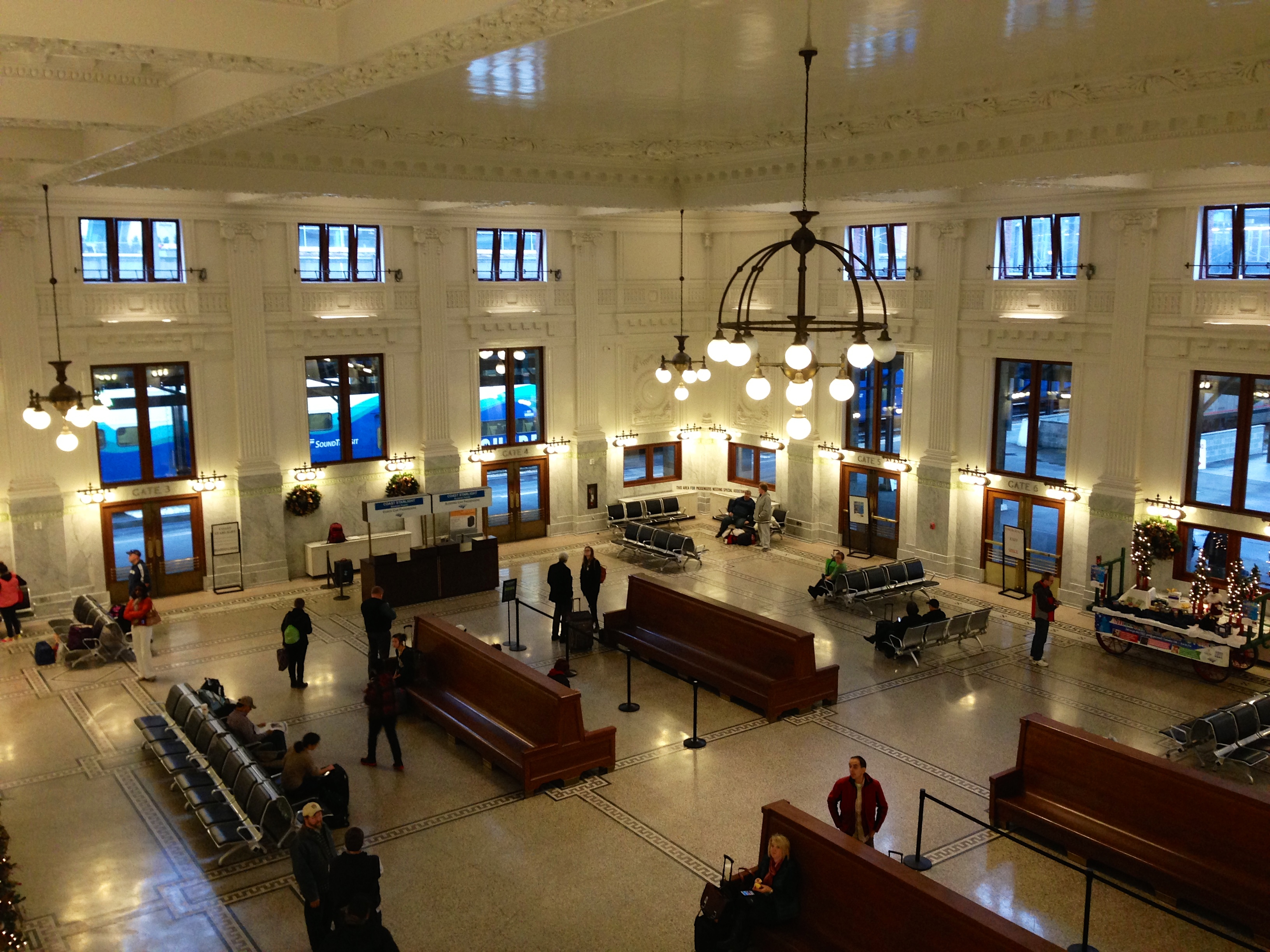
King Street Station
In late 1967, workers punched hundreds of holes through ornamental plaster to hang a drop ceiling ten feet below the original, hiding a hand-carved coffered ceiling, brass chandeliers, marble panels, and glass tile mosaics behind plastic, sheet rock, and Formica. It was supposed to be progress. For nearly four decades, travelers passing through King Street Station had no idea they were walking beneath one of the finest Beaux Arts interiors on the West Coast. The story of Seattle's oldest surviving train station is a parable about what cities lose when they stop looking up -- and what they can reclaim when they finally do.
The Empire Builder's Station
James J. Hill, the railroad magnate who controlled both the Great Northern Railway and Northern Pacific Railway, needed a proper Seattle terminal. The antiquated station on Railroad Avenue -- today's Alaskan Way -- was inadequate for his ambitions. He commissioned Reed and Stem of St. Paul, Minnesota, the same firm that would serve as associate architects for Grand Central Terminal in New York City. Construction ran from 1904 to 1906, and King Street Station opened on May 10, 1906, as part of a larger project to reroute mainline traffic through a planned tunnel under downtown, bypassing the congested waterfront railyards. Its crowning feature was a clock tower modeled after the recently collapsed Campanile di San Marco in Venice -- a deliberate echo that made the tower the tallest building in Seattle at the time. Four mechanical clock faces built by E. Howard & Co. of Boston offered the time to each cardinal direction, said to be the second-largest timepiece on the Pacific Coast after San Francisco's Ferry Building.
The Compass Room and the Slow Decline
Step inside and the first thing that greets you is the Compass Room, an entry hall at the base of the clock tower where a navigational compass rose is laid out in hand-cut marble tiles on the floor. The building is L-shaped, red brick masonry over a steel frame, with terra cotta and cast stone ornamentation -- an architectural style sometimes called Railroad Italianate, blending Italian-inspired interiors with Beaux Arts influences on the exterior. For decades it served as Seattle's primary train terminal, flanked by Union Station one block east after 1911. But after World War II, as passenger rail declined, the station endured a series of modernizations that stripped away its character piece by piece. In the late 1940s, escalators were built over the open stairwell to Jackson Street. The 1950s brought chrome and plastic seats to replace the original yellow oak benches. Then came the devastating 1967 renovation: plaster reliefs sheared from walls, brass sconces ripped out, the women's waiting room gutted for offices. Only the terrazzo tile floor and a single wall clock survived visible in the main hall.
Vending Machines and Walled-Off Escalators
The creation of Amtrak in 1971 consolidated all Seattle passenger rail service at King Street Station, closing Union Station next door. But consolidation brought austerity, not renewal. The station's restaurant, lunch counter, and gift shop were shuttered immediately, replaced by vending machines. The escalators stopped running and, without funds or ridership to justify repairs, were permanently walled off. The station was listed on the National Register of Historic Places in 1973, an acknowledgment of its significance even as it continued to decay. For years, King Street Station functioned as a monument to deferred maintenance -- its clock tower doubling as a microwave relay for Burlington Northern Railroad, the successor to Hill's two railways, whose offices still occupied the upper floors.
Ten Dollars and a Resurrection
The turnaround began with a remarkable transaction. In 2006, Seattle Mayor Greg Nickels announced a deal with BNSF Railway to purchase King Street Station for one dollar. The city council formalized the agreement, and the deal was ultimately signed on March 5, 2008, for the revised price of ten dollars. That purchase unlocked $19 million in state and federal restoration funds, supplemented by $10 million from a local transportation levy. The restoration unfolded in phases. In 2008, the clock tower clocks were repaired and old microwave antennas removed. The breakthrough moment came in early July 2010, when crews worked overnight shifts to remove over 1,600 acoustic ceiling tiles and their framing -- finally exposing the coffered ceiling that had been hidden since 1967. The final phase drilled 36 geothermic wells deep underground to heat and cool the building. On April 24, 2013, King Street Station was officially rededicated, its original fixtures restored at a total cost of $55 million.
A Living Hub
Today King Street Station is the 15th-busiest station in the Amtrak system, serving as the Pacific Northwest's rail hub. Amtrak's Cascades, Coast Starlight, and Empire Builder all call here, alongside Sounder commuter trains. The station anchors a transit cluster that includes Link light rail at the adjacent International District/Chinatown station and stops on the First Hill Streetcar. Ten tracks and four platforms handle the traffic. The original upper entrance off Jackson Street, sealed for decades, has been reopened. The Compass Room gleams again, its marble compass rose catching the light that filters through restored mahogany-framed windows. Pioneer Square stretches to the north, the stadiums rise to the south, and the Chinatown-International District unfolds to the east. King Street Station stands where it always has -- but for the first time in half a century, it looks like itself again.
From the Air
Located at 47.598°N, 122.330°W at the southern edge of downtown Seattle, near the intersection of South Jackson Street and 4th Avenue South. The station's distinctive clock tower, modeled after Venice's Campanile di San Marco, is a recognizable landmark from the air. It sits between Pioneer Square to the north and the stadium district (T-Mobile Park, Lumen Field) to the south, with the Chinatown-International District to the east. Nearby airports: KBFI (Boeing Field, 2 nm south), KSEA (Seattle-Tacoma International, 10 nm south). Best viewed at 2,000-3,000 ft AGL. The rail corridor running north-south through the station is clearly visible from altitude.