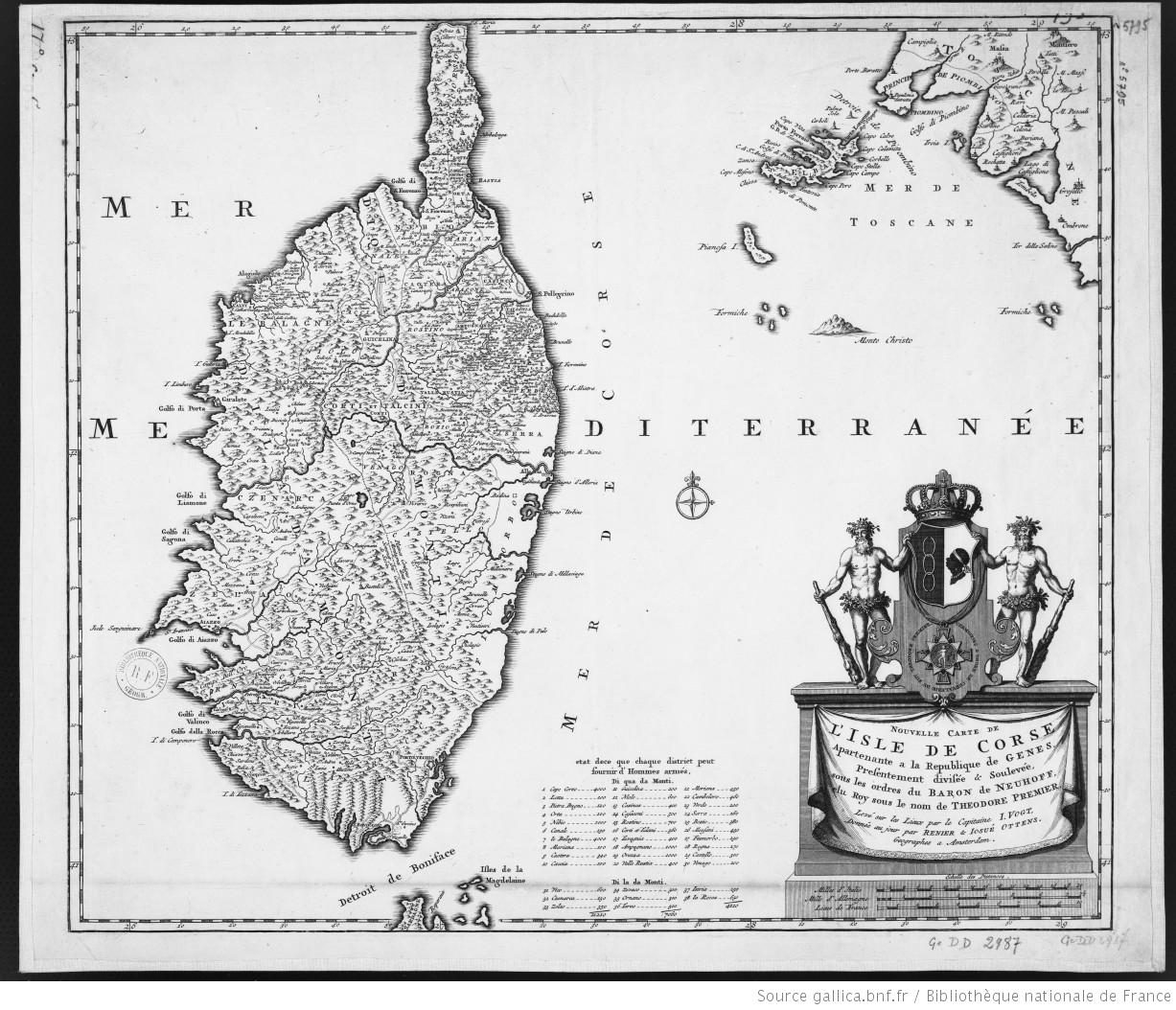
Kingdom of Corsica (1736)
The story of Theodore von Neuhoff reads like a picaresque novel that no editor would accept as plausible. A German baron of modest means and grand ambitions, he met Corsican exiles in Genoa and convinced them he could liberate their island from Genoese rule -- if they made him king. They agreed. He arrived in Corsica on March 12, 1736, armed with weapons supplied by the Bey of Tunis, and the islanders crowned him Theodore I. Eight months later, he fled the island with a bounty on his head. He would spend the next two decades chasing his lost kingdom across Europe, dying in a London debtor's prison, having legally signed over Corsica to his creditors.
A Crown Won by Charm
Neuhoff was no ordinary con man. He was educated, multilingual, and possessed a talent for telling powerful people exactly what they wanted to hear. At Genoa, he encountered Corsican rebels whose guerrilla war against Genoese colonial rule had stalled. The islanders were desperate for foreign support -- military supplies, diplomatic recognition, anything that might tip the balance. Neuhoff offered all of this, and asked only one thing in return: the crown. With military aid secured from the Bey of Tunis, he landed in Corsica and was elected king by the rebel leadership. He assumed the title Theodore I, established a court, created an order of knighthood, and began issuing royal edicts. He even minted coins with his initials. For a brief moment, it seemed almost real.
Eight Months of Majesty
Theodore waged war against the Genoese with the consent of a 24-member Diet, and at first he achieved some success. But the rebel coalition that had crowned him was fragile, held together more by opposition to Genoa than by loyalty to a foreign king. Infighting among the factions eroded his authority. The Genoese put a price on his head and published damaging accounts of his colorful past -- debts, schemes, and wanderings across the courts of Europe. On November 11, 1736, just eight months after his coronation, Theodore left Corsica, claiming he would return with foreign reinforcements. He never did -- at least not as a king with any real power.
The Long Decline
What followed was two decades of increasingly desperate attempts to reclaim his throne. Theodore sent his nephew to Corsica with arms. He returned to the island himself in 1738, 1739, and 1743, but combined Genoese and French forces had tightened their grip. He sought support from Spain, Naples, and Holland, finding mostly closed doors. In Amsterdam, he was arrested for debt. In 1749, he arrived in England hoping for British backing, but instead ended up confined in a debtor's prison in London. He remained there until 1755, when he regained his freedom through the only option left: declaring bankruptcy and formally ceding his kingdom of Corsica to his creditors. It was the most unusual asset ever surrendered in a bankruptcy proceeding.
A King Without a Country
Theodore spent his final year surviving on the charity of Horace Walpole and a few sympathetic friends. He died in London in 1756, having outlived his reign by twenty years but never his royal pretensions. Walpole arranged for an epitaph that captured the absurdity and pathos of Theodore's life. The irony runs deeper than Walpole could have known: just nineteen years after Theodore's death, a far more capable leader, Pasquale Paoli, would establish the Corsican Republic on the same island, creating a genuine democratic experiment that would inspire the American Revolution. Theodore's kingdom was a farce; Paoli's republic was the real thing. But it was Theodore who first demonstrated that Corsicans were willing to follow anyone -- even a penniless German adventurer -- who promised them freedom from Genoa.
From the Air
Located at 42.17N, 9.13E, centered on Corsica in the western Mediterranean. The island's mountainous terrain is visible from cruising altitude. Corte, in the interior, served as the seat of Theodore's brief government. Nearest airports: Bastia-Poretta (LFKB), Ajaccio Napoleon Bonaparte (LFKJ). The rugged mountain interior and fortified coastal towns that shaped Corsica's rebellious history are all visible from the air.