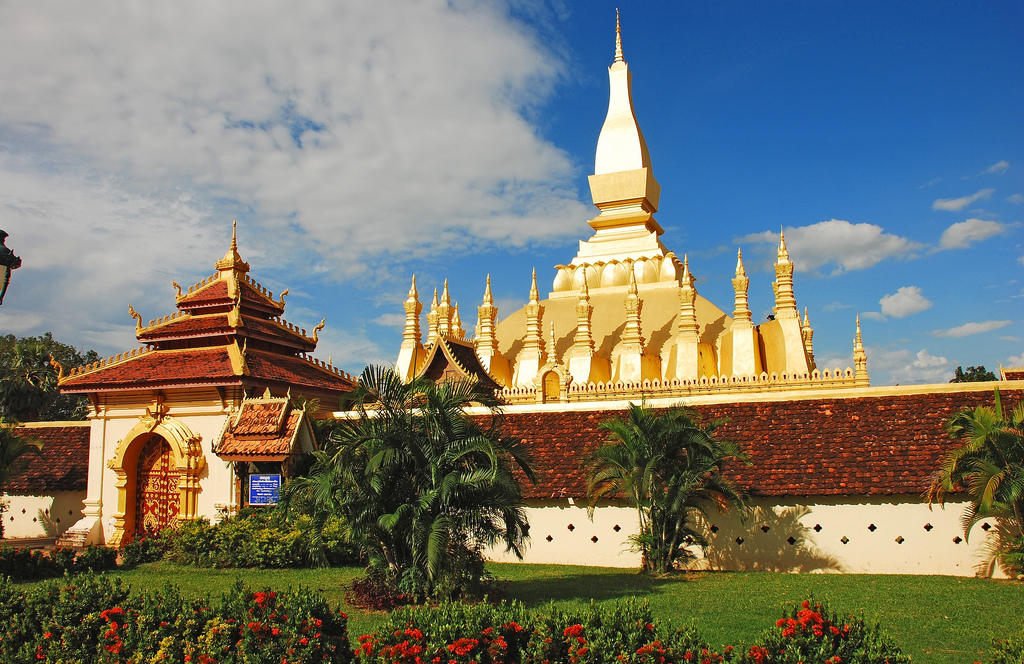
Kingdom of Laos
Three princes, all related by blood, tore a country apart. The neutralist, the rightist, and the communist -- Prince Souvanna Phouma, Prince Boun Oum of Champassak, and Prince Souphanouvong -- each claimed to represent the future of Laos after the French departed in 1953. Their fratricidal contest played out against the larger collision of the Cold War, drawing in the United States, the Soviet Union, North Vietnam, and Thailand. The Kingdom of Laos, a constitutional monarchy born from the wreckage of French Indochina, survived for twenty-eight years. It ended on December 2, 1975, when the last king surrendered his throne to the Pathet Lao and the nation became one of the few remaining Marxist-Leninist states on Earth.
Independence and the Three Princes
France granted Laos self-rule under a new constitution in 1947, making it part of the French Union alongside Vietnam and Cambodia. Full sovereignty came with the Franco-Lao Treaty of 1953, but the agreement left a dangerous ambiguity: it did not specify who would rule. Into that vacuum stepped the Three Princes, whose rivalry defined Lao politics for two decades. Souvanna Phouma sought neutrality, a middle path between Washington and Moscow. Boun Oum aligned with the West and the military establishment. Souphanouvong, the so-called Red Prince, allied with North Vietnam and led the Pathet Lao guerrilla movement. Behind the princes, the real power broker was Kaysone Phomvihane, who would become the first prime minister of the communist state that replaced the monarchy.
The Most Bombed Country on Earth
What happened to Laos during the Vietnam War defies easy comprehension. North Vietnam invaded Lao territory to build supply routes to the south, and the United States responded with a bombing campaign of staggering scale. Between 1964 and 1973, American B-52s dropped more ordnance on Laos than all combatants dropped during the entirety of the Second World War. On average, a planeload of bombs fell every eight minutes, around the clock, for nine years. Xiangkhouang Province and the Plain of Jars bore the worst of it. Of the roughly 260 million bombs that fell, some 80 million failed to detonate. They remain in the soil today, continuing to injure and kill Lao civilians more than fifty years later. Laos holds the grim distinction of being the most heavily bombed nation per capita in history.
The Fall of the Kingdom
By the early 1970s the kingdom was hollowed out. A 1968 North Vietnamese multi-division offensive had effectively demobilized the Royal Lao Army, leaving the fight to irregular forces -- including Hmong guerrillas led by General Vang Pao -- funded by the United States and Thailand. A ceasefire came in February 1973, following the Paris Peace Accords, and another coalition government formed in April 1974 under Souvanna Phouma. But the Pathet Lao already controlled vast stretches of the countryside. When Saigon and Phnom Penh fell to communist forces in April 1975, the last pretense of a negotiated settlement collapsed. The Pathet Lao advanced on Vientiane. On December 2, Crown Prince Vong Savang delivered his father King Savang Vatthana's letter of abdication. The Lao People's Democratic Republic was proclaimed that same day.
The Price of Defeat
The aftermath was swift and merciless. Between 30,000 and 40,000 citizens -- officials, military officers, intellectuals, and members of the old government -- were sent to re-education camps in remote areas of Laos. The king, the queen, and the crown prince all died in captivity, their fates concealed from the public for years. Tens of thousands of Hmong, targeted for their alliance with the CIA during the war, fled across the Mekong into Thailand, where refugee camps like Ban Vinai grew into displaced cities of 45,000. Others made their way to the United States, France, and Australia. The kingdom vanished not only from the map but from public memory inside Laos itself, where discussion of the monarchy remains sensitive to this day.
From the Air
Centered on Vientiane at 17.97N, 102.60E, the former capital of the Kingdom of Laos. The city sits on the north bank of the Mekong River, which forms the border with Thailand. Wattay International Airport (VLVT) is the nearest major airfield, located on the western edge of the city. The Mekong is a prominent visual landmark from altitude, curving in a broad arc around Vientiane. The Plain of Jars, heavily bombed during the war, lies approximately 130nm to the northeast near Phonsavan.