Kingdom of Loango
In 1624, the Portuguese governor of Luanda sent a message to the Maloango -- the king of Loango -- demanding he expel Dutch traders from his coast and close their competing factories. In return, the governor promised better goods, military protection, and Jesuit priests to baptize the king. The Maloango's reply was blunt: he would trade with both parties under the same conditions, and he had no intention of converting to Catholicism. It was not the response of a subordinate. For roughly three centuries, the Kingdom of Loango operated on its own terms along what is now the western coast of the Republic of the Congo, southern Gabon, and Cabinda, controlling a stretch of Atlantic shoreline from Cape St. Catherine in the north to near the mouth of the Congo River.
A Kingdom Built on Alliances
The origins of Loango trace to the mid-sixteenth century, when a figure named Njimbe -- hailing from the district of Nzari in the small coastal kingdom of Kakongo, itself a vassal of the Kingdom of Kongo -- unified a collection of small, warring polities through a combination of alliances and military force. According to traditions recorded by the Dutch geographer Olfert Dapper in the 1640s, the region that became Loango was home to competing groups including Mayumba, Kilongo, Piri, and Wansi, each led independently. Njimbe defeated his rivals through diplomacy as much as warfare, and once the conquest was complete, more distant territories submitted voluntarily. He moved northward, founded settlements, and established his capital at Buali in the province of Piri. The people, a branch of the Bakongo who spoke a northern dialect of Kikongo, came to be known as the Vili.
Cloth, Copper, and the Price of Power
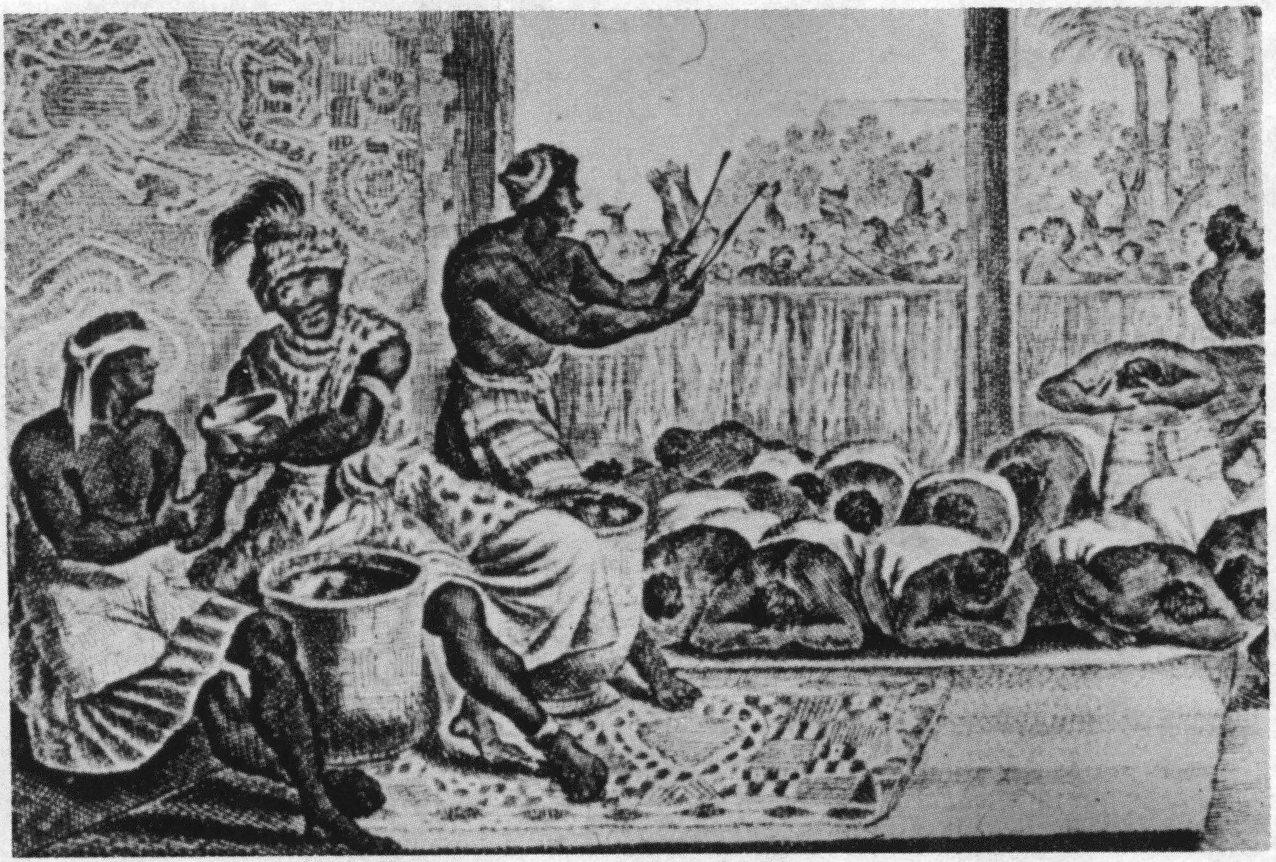
Before the slave trade dominated the coast, Loango was a commercial power in its own right. The kingdom exported copper to European markets and produced cloth in enormous quantities -- thousands of meters of raffia fabric shipped to Luanda and traded throughout the interior. Vili merchants traveled far from home, reaching copper mines at Mindouli and establishing trade networks that extended to the Teke Kingdom and beyond along the Congo River. When Dutch traders arrived in the early seventeenth century, they initially sought ivory, rare wood, and copper. By the 1650s, however, European demand shifted decisively toward enslaved people. Loango entered the trade but maintained control: foreign merchants were escorted to Bwali, the capital, to negotiate terms with royal officials called mafouks, and no European factories were permitted on a permanent basis. The kingdom played French, English, and Dutch traders against one another, preferring those whose goods were cheapest and highest quality.
The Throne That Stayed Empty
Njimbe established a system of succession rotating the kingship among four provincial families. For a time, it worked. But the wealth generated by Atlantic trade destabilized the balance. Historian Phyllis Martin argues that enriched nobles -- particularly those who profited from the slave trade -- pressured the older constitutional order, extending interregna between kings as councils competed for influence. Religious upheaval compounded the crisis: in 1663, a Hungarian Capuchin priest baptized the king and 6,000 subjects, triggering a civil war between Christian and non-Christian factions that lasted into the 1670s. After the death of King Buatu in 1787, no new king was elected for over a century. Royal authority passed to a figure called the Nganga Mvumbi -- the "priest of the corpse" -- who oversaw the dead king's body awaiting burial. Several of these custodians succeeded one another through the nineteenth century, maintaining a shadow of sovereignty while the kingdom's real power fragmented.
Gods, Devils, and Traveling Spirits
Loango's spiritual world was rich and decentralized. According to Dapper's seventeenth-century accounts, the people acknowledged a supreme god they called Nzambi a Mpungu but did not elaborate on him in daily worship. Instead, they devoted attention to nkisi -- divine objects that could be good, bad, or neutral, each with a specific name, jurisdiction, and locality. Priests called nganga nkisi created new nkisi through elaborate possession ceremonies, and communities judged them effective or not based on results. Some protected households; others guarded entire towns. In the village of Thiriko, a large shrine shaped like a house protected the general welfare. Travelers and merchants carried portable nkisi -- small pouches of lion skin filled with shells, stones, and iron bells. Christianity arrived repeatedly but never took permanent hold. A black Jewish community appeared on the Loango coast around the seventeenth century, first documented in 1777 and described by the German Loango Expedition of 1873-76. It had no links to Jewish communities elsewhere and eventually disappeared.
From the Air
Located at 4.71S, 11.84E on the Atlantic coast of the Republic of the Congo. The historical territory of Loango extended along the coast roughly between modern Pointe-Noire and southern Gabon. The former capital of Buali (now Diosso) sits on cliffs overlooking the coast northeast of Pointe-Noire. Nearest airport: Pointe-Noire Airport (FCPP). The dramatic red-earth cliffs of Diosso Gorge are visible from altitude as a striking geological feature near the coast.