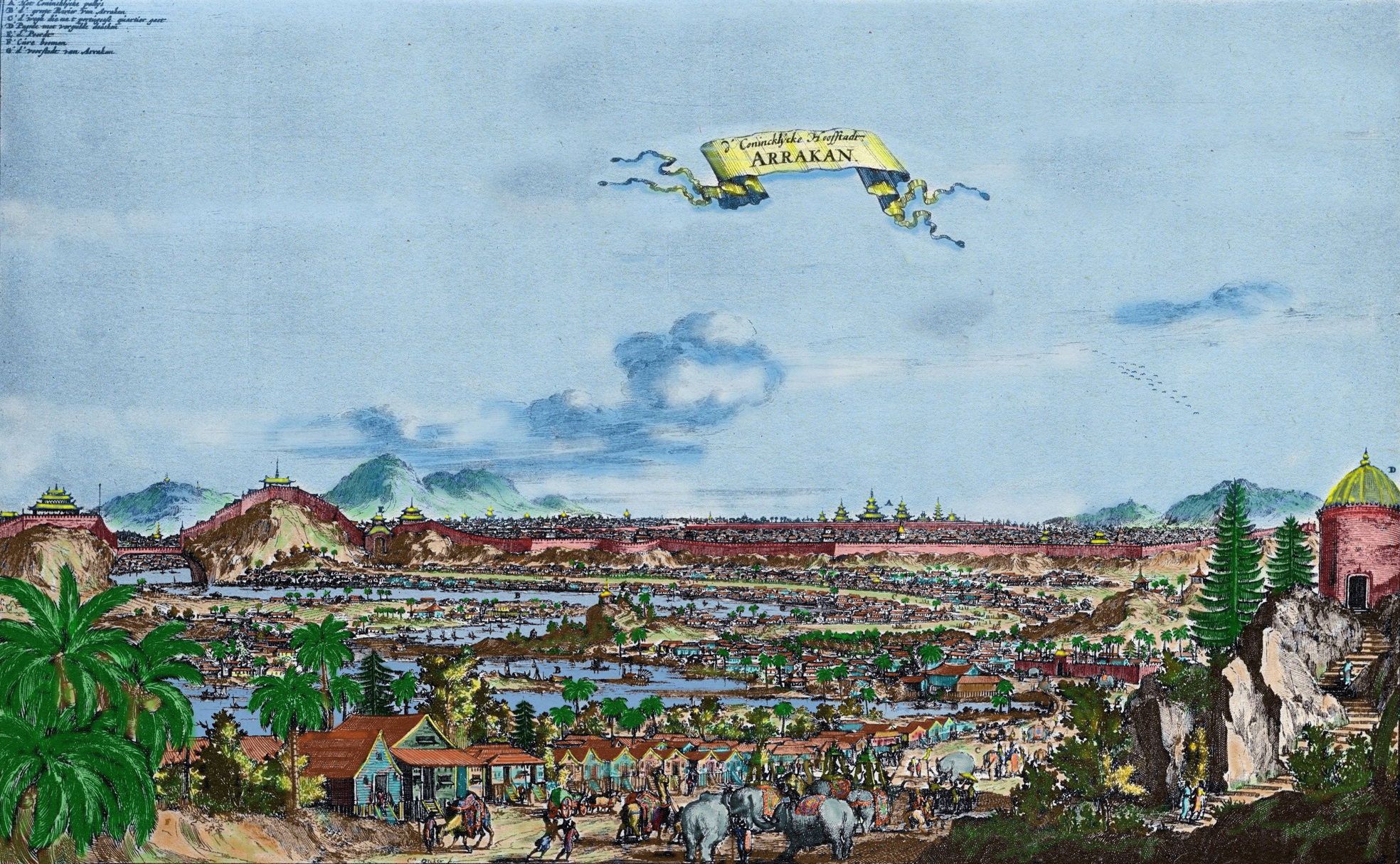
Kingdom of Mrauk U
In the early 1630s, Augustinian friar Sebastien Manrique arrived at a city on Myanmar's western coast and estimated its population at 160,000. He compared its grandeur to Venice. The city was Mrauk U, capital of the Arakanese kingdom, and almost nothing about it fit European expectations. Its Buddhist kings bore Islamic titles inherited from their years as vassals of the Bengal Sultanate. Portuguese mercenaries manned its warships. Arab, Danish, and Dutch traders haggled in its markets. Temples and mosques stood within sight of each other. For 356 years, from 1429 to 1785, the Kingdom of Mrauk U controlled the Arakan coastal plain and, at its peak, stretched from the Sundarbans to the Gulf of Martaban -- one of the most powerful and least-remembered states in Southeast Asian history.
An Exile's Return
The kingdom's founding reads like a revenge epic. In 1404, a young Arakanese king named Narameikhla was driven from his throne by Burmese forces and fled to the court of the Bengal Sultanate at Gour. He would spend twenty-four years in exile while Arakan became a battleground between the kingdoms of Ava and Pegu, with governors installed and executed as the power shifted. In 1430, Narameikhla finally regained control with military assistance from Bengali commanders Wali Khan and Sindhi Khan. The price of that help was high: he ceded territory to the Sultan of Bengal, accepted tributary status, and adopted an Islamic royal title despite being a Buddhist king. He also legalized the use of Islamic gold dinar coins from Bengal within his domain. The following year, he founded Mrauk U as his new capital, a city that would grow into one of the most remarkable urban centers in Asia.
Pirates, Poets, and Portuguese Guns
Mrauk U's economy rested on a foundation that modern sensibilities would find deeply uncomfortable. From 1531 to 1629, Arakanese raiders and their Portuguese pirate allies operated from coastal havens, conducting slave raids deep into Bengal and the Ganges delta. The enslaved -- members of Mughal nobility among them -- were put to work in agriculture and other industries. Rice became the principal export crop, and the kingdom's revenue depended heavily on its trade. Among those captured was Alaol, a Bengali man enslaved during a raid who rose to become one of the most celebrated poets in the Arakanese court. The kingdom's relationship with the Portuguese was transactional and volatile: mercenaries provided the naval muscle that made Mrauk U a regional power, but when commander Filipe de Brito revolted and seized the port of Syriam in 1603, King Min Razagyi responded by executing 600 Portuguese settlers on Dianga Island.
The Golden City at High Tide
Under Min Razagyi, who reigned from 1593 to 1612, the kingdom's territory nearly doubled. In 1599, an Arakanese force of approximately 30,000 troops and 300 war boats, bolstered by Portuguese mercenaries, captured the strategic port of Syriam and laid siege to the capital of the declining First Toungoo Empire. The victors divided immense plunder: gold, silver, precious stones, bronze cannons, and thirty Khmer bronze statues. Mrauk U's control briefly extended from the Sundarbans in the west to the Gulf of Martaban in the east. The capital itself became a cosmopolitan marvel. Over 700 ancient temples and pagodas filled the city and surrounding hills. The Shitthaung Pagoda -- the "Temple of 80,000 Buddhas" -- displayed ranks of carved figures along its interior corridors. The kings minted their own coins, with Arakanese script on one side and Persian on the other, designed for acceptance by neighboring countries and Arab traders. Japanese warriors served as royal bodyguards. Buddhist monks traveled between Arakan, Bengal, and Tibet.
The Mughal Reckoning
The kingdom's overreach eventually brought a confrontation it could not win. In 1660, Prince Shah Shuja, a Mughal claimant to the Peacock Throne, fled to Arakan after losing a succession war. King Sanda Thudhamma granted him asylum, then confiscated his gold and jewelry -- a provocation that led to an insurrection by the Mughal refugees. Shuja's fate remains uncertain: some accounts say he was killed, others that he escaped to Manipur. But members of his entourage stayed, becoming archers and court guards who would serve as kingmakers in Arakanese politics. Emperor Aurangzeb used his brother's mistreatment as a pretext for war. In 1664, Arakanese ships raided Bengal and destroyed some 160 Mughal imperial vessels, hardening the emperor's resolve. Aurangzeb appointed Shaista Khan as governor of Bengal, and in January 1666, a Mughal force captured Chittagong after a three-day siege. The Arakanese would attempt to recapture the city but never succeed. Losing Chittagong -- their most important trade center -- marked the beginning of Mrauk U's long decline.
Conquered and Forgotten
The end came from the east. In 1785, King Bodawpaya of Burma's Konbaung Dynasty invaded Arakan, framing the conquest as a restoration of Buddhist order in a "fallen" kingdom. He relocated the venerated Mahamuni Buddha image to Mandalay, a symbolic theft that still resonates in Rakhine memory. As many as 35,000 people fled to British Bengal in the years following the invasion, seeking protection under the Raj. The kingdom that had once rivaled Venice was absorbed into the Burmese empire, and its remarkable history -- the Islamic-titled Buddhist kings, the Portuguese mercenaries, the cosmopolitan markets, the enslaved poet who became a literary giant -- faded from mainstream memory. Today, Mrauk U's temples stand among green hills in Rakhine State, visited by far fewer travelers than Bagan. English author Maurice Collis brought some attention to the site with his book "The Land of the Great Image," drawn from Manrique's seventeenth-century accounts. The ruins remain, waiting for the world to notice what it has forgotten.
From the Air
Located at 20.55N, 93.20E in Rakhine State, western Myanmar. From altitude, the Mrauk U archaeological zone is visible as clusters of temple ruins and pagodas scattered across and between green hills in a river valley. The Lemro River runs nearby. The site contains over 700 ancient temples and pagodas. The Shitthaung Pagoda and Htukkanthein Temple are among the largest structures. Nearest airport is Sittwe Airport (VYSW), approximately 70 km to the west along the coast. The Bay of Bengal coastline is visible to the west. The Rakhine Yoma mountain range separates this region from central Myanmar to the east.