Kingdom of Singapura
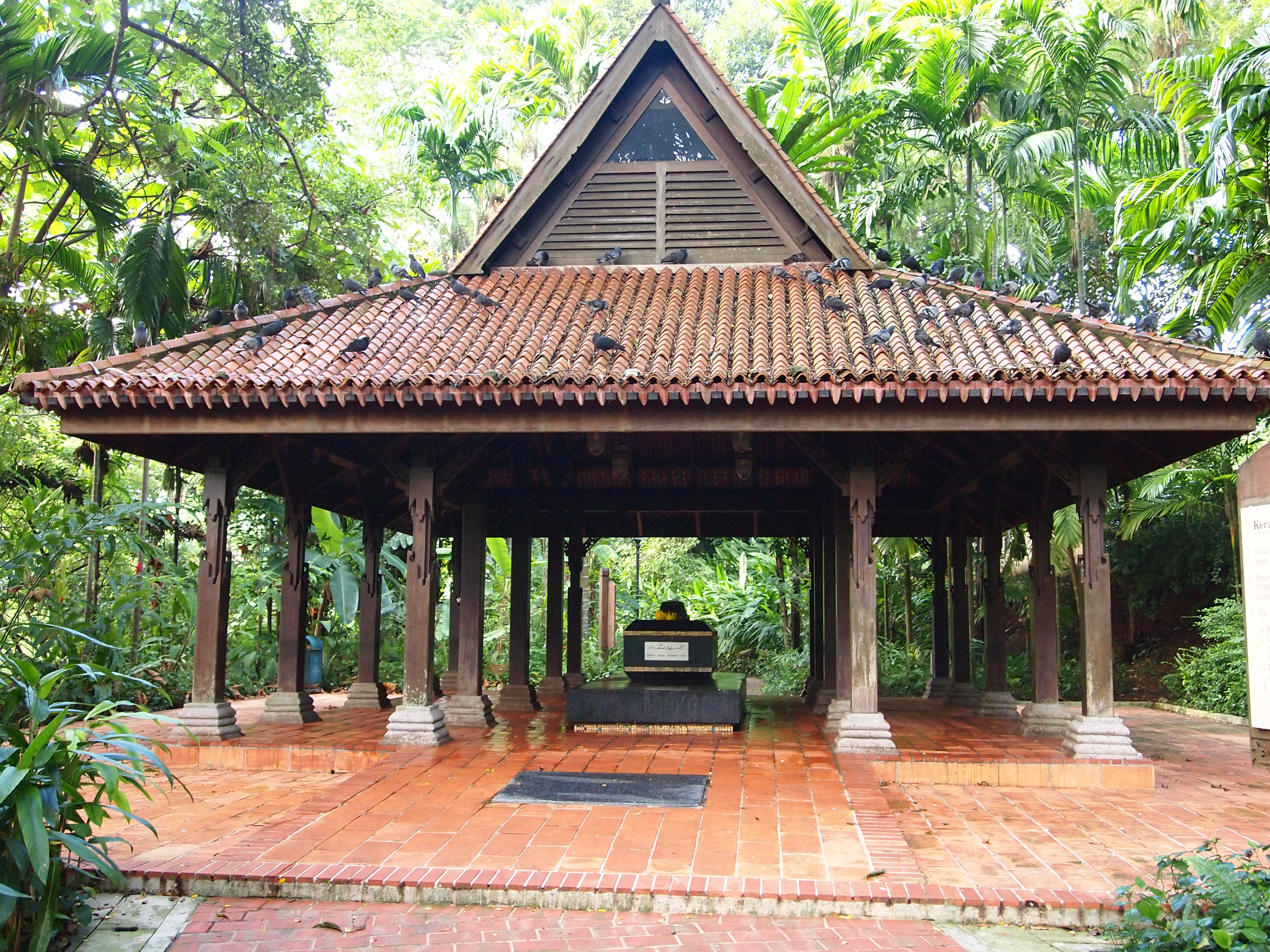
In 1928, workers excavating Fort Canning Hill for a reservoir broke through soil and struck gold - literally. A cache of ornaments emerged: flexible armlets, a finger ring inscribed with a bird motif, circular rings that may have been earrings, and a jewelled clasp bearing a disc-and-conch design. Most of this treasure was lost during the Japanese occupation in World War II; only one armband and two rings survive. But those few pieces confirmed what the Malay Annals had claimed for centuries: that this hill, known to locals as Bukit Larangan - the Forbidden Hill, abode of spirits and buried kings - had once been the seat of a genuine kingdom. The Kingdom of Singapura, founded around the late 13th or early 14th century on the island then called Temasek, lasted roughly a hundred years before falling to invasion. In that time, it grew from a small Orang Laut settlement into an international trading port that linked the Malay Archipelago, India, and Yuan dynasty China.
The Lion That Wasn't
The name tells a story that probably never happened. Singapura means "Lion City" in Sanskrit - sinha for lion, pura for city. According to the Malay Annals, a Palembang prince named Sang Nila Utama spotted a strange animal while exploring Temasek: red-bodied, black-headed, white-breasted, and fast enough to vanish into the jungle. His chief minister, Demang Lebar Daun, identified it as an Asiatic lion. Sang Nila Utama named his new kingdom accordingly. The problem is that lions have never lived in Southeast Asia. Scholars have proposed alternatives - a Malay tiger, a sun bear, perhaps nothing at all. Some argue the name was adopted later by Parameswara, the kingdom's last ruler, as a political statement connecting his island stronghold to the lion throne he had claimed in Palembang. Whatever animal Sang Nila Utama saw or didn't see, the name stuck. Modern Singapore still uses it, the Merlion statue in Marina Bay a monument to a founding legend that is almost certainly fiction.
The Hill, the River, the Trade
The kingdom's geography was its fortune. Fort Canning Hill provided a freshwater spring on its slope - a bathing place for royalty above, drinking water for the populace below. In Hindu-Buddhist tradition, the hill represented Mount Meru, seat of the gods, and building a palace on its summit allowed Sang Nila Utama to assert divine authority. The Singapore River at the base offered a natural harbor. Within decades, what had been a small Orang Laut fishing settlement became a cosmopolitan port where Chinese, Malay, Indian, and Arab traders exchanged red gold, cotton prints, blue satin, lakawood, and hornbill casques - ivory-like pieces from the hornbill bird, prized for carved ornaments. Wang Dayuan, a Yuan dynasty traveler who visited around 1330, described two settlements: Ban Zu, the peaceful trading town, and Long Ya Men, an area plagued by pirates. Chinese merchants lived "side by side with the natives," he wrote. The kingdom was not a producer but a connector - a point of exchange where goods from Java, India, and China changed hands under the watchful eye of government agents who structured the trade.
Besieged from Every Direction
Singapura's strategic position made it a prize worth fighting over. Two regional empires wanted it: Ayutthaya from the north and Majapahit from the south. According to Wang Dayuan's account, a Siamese fleet of 70 junks attacked the fortified city sometime before his visit in the 1330s. The siege lasted a month. Singapura's moats and walls held, and the Siamese withdrew only when a Yuan dynasty imperial envoy arrived - suggesting that Chinese diplomatic protection shielded the kingdom. The Majapahit struck later, sending 100 warships under commander Damang Wiraja. Singapura's defenders launched 400 warboats in response, and the battle raged along the coast for three days and three nights before the Javanese were driven back. Yet the Javanese chronicle Nagarakretagama listed Singapura as a Majapahit subject in 1365, suggesting that military defeat did not settle the question of sovereignty. The walls Wang described - five metres wide and three metres high, according to later British measurements by John Crawfurd along what is now Stamford Road - were the most substantial fortifications in the region.
The Fall and the Flight
The kingdom's end came violently. Sometime in the 1390s, depending on whether you trust the Malay Annals or Portuguese accounts by Tome Pires, the city was finally sacked - by Majapahit forces according to one version, by Siamese according to another. The last ruler, known as Iskandar Shah in the Malay Annals and Parameswara in Portuguese sources, fled westward across the Malay Peninsula. He founded a new stronghold at the mouth of the Bertam River, which grew within decades into the Malacca Sultanate - one of the great trading empires of Maritime Southeast Asia and a center for the spread of Islam. Whether Iskandar Shah and Parameswara were the same person or father and son remains debated; Ming dynasty records and Portuguese sources give conflicting answers. What is clear is that Singapura did not disappear overnight. The account by Joao de Barros suggests the city declined gradually as trade was deliberately redirected to Malacca. The island passed through Malaccan and then Johor Sultanate control before Sir Stamford Raffles claimed it for the British East India Company in 1819 - deliberately invoking the Malay Annals to justify what was, in practice, a commercial land grab.
Digging Up the Evidence
For centuries, the Kingdom of Singapura existed primarily as literature. The Malay Annals, written to legitimize royal Malay lineages, mixed legend with history freely enough that many scholars dismissed the five kings of Singapura as invented. Then the archaeology began to catch up. The 1928 gold hoard was the first major confirmation. Subsequent excavations around Fort Canning Hill and the Singapore River yielded fragments of Chinese ceramics, porcelain, and glassware - with the higher-quality pieces concentrated on the hill, consistent with an elite residence. Remnants of the fortification wall appeared along Stamford Road. Modern Singapore has embraced the discovery. The Maritime Experiential Museum on Sentosa showcases the kingdom's trading history, and the Sang Nila Utama chronicle is part of the primary school curriculum. A statue of the legendary founder now stands at the Raffles' Landing Site along the Singapore River - the same river where, seven centuries ago, his kingdom's port received ships laden with satin and gold from across the known world.
From the Air
The Kingdom of Singapura was centered on Fort Canning Hill (1.30°N, 103.85°E) and the Singapore River, now in the heart of modern Singapore's civic district. From altitude, Fort Canning Hill is visible as a green park between the skyscrapers of the Central Business District and Orchard Road. The Singapore River runs south from the hill to Marina Bay. The Padang, Raffles' Landing Site, and the Merlion statue are all within the ancient kingdom's footprint. Singapore Changi Airport (WSSS) lies 16km to the east. Seletar Airport (WSSL) is 12km north. Approach from the south over the Singapore Strait offers the best perspective on how the island's geography - the river mouth, the hill, the natural harbor - made this location a natural trading hub for seven centuries.