Kingdom of Warri
The founding story of the Kingdom of Warri begins with a wooden box drifting down a river. Around 1470, Prince Ginuwa -- eldest son of Oba Olua of the Kingdom of Benin -- was sealed inside an ark crafted from iroko wood, accompanied by the firstborn sons of seventy chiefs. His father had arranged the departure to protect Ginuwa from court rivals who feared his reformist temperament. Pursued by Benin warriors, Ginuwa prayed to Umalokun, God of the Sea, and the waters rose to cover his escape. He drifted through the creeks and rivers of the Niger Delta for years before arriving at Ijala, where he was crowned the first Olu of Iwere. The kingdom he established would endure for over five centuries.
A Prince Adrift in the Delta
Ginuwa's journey from Benin to Warri was no quick passage. After emerging from the iroko ark at Ugharegin, his party drifted to Efurokpe on the Jamieson River, where his sister Oyeifo stayed behind due to impending childbirth. They moved through Arun-owun to the Escravos River, settling at Amatu for several years before the sandy, infertile soil drove them onward to Oruselemo. There, Ginuwa married Derumo, an Ijaw woman, but her death triggered a near-war with the Ijaw of Gulani. Ginuwa's people staged a public mourning to deflect suspicion, then relocated once more. Guided by Idibie, a renowned diviner, they finally reached Ijala, where Ginuwa met the Itsekiri people and was crowned the first Olu of Iwere. He ruled until his death around 1510. His son Ijijen later moved the capital to Ode-Itsekiri and unified the indigenous Itsekiri communities -- Omadino, Ureju, Ugborodo, and Inorin -- into the kingdom that became known as Warri.
Christianity Before the British
The kingdom's location in the Niger Delta made it a natural meeting point with European seafarers. The Portuguese explorer Duarte Pacheco Pereira documented the Itsekiri settlement of Tebu around 1500, recording it in his work Esmeraldo de Situ Orbis as "Huela" -- a variant of the native name Iwere. By 1570, the relationship had deepened profoundly: Olu Atorongboye, also known as Sebastian I, became the first Christian Olu, cultivating close ties with Portuguese missionaries and traders. His successor, Olu Atuwatse I, traveled to Portugal for a university education and returned in 1611 as one of the earliest university-educated African monarchs. He married a Portuguese woman, brought back a European silver crown, and strengthened both the kingdom's Christian identity and its access to firearms. His son Olu Oyenakpagha added a diamond crown adorned with a cross in 1645. The Warri Kingdom has remained predominantly Christian ever since -- a continuity spanning more than four centuries.
Canoes Armed with Blunderbusses
Warri's power was exercised on water, not land. The kingdom controlled both banks of the Benin River and the surrounding waterways, and its military was fundamentally naval. In 1656, Warri forces carried arrows, javelins, and a few muskets. By the following century, firearms had become standard equipment. The kingdom's war canoes were equipped with simple sails and could carry roughly 100 personnel, with shields built onto the hulls for protection. Jean-François Landolphe, writing in the early 19th century, described the king's canoes as mounting seven blunderbusses arranged in series on a swivel, capable of firing simultaneously. One European traveler estimated the kingdom's naval and marine forces at 60,000 -- a figure that, even allowing for exaggeration, speaks to the scale of Warri's riverine military presence. Throughout the 17th and 18th centuries, this naval strength underpinned Warri's role as a major intermediary in the trans-Atlantic trade, exporting palm oil, ivory, and enslaved people.
The 88-Year Vacancy
When Olu Akengbuwa died in 1848, his designated successors died shortly afterward, plunging the kingdom into an 88-year interregnum -- nearly a century without a crowned Olu. Merchant-governors called Gofine administered the kingdom's affairs, including Nana Olomu, whose tenure from 1884 to 1894 coincided with the final years of Warri's sovereignty. On July 16, 1884, Warri chiefs signed a protectorate treaty aboard HMS Flirt, granting British traders access to Itsekiri territory. A decade later, a dispute with the British led to Nana's defeat by the Royal Navy, and Warri's autonomy ended. By 1900, Chief Dore Numa had been installed as paramount chief under the Southern Nigeria Protectorate. The iroko-wood ark that had carried Ginuwa to freedom four centuries earlier would not save his descendants from colonial incorporation.
Crowns Lost and Forged
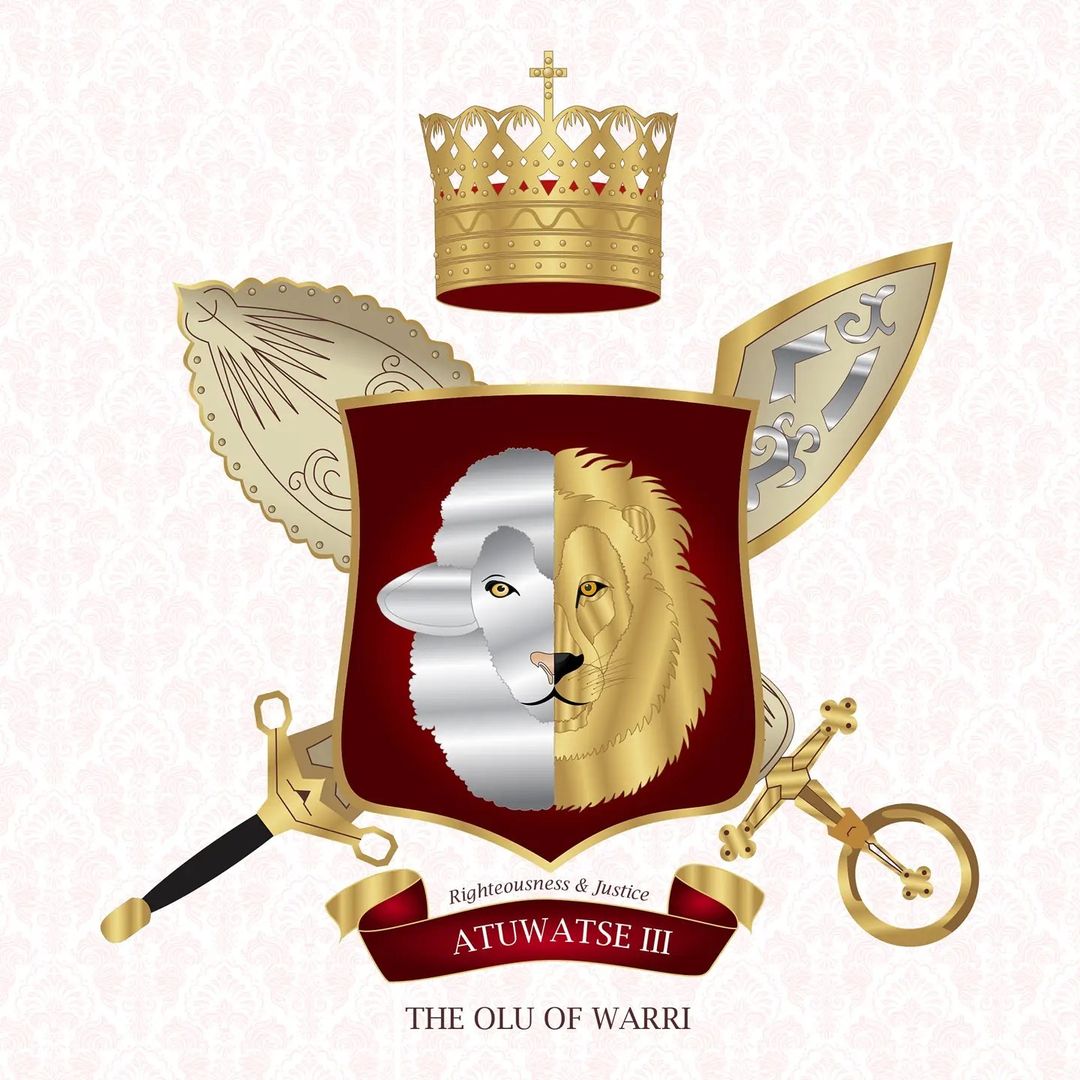
The crowns of Warri tell the kingdom's story in miniature. The original, brought by Ginuwa from the Benin court, was a cone-shaped cap three feet high, covered in coral beads with birds' heads mounted on top -- a form resembling the Yoruba royal crown. Seven Olu monarchs wore it before the Christian kings introduced European alternatives. Lieutenant John King of the Royal Navy, visiting between 1815 and 1820, described seeing the ancient coral crown still in use. In 2021, during a succession dispute over the throne, two princes stole both the Portuguese silver crown and the diamond crown from the royal collection. The coronation of Olu Atuwatse III proceeded anyway. On August 21, 2021, the new Olu introduced replacement crown jewels in silver and pure gold, continuing a tradition that stretches back to a prince who emerged from a wooden box on a river five and a half centuries ago.
From the Air
Located at 5.52°N, 5.75°E in Delta State, Nigeria, on the western edge of the Niger Delta. The city of Warri is visible as a major urban area along the Warri River. The ancestral capital of Ode-Itsekiri lies to the south amid the delta's labyrinth of creeks and waterways. The Benin River and Escravos River -- both central to the kingdom's history -- are visible as major waterways threading through the delta. Nearest airports are Osubi Airstrip (DNSU) on the outskirts of Warri and Benin City Airport (DNBE) approximately 100 kilometers to the north. The delta terrain is flat, low-lying, and laced with rivers and mangrove swamps. Recommended viewing altitude: 3,000-8,000 feet AGL.