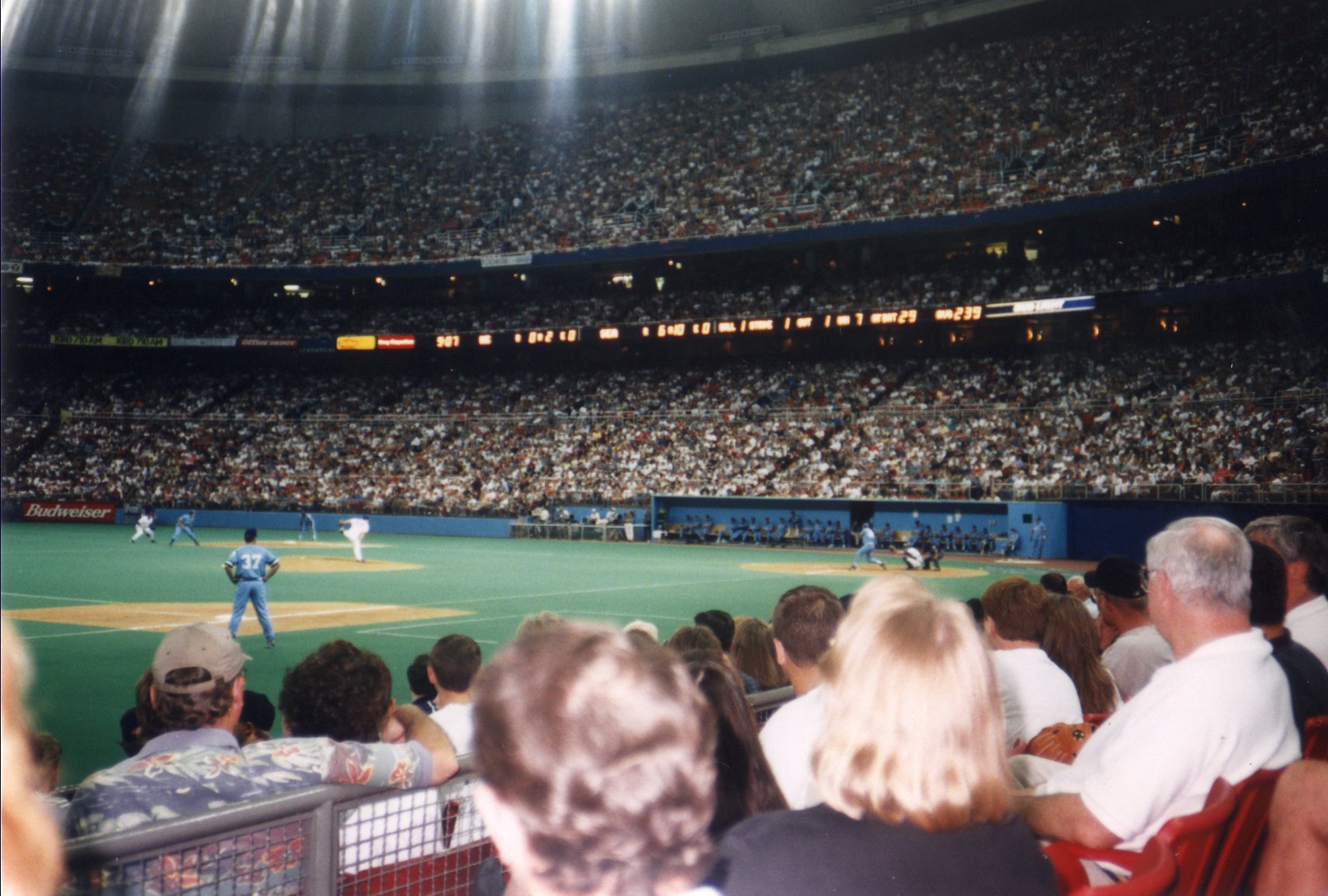
Kingdome
On the morning of March 26, 2000, charges detonated in sequence around the base of a massive concrete dome in Seattle's SoDo neighborhood, and in 16.8 seconds the Kingdome ceased to exist. It was the largest building ever demolished by controlled implosion at the time, generating a dust cloud that rolled across the industrial district like a gray tidal wave. What vanished that morning was more than steel and concrete. It was the arena where 58,120 fans set a North American soccer attendance record, where the Seahawks played their first-ever game, where Ken Griffey Jr. slid home to beat the Yankees in 1995, and where the ceiling once fell in before a baseball game. King County would not finish paying off the bonds that built and repaired the Kingdome until 2015, fifteen years after the building was dust.
A Dome Born from Drizzle
Seattle's rain made a covered stadium feel inevitable. In 1959, restaurateur David L. Cohn wrote to the Seattle City Council arguing the city needed one to attract a major professional sports franchise. Voters disagreed, rejecting funding measures in 1960 and 1966. The 1966 vote was particularly painful: it received 51.5 percent approval but failed to reach the 60 percent supermajority required by a 1932 initiative. Two years later, in February 1968, King County voters finally approved $40 million in bonds for a "King County Multipurpose Stadium." But the site remained contentious. Voters rejected a Seattle Center location in 1970, and the county council ultimately approved a King Street site adjacent to Pioneer Square and the International District, a location that had originally ranked last among candidates. A multiracial coalition led by activist Bob Santos protested at the 1972 groundbreaking, foreseeing the disruption the massive project would bring to the neighboring Chinatown-International District.
The Concrete Crown
Construction stretched four years and came in $20 million over budget. The stadium finally held its opening ceremony on March 27, 1976, and hosted its first professional event two weeks later: an exhibition soccer match between the Seattle Sounders and New York Cosmos that drew a record-breaking 58,120 fans. The NFL had awarded Seattle an expansion franchise in December 1974, and the newly named Seahawks played their first-ever game at the Kingdome on August 1, 1976, a preseason loss to the San Francisco 49ers before 60,825 fans. The Mariners arrived the following year, and the SuperSonics moved in for the 1978-79 season. At its peak, the Kingdome hosted the 1977 Pro Bowl, the 1979 MLB All-Star Game, the 1987 NBA All-Star Game, and three NCAA Final Four tournaments in 1984, 1989, and 1995. The AstroTurf playing surface was so integral to the building's identity that when celebrating Mariners fans ripped off a 40-by-4-inch strip after the 1995 AL West tiebreaker victory, it had to be patched before the next home game.
When the Ceiling Fell
The Kingdome's troubles began overhead. On July 19, 1994, four acoustic ceiling tiles, each weighing about 15 pounds, fell from the roof onto seating areas just hours before a scheduled Mariners game. The game was cancelled, and engineers discovered that moisture infiltration had degraded the adhesive holding thousands of tiles in place. The stadium was closed for months of repairs. The incident crystallized what both the Seahawks and Mariners ownership groups had been arguing: the Kingdome was aging poorly and neither team found its shared tenancy profitable. The Mariners leveraged the crisis into a publicly funded stadium deal approved in 1995, and the Seahawks secured their own package in 1997. Neither team wanted to spend another decade under a roof that had literally started falling apart.
The Loudest Goodbye
The Mariners moved to Safeco Field, now T-Mobile Park, midway through the 1999 season. The Seahawks decamped to Husky Stadium after the 1999 season. On that March morning in 2000, Controlled Demolition, Inc. brought down the Kingdome using 4,461 pounds of explosives placed at the base of the structure. The implosion generated a seismic reading equivalent to a magnitude 2.3 earthquake. Thousands watched from surrounding hillsides and rooftops as the dome folded inward and collapsed into a mountain of rubble. Cleanup and site preparation followed, and the Seahawks' new stadium, now Lumen Field, rose on the same footprint, opening in 2002. The irony was not lost on taxpayers: King County continued making bond payments on a building that no longer existed, finally retiring the debt in 2015. The Kingdome had cost the county money for 47 years, from the 1968 bond vote to the last payment, for a structure that stood only 24 of them.
From the Air
The Kingdome's former site at 47.595N, 122.331W is now occupied by Lumen Field, easily identifiable from the air by its distinctive open roof and the adjacent T-Mobile Park baseball stadium to its south. The twin stadiums sit in Seattle's SoDo district, between the downtown core and the industrial area along the Duwamish Waterway. The railroad yards of King Street Station are immediately to the north. Nearest airports: Boeing Field/King County International (KBFI) 3nm south, Seattle-Tacoma International (KSEA) 10nm south. Renton Municipal (KRNT) 9nm southeast.