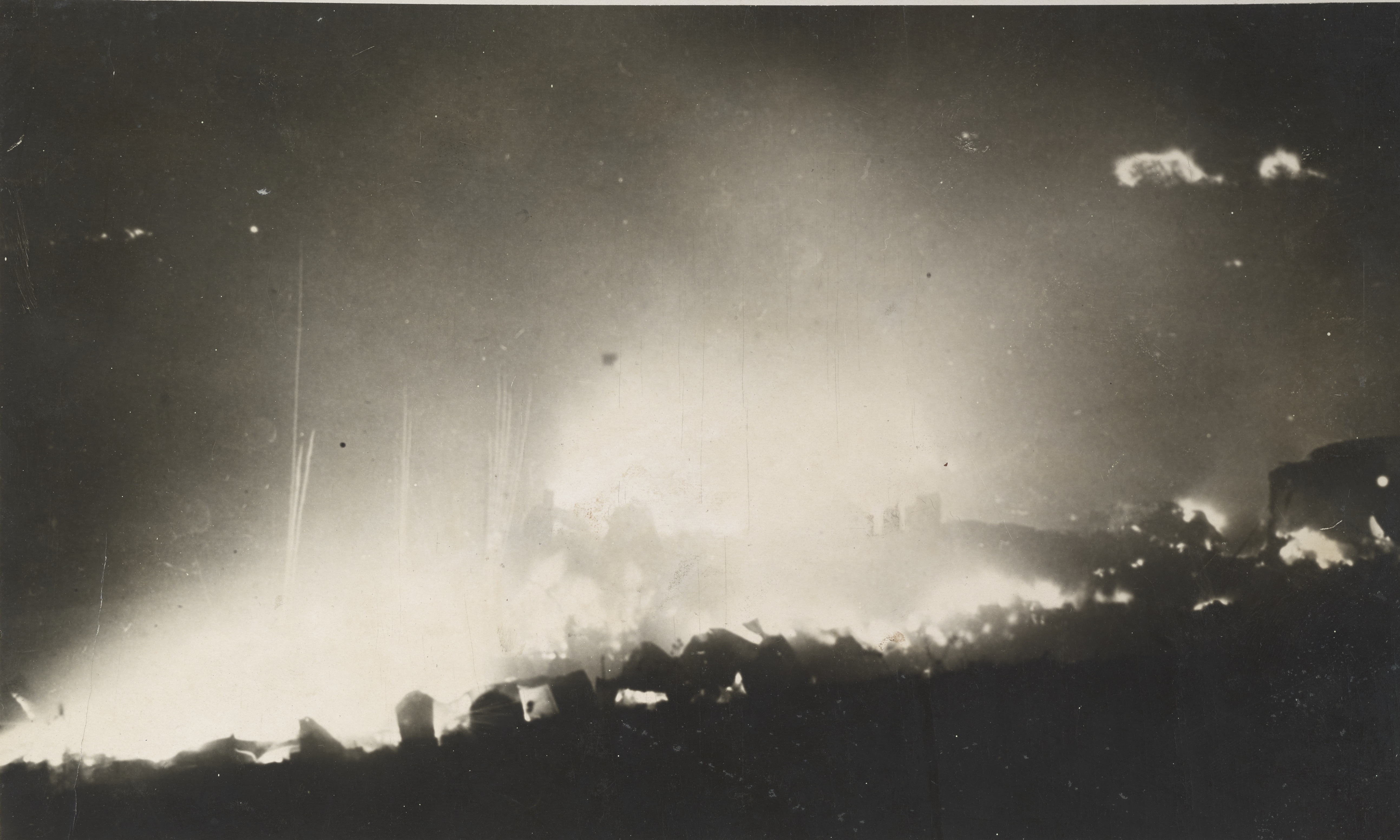
Kingsland Explosion
At the asylum on Snake Hill, nine hundred residents watched the sky light up and believed the world was ending. Dr. James Meehan had a different idea. He rushed to the institution with supplies of ice cream, fruit, and candy, gathered everyone in the lecture hall, and announced that the European War was over -- the explosions they heard were celebratory gunfire. It was January 11, 1917. The war would not end for nearly two more years. But the story he told was kinder than the truth: a few miles away, the Canadian Car and Foundry Company's munitions plant in Kingsland, New Jersey, had just blown itself apart in a chain of explosions so spectacular that office workers in Manhattan pressed against their windows to watch.
Three Million Shells a Month
Though the United States would not enter World War I until April 1917, American factories were already feeding the war machine. The British naval blockade of Germany meant the Allied powers were the only customers, and the Kingsland plant was among the busiest suppliers. Munitions arrived from over one hundred different factories -- shells, shell cases, shrapnel, powder -- to be assembled and shipped to Russia. The facility produced three million shells per month, making it a worthy objective for anyone seeking to disrupt the Allied supply chain. Inside Building 30, forty-eight workers sat at benches cleaning shells with gasoline-soaked cloths wrapped around wooden sticks, rotating each shell in a small belt-driven machine. Pans of gasoline sat on every workbench.
The Man at Workbench Thirty
The fire started at the workbench of Theodore Wozniak in Building 30. How it began was a matter of fierce dispute for decades. According to one account, a network of German saboteurs operated under Frederick Hinsch, who recruited a German national named Curt Thummel -- working under the alias Charles Thorne -- to infiltrate the factory. Thorne was hired as assistant employment manager and used his position to bring in operatives, Wozniak allegedly among them. An arbitration commission in 1931 found no evidence that the fire was caused by a German agent. But the story refused to die, and decades later, Germany paid $50 million to settle claims from both the 1917 Kingsland explosion and the 1916 Black Tom explosion without ever admitting guilt.
A Broadside from a Battleship
The entire plant was destroyed. The spectacle was said to surpass even the Black Tom explosion the previous year, and people across the New York metropolitan area watched the fireballs from office buildings and apartment windows. Two miles of Delaware, Lackawanna, and Western Railroad tracks were torn up by the blasts. At one point, 40,000 commuters were jammed into the Hoboken station in what newspapers described as a "clamoring, close-packed mass." Express trains between New York and Washington were disrupted, and a comical dispute over rights to a diner car broke out among stranded passengers. Dairy and produce shipments to New York City were delayed by twenty-four hours. Trees and telephone poles were cut down by flying shells. Remarkably, no one at the plant was killed in the explosion -- a fact that distinguished Kingsland from the Black Tom disaster, where several people died.
Ice Cream at the End of the World
The institutions on Snake Hill in Secaucus -- an almshouse, a penitentiary, a hospital for contagious diseases, a tuberculosis sanitarium, and a psychiatric hospital -- sat close enough to the blast that residents could see what the warden later described as a massive display of fireworks. As the over nine hundred residents of the psychiatric hospital grew increasingly panicked, the superintendent, Dr. George W. King, and Dr. Meehan improvised. The ice cream, fruit, and candy were props for a performance of reassurance. In the lecture hall, they told the residents that the war in Europe had ended and the explosions were celebrations. It was a lie built on compassion -- an act of quick thinking that reads, a century later, as both resourceful and deeply human.
Fifty Million Dollars of Silence
John J. McCloy launched a reparations case against Germany in 1934. The legal battle dragged on for years, entangled with the parallel claims from the Black Tom explosion. Germany never admitted that its agents had anything to do with the Kingsland fire. But between 1953 and 1979, the German government paid $50 million to settle both cases. The Kingsland site itself has long since been absorbed into the suburban landscape of Lyndhurst. No monument marks where Building 30 stood, where Wozniak sat at his bench, or where three million shells a month passed through the hands of workers cleaning them with gasoline and rags.
From the Air
Located at 40.80N, 74.12W in Lyndhurst, New Jersey, in the Meadowlands area. The former factory site is now part of the suburban development west of the Hackensack River. The New Jersey Meadowlands and their distinctive marshland are clearly visible from altitude. Snake Hill (now Laurel Hill) in Secaucus is a prominent rocky outcrop visible to the east. Nearby airports: Teterboro (KTEB) approximately 3 nm north, Newark Liberty (KEWR) approximately 8 nm south. Best viewed at 2,000-3,000 ft AGL.