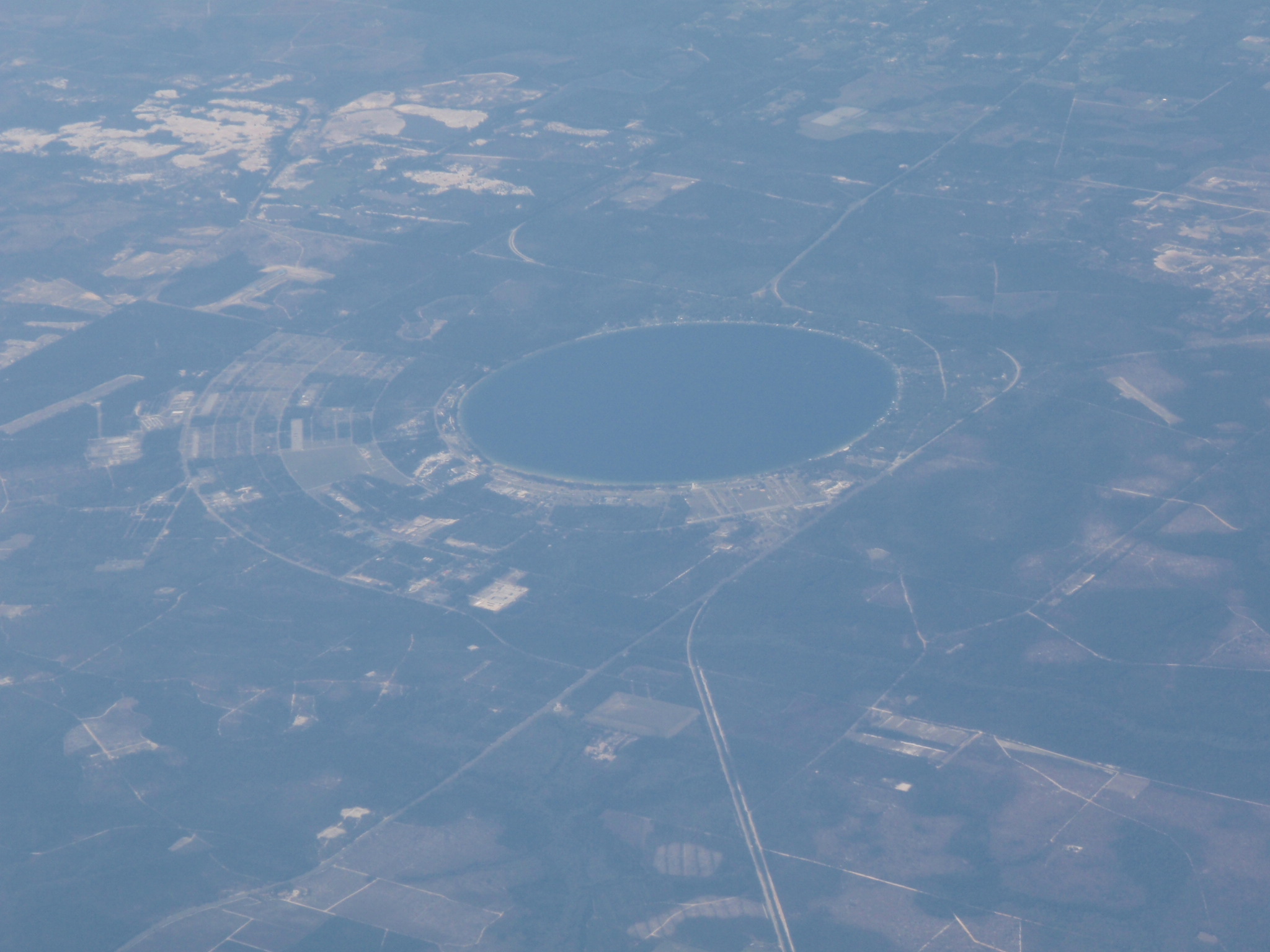
Kingsley Lake
From the air, it looks counterfeit. No natural lake should be this round. Yet there it is in Clay County, northeastern Florida: a disc of dark water so geometrically precise that early aviators nicknamed it the Silver Dollar Lake. Kingsley Lake is not the work of human engineering. It is a sinkhole, one vast dissolution cavity in the limestone bedrock, filled to the brim with some of the clearest freshwater in the state. The lake sits atop Trail Ridge, a Pleistocene-era coastal dune system that ranks among Florida's highest natural elevations, and its uncanny symmetry has puzzled and delighted observers for generations.
A Hole in the Rock
Florida's karst topography is famous for swallowing houses and highways, but Kingsley Lake represents the gentler side of that same geology. Over millennia, slightly acidic rainwater percolated through Trail Ridge's sandy soils and dissolved the calcium carbonate bedrock below, hollowing out a steep-sided basin. The lake's sandy bottom slopes gently along its perimeter before plunging into a central depression. USGS seismic reflection studies confirm the classic solution-collapse structure beneath the lakebed, though the bottom remains largely sealed by sand, cutting it off from the deeper Floridan aquifer. The result is a closed hydrologic system of remarkable stability: monitoring data from 1945 to 1995 recorded only minor water-level fluctuations. The lake is classified as oligotrophic, meaning its nutrient concentrations are so low that algal growth stays minimal, keeping the water startlingly clear.
Twenty-Five Cents to Paradise
For more than half a century, Strickland's Landing was the place to be on a Clay County summer afternoon. Opening on the lake's north shore in 1946, the resort charged a quarter for admission and offered swimming beaches, water slides, boat rentals, bathhouses, and a snack bar. Generations of Jacksonville families made the drive out to Strickland's Landing as a rite of summer, cooling off in the oligotrophic water that stayed clear enough to see your toes at chest depth. By the late 1990s, rising insurance costs and declining attendance had taken their toll, and Strickland's closed for good in 2002. The shuttered resort left behind a quiet shoreline and a deep well of local nostalgia.
Behind the Wire
Half of Kingsley Lake's shoreline belongs to Camp Blanding, a Florida National Guard installation that has occupied the surrounding uplands since 1939. The base serves as the primary training site for the Florida National Guard, hosting Army and Air National Guard units, U.S. Army Reserve, ROTC cadets, and allied military missions. Specialized programs range from air assault courses to counterdrug operations and joint interagency exercises. The military presence means public access to the lake is severely limited: the remaining shoreline consists of private residential properties dotted with roughly 180 private docks. That restricted access has proved to be the lake's greatest protection, sparing it the overdevelopment and nutrient pollution that plague so many Florida waters.
A Refuge by Accident
The same fences that keep the public out have kept ecological damage at bay. Kingsley Lake's watershed harbors an impressive roster of wildlife. Alligators patrol the shallows. Ospreys, herons, egrets, and kingfishers work the surface. Upland areas support gopher tortoises, eastern indigo snakes, red-cockaded woodpeckers, and Florida black bears. Perhaps most notably, nearby tributaries provide designated critical habitat for the federally protected Black Creek crayfish, a species so sensitive to water quality degradation that its very presence serves as a biological barometer for the health of the watershed. The Timucuan-speaking people who inhabited this basin long before European contact understood the value of the lake's clean, reliable water. The name Kingsley, ironically, comes from a far less noble association: Zephaniah Kingsley, an English-born slave trader and planter active in early 19th-century Florida.
From the Air
Kingsley Lake is centered at 29.965N, 81.998W in Clay County, Florida. Its nearly perfect circular shape makes it unmistakable from the air at any altitude. The lake sits atop Trail Ridge at one of Florida's higher natural elevations. Camp Blanding Joint Training Center occupies the surrounding land, so look for military facilities along the southern and western shores. Nearest airports include Keystone Airpark (42J) approximately 5 nm to the northwest and Jacksonville Executive at Craig Airport (KCRG) about 25 nm to the east. Best viewed at 2,000-4,000 ft AGL to appreciate the remarkable circular geometry.