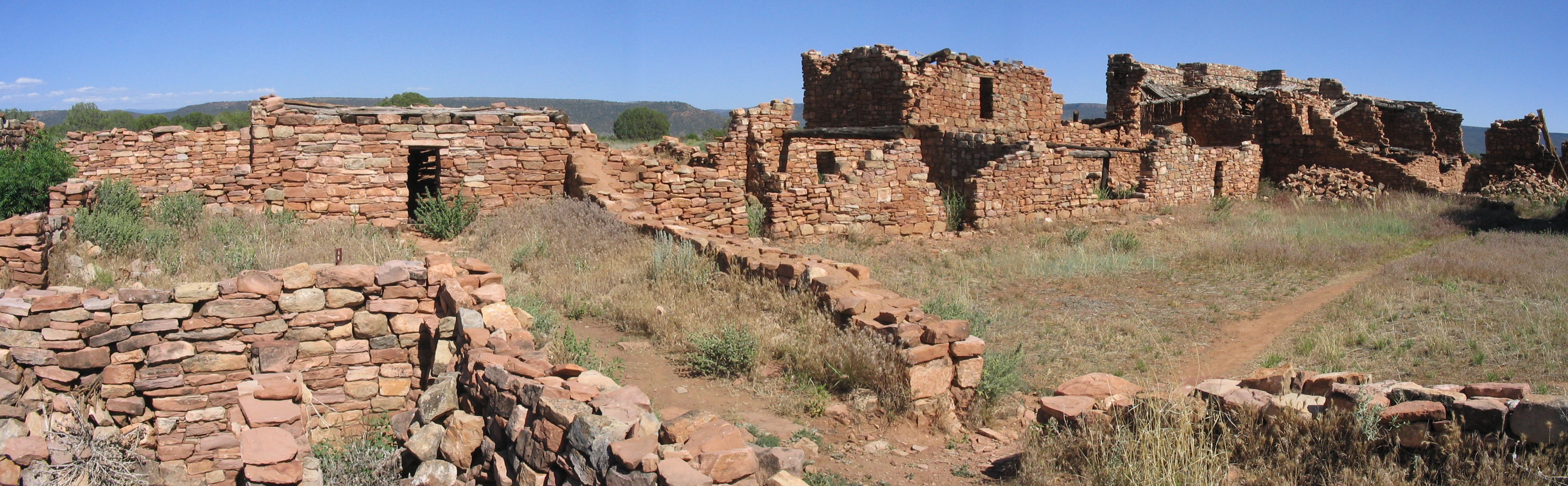
Kinishba Ruins
Six hundred rooms, and not a single occupant for over six centuries. Kinishba Ruins sits at the eastern foot of Tse Sizin -- "Rock Standing Up" in the Apache language -- a massive stone complex that once housed a thriving community south of the Mogollon Rim. What makes Kinishba remarkable is not just its scale but its identity crisis: archaeologists cannot neatly assign it to one culture. The great house carries the fingerprints of both the Mogollon and Ancestral Puebloan peoples, placing it at a rare cultural crossroads that links the ancestry of both the Hopi and Zuni nations. Today, the White Mountain Apache Tribe administers these ruins on the Fort Apache Indian Reservation, near their community of Canyon Day, preserving a place that predates their own arrival by centuries.
Where Two Worlds Met
Built and occupied from the 12th to the 14th centuries, Kinishba emerged during an ancient population boom across the Mogollon Rim region. The great house rose in a lush valley within the Mt. Baldy watershed, positioned between the Mogollon Rim to the north and the Salt River to the south. The people who built it drew from two distinct cultural traditions -- the Mogollon, native to the mountainous terrain, and the Ancestral Puebloan (once called Anasazi), whose influence stretched south from the Colorado Plateau. This blending produced what archaeologists classify as the western Pueblo complex, making Kinishba one of roughly 20 large pueblo sites in the Fort Apache area, each containing 150 rooms or more. But Kinishba, with its 600 rooms, dwarfed most of its neighbors.
Rediscovery and Ruin
Long known to the Apache people of the region and allegedly visited by Spanish Conquistadors centuries ago, Kinishba first entered the English-language record in 1892 when pioneering archaeologist Adolph Bandelier described the site. It was Byron Cummings, a University of Arizona professor sometimes called the "Dean of Southwest Archaeology," who excavated the ruins in the 1930s, recovering pottery and artifacts that helped establish Kinishba's cultural significance. Cummings envisioned the site as a monument to Native civilization. In 1964, the Department of the Interior designated Kinishba a National Historic Landmark and placed it on the National Register of Historic Places. But designation did not guarantee preservation. For decades after, the ruins deteriorated. The museum Cummings had helped establish fell into disrepair alongside the ancient walls themselves.
A Slow Rescue
It was not until 2005 that a partial restoration effort began, stabilizing much of the site over two years. The White Mountain Apache Tribe and the Fort Apache Heritage Foundation now administer the complex as a satellite element of the Fort Apache Historic Park, which encompasses a National Historic District containing 27 buildings from the U.S. Army's era during the Apache Wars. The reservation holds structures spanning from ancient to contemporary times, and the tribe has worked to explain the full arc of history in this corner of Arizona -- from the Mogollon Rim Pueblo builders who raised Kinishba's walls, to the White Mountain Apache who have called this land home for generations. It is a place where the deep past and the living present occupy the same ground.
Standing on Layered Ground
Approaching Kinishba from above, the alluvial valley spreads out below pine-fringed ridgelines, the ruins visible as geometric patterns against the natural landscape. The site sits on White Mountain Apache trust lands, a reminder that these ruins are not just an archaeological curiosity but part of a living cultural landscape. The tribe has embraced stewardship of Kinishba not as custodians of someone else's past but as guardians of a place woven into the broader tapestry of Southwestern peoples. For the Hopi and Zuni, Kinishba represents ancestral ground. For the Apache, it is part of the homeland they protect. The 600 rooms may be empty, but the site carries the weight of overlapping histories that few places in the American Southwest can match.
From the Air
Kinishba Ruins is located at 33.815N, 110.054W in eastern Arizona, south of the Mogollon Rim on the Fort Apache Indian Reservation. The site sits in a pine-fringed alluvial valley at the foot of Tse Sizin (Sawtooth Mountain). Recommended viewing altitude is 3,000-5,000 feet AGL for valley context. The nearest airport is Whiteriver (KWHR/E24), approximately 5 nm east. Be aware of mountainous terrain and variable weather conditions along the Mogollon Rim. The ruins appear as geometric stone patterns in the valley floor, best visible in low-angle light.