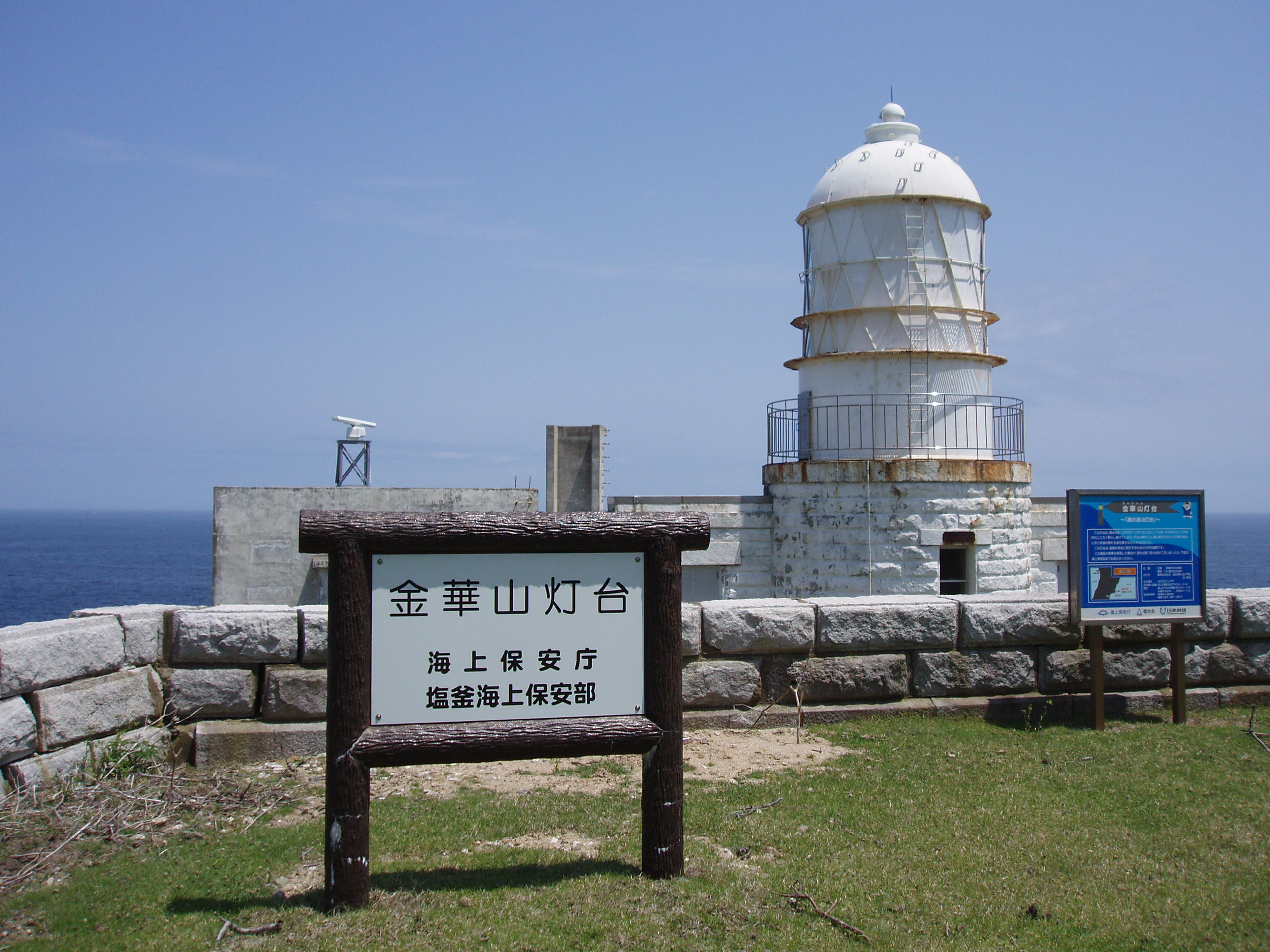
Kinkasan Lighthouse
Richard Henry Brunton had never built a lighthouse in his life when the Japanese government hired him in 1868. A Scottish civil engineer recommended by the famous Stevenson lighthouse family, Brunton learned of the Tokugawa shogunate's fall while his ship was docked at Aden -- and decided to continue on anyway, reasoning that the new Meiji government was still bound by its predecessor's international commitments. Over the next seven and a half years, he designed and built 26 lighthouses across Japan, essentially creating the nation's maritime safety infrastructure from scratch. The Kinkasan Lighthouse, perched on a sacred island off the Oshika Peninsula, was among the last of his designs -- and one he never saw completed.
The Father of Japanese Lighthouses
Brunton arrived in Japan at a hinge point in history. The Meiji Restoration was remaking every institution in the country, and Japan's new leaders understood that modernizing their coasts meant opening to international trade. Brunton was one of many o-yatoi gaikokujin -- hired foreign experts -- brought in to accelerate the transformation. Beyond his 26 lighthouses, he surveyed and drew the first detailed maps of Yokohama, planned its sewage system and street paving, introduced gas lighting, built the settlement's first iron bridge, and helped establish Japan's first school of civil engineering. Emperor Meiji received him in a personal audience in 1871. Work on the Kinkasan Lighthouse began in March 1874, but Brunton departed Japan before it was finished. The light was completed and first lit on November 1, 1876, eight months after the man who designed it sailed home to Scotland.
Sacred Ground, Practical Light
Kinkasan Island is no ordinary piece of rock. Lying just 700 meters off the tip of the Oshika Peninsula in Ishinomaki, Miyagi Prefecture, the island is considered one of the three holiest places in the Tohoku region. A Shinto shrine has stood here since 750 AD, established to celebrate the discovery of Japan's first gold in the nearby hills. Some 450 deer roam the island freely, regarded as divine messengers by the shrine's priests. An annual antler-cutting ceremony each October keeps the male deer safe for visitors, and the shrine turns the cuttings into charms and talismans. Into this ancient, sacred landscape, Brunton inserted a piece of Victorian engineering -- a Western-style lighthouse built to guide merchant vessels through the treacherous waters where the Oshika Peninsula meets the open Pacific.
Destroyed and Reborn
The lighthouse stood for nearly seven decades before war found it. Between July and August 1945, during the final months of World War II, the United States Navy destroyed the Kinkasan Lighthouse. The strategic logic was straightforward: Japan's coastal navigation aids were military assets, and eliminating them hampered the movement of naval vessels and supply ships. But the destruction was short-lived. By February 1946 -- barely six months after Japan's surrender -- the lighthouse had been rebuilt. The speed of reconstruction speaks to how essential the light was for safe navigation along this stretch of coast, where currents, fog, and rocky shorelines make the waters around the Oshika Peninsula dangerous for shipping.
A Light That Outlasted Its Keepers
For over a century, lighthouse keepers maintained the Kinkasan light, living on an island accessible only by a 20-minute boat ride from Ayukawa Port. On April 1, 2005, the lighthouse was fully automated, ending the human presence that had kept the beam burning through typhoons, earthquakes, and war. The automation was part of a broader trend across Japan, where one lighthouse after another has traded human keepers for electronic sensors. Today the Kinkasan Lighthouse continues to flash its signal across the Pacific approaches, a beacon that has survived destruction, reconstruction, and the quiet retirement of the last hands that once tended its flame. From the air, the white tower is visible against the dark green forest of the island -- a small, bright punctuation mark on a coastline shaped by geology, faith, and the restless sea.
From the Air
Located at 38.28N, 141.58E on the southeastern tip of Kinkasan Island, off the Oshika Peninsula in Miyagi Prefecture. The white lighthouse tower is visible against the island's dense forest canopy. Kinkasan Island itself is a prominent landmark -- a roughly circular island with a mountainous interior rising from the sea. The Oshika Peninsula extends southeast from the mainland like a crooked finger, with the island sitting just off its tip. Nearest airports: JASDF Matsushima Air Base (RJST) approximately 25nm west-northwest, Sendai Airport (RJSS) approximately 50nm southwest. The waters around the island are subject to strong currents and frequent fog, especially in spring and early summer.