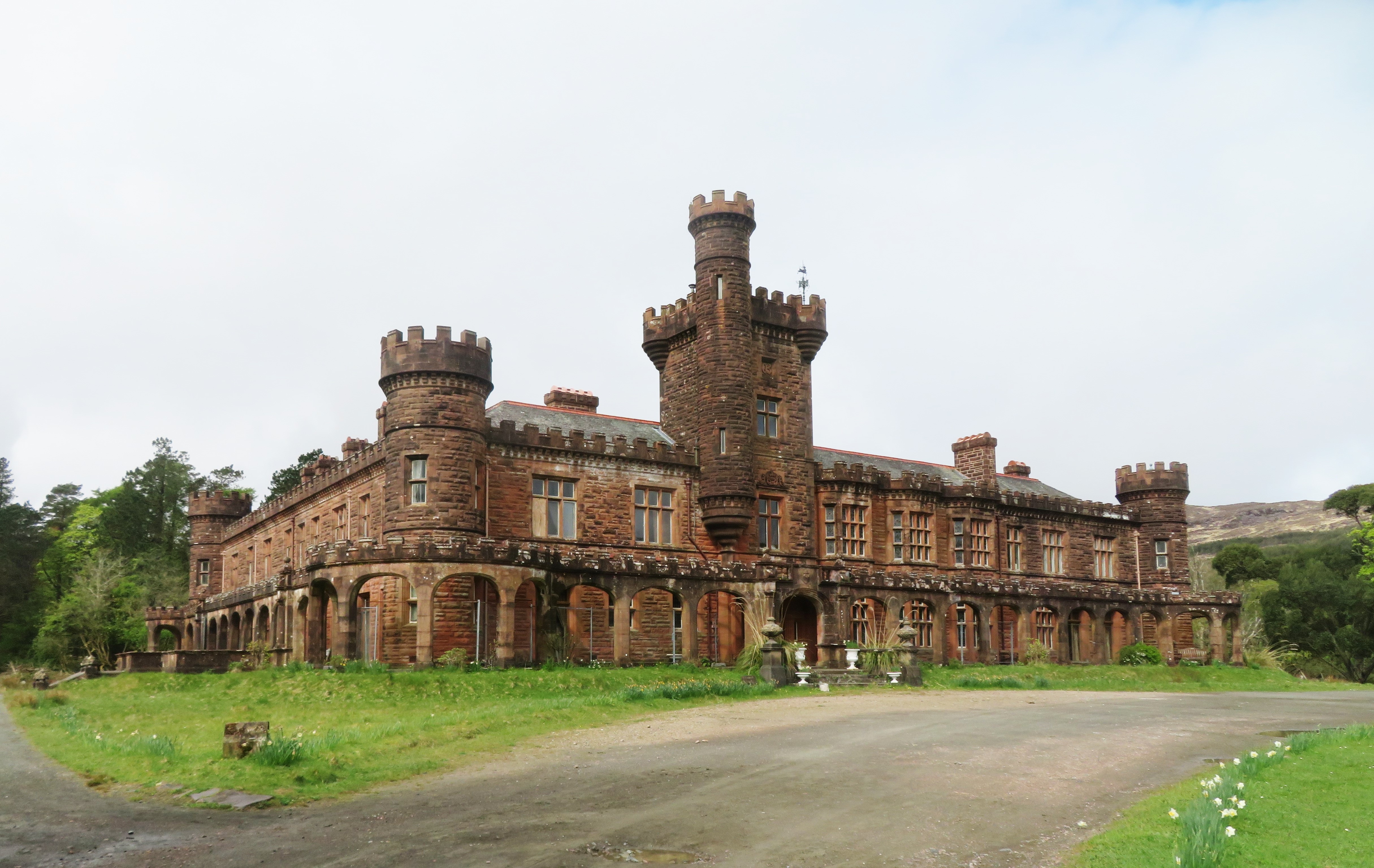
Kinloch Castle
The alligators did not last long in the Hebrides. Neither, in the end, did the lifestyle they represented. Kinloch Castle on the island of Rum is a monument to Edwardian excess planted on a landscape of extraordinary natural beauty -- a castellated Tudor mansion built from red sandstone imported from Dumfries and Galloway, set in gardens landscaped with topsoil shipped from Ayrshire, on an island whose entire human population had been cleared off it seventy years earlier to make room for sheep. Sir George Bullough, the Lancashire textile tycoon who built it, spent a quarter of a million pounds -- a sum almost incomprehensible in 1900 -- to create a private playground that included a Japanese garden, a bowling green, a golf course, heated glasshouses that briefly housed alligators, and an orchestrion hidden under the main staircase.
An Island Emptied
Rum's tragedy preceded its palace. In the early 19th century, the island was owned by Alexander Maclean of Coll. During the Napoleonic Wars, Hebridean kelp was a valuable commodity, used to produce soda ash for explosives. When the wars ended and kelp prices collapsed, Maclean leased the island for sheep farming. The entire population -- 443 people recorded in 1795 -- was cleared by 1828. New tenants were brought in from Skye and Muck to service the sheep farm, but Rum had been hollowed out. In 1888, John Bullough, a Lancashire textile magnate, bought the island as a sporting estate. His son George inherited it and commissioned the London architects Leeming and Leeming to design a new house. Construction began in 1897, employing 300 men from the neighbouring island of Eigg and from Lancashire. Kinloch Castle was completed in 1900 with its own electricity supply, modern plumbing, central heating, and a telephone system -- luxuries that most of the Scottish mainland could not yet claim.
Orchestrions and Emperors
The interior of Kinloch Castle was designed to impress visitors accustomed to the grandest country houses in England. The entrance hall displayed gifts from the Emperor of Japan. An orchestrion -- a mechanical instrument capable of reproducing the sound of an entire orchestra -- was installed beneath the main staircase. Four-poster beds furnished the guest rooms. The gardens outside were laid out formally and informally between 1900 and 1912, with a water garden, Japanese garden, and walled garden complete with glasshouses. During the Boer War, Bullough lent his yacht Rhouma as a hospital ship, bringing wounded soldiers back to Kinloch Castle for recuperation. For this service he was knighted in 1901. But the castle's golden age was brief. The social world that sustained such extravagance -- the Edwardian smart set, the sporting estate culture, the assumption that wealth conferred the right to empty an island and fill it with gardens -- was already beginning to fracture.
A Castle Looking for a Purpose
The island was eventually purchased by the Nature Conservancy, a government agency, for 23,000 pounds -- a fraction of what the castle alone had cost to build. Rum became a National Nature Reserve, and Kinloch Castle passed into public ownership. Scottish Natural Heritage, later renamed NatureScot, operated part of the building as a hostel until 2015, offering guests a choice between bunk rooms and a handful of Oak Rooms with four-poster beds. Tours continued, timed to coincide with the ferry from Mallaig. But the castle's long-term future has remained uncertain for decades. Proposals for an eight-million-pound restoration did not progress. In 2022, a businessman announced plans to purchase and restore the building, only to withdraw after the Scottish government paused the sale over community concerns. In 2025, NatureScot put the castle back on the market with an asking price of 750,000 pounds. The Scottish nature writer Jim Crumley called Kinloch Castle "a monument to colossal wealth and ego and acquisitive greed" and suggested demolition. Others see it differently -- as an irreplaceable time capsule of Edwardian Highland life, its social significance lying precisely in what it reveals about the relationship between wealth, land, and power in Scotland. The orchestrion still sits under the stairs. The alligators are long gone.
From the Air
Kinloch Castle sits at 57.014N, 6.282W on the island of Rum (Rhum), one of the Small Isles in the Inner Hebrides. The castle is located at Kinloch, at the head of Loch Scresort on the island's east coast. The Rum Cuillin mountains rise to the south and west, with Askival (812 m) the highest peak. Nearest airfield is Oban Airport (EGEO), approximately 50 nm south. The ferry from Mallaig serves the island. The neighbouring islands of Eigg, Muck, and Canna are visible from altitude.