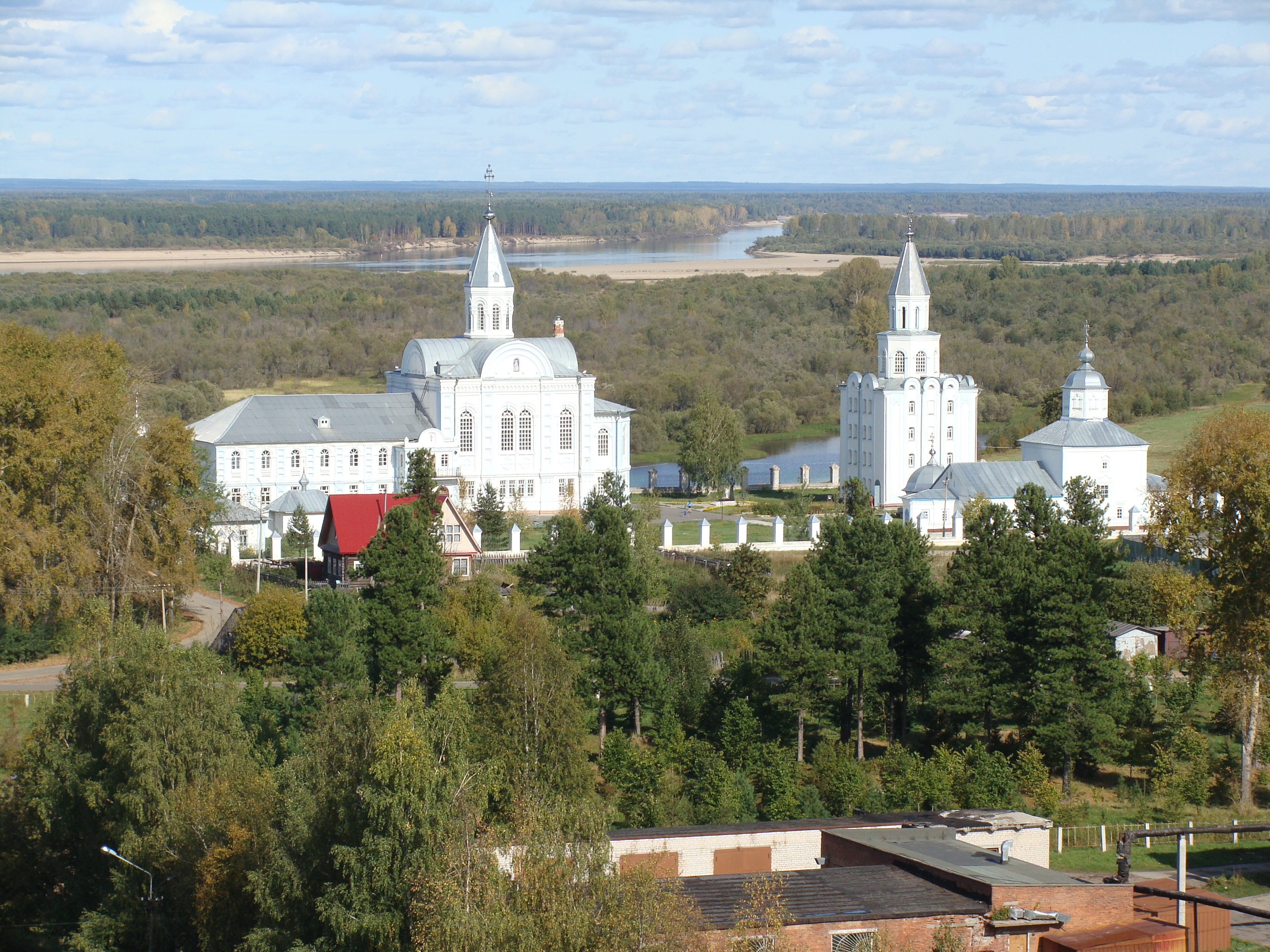
Kirillo-Belozersky Monastery
In 1397, a monk from one of Moscow's most powerful aristocratic families walked away from the greatest monastery in the capital, traveled north into the forests beyond the Volga, and dug a cave on the shore of Lake Siverskoye. His name was Kirill -- Cyril in English -- and he belonged to the Velyaminov clan of boyars. He had been father superior of the Simonov monastery in Moscow, the most prestigious cloister in the city. His teacher, the revered Sergius of Radonezh, had advised him to go north. He built a wooden chapel dedicated to the Dormition of the Theotokos, then a loghouse for the monks who followed. From that cave and chapel grew one of the largest monasteries in Russia.
A Strategic Foothold in the Northern Wilderness
The monastery's rapid growth was not accidental. Kirill's aristocratic connections meant that the Muscovite rulers saw his foundation as more than a spiritual retreat -- it was a strategic point for controlling northern trade routes and contesting the power of the Novgorod Republic. By the time Kirill died in 1427, the prince of Belozersk-Mozhaisk was the monastery's patron. Under Hegumen Trifon, who led the community from roughly 1435 to 1448, the monastery adopted an Athonite cenobitic rule and established a Byzantine-style secondary school. Translations of textbooks on grammar, semantics, geography, and history were used in instruction. The school produced scholars of lasting importance: the elder Yefrosin pioneered bibliographical studies, while Nil Sorsky -- who lived from 1433 to 1508 -- became one of Russia's most significant monastic thinkers and founded a skete on the nearby Sora River.
Wealth, Power, and the Tsar's Own Cell
By the sixteenth century, the Kirillo-Belozersky Monastery had become the second-richest landowner in all of Russia, surpassed only by the Trinity Monastery near Moscow -- the very institution it took as its model. Ivan the Terrible maintained a personal cell within the cloister and planned to take monastic vows there, a measure of the monastery's prestige that no amount of wealth statistics can convey. When a tsar reserves a room for himself in your monastery, you have become something more than a religious institution. You have become an extension of state power, a place where the boundaries between devotion and politics dissolve into the incense-heavy air of the dormition chapel.
A Prison of Uncommon Distinction
The monastery's thick walls and remote location made it an ideal political prison, and the Muscovite state used it as one for centuries. The roster of exiles sent to Kirillov reads like a catalog of Russian power struggles. Vassian Patrikeyev, the influential boyar and monastic reformer, was confined here. Tsar Simeon Bekbulatovich -- the Tatar prince whom Ivan the Terrible briefly installed as a puppet grand prince -- ended his days within these walls. Patriarch Nikon, whose religious reforms split the Russian Orthodox Church, was imprisoned here after his fall from power. Boris Morozov, effectively the prime minister under the young Tsar Alexei, was exiled to the monastery following popular uprisings against his policies. Each prisoner added another layer to the complex story of a place that served simultaneously as sanctuary and cage.
Fortress, Museum, and Living Monastery
In the fifteenth to seventeenth centuries, the Kirillo-Belozersky Monastery was not merely a wealthy religious house but one of the most heavily fortified structures in the Russian North. Its walls and towers were built to withstand siege, and its position on the shore of Lake Siverskoye gave it a natural defensive advantage. The monastery's ensemble has been designated a cultural heritage monument of federal significance. Monks were readmitted into the Ivanovsky priory in 1998, restoring monastic life after decades of Soviet-era closure. As of 2011, it was one of only four functioning monasteries in Vologda Oblast. The town of Kirillov, which grew from the settlement that formed around the monastery walls, exists because Kirill dug his cave here six centuries ago -- a reminder that in the Russian North, it was often monks, not merchants or soldiers, who founded cities.
From the Air
Located at 59.86N, 38.37E on the shore of Lake Siverskoye, near the town of Kirillov in Vologda Oblast. The monastery complex is a large, walled compound visible from the air as a distinctive cluster of buildings and fortifications on the lakeshore. Nearest airports include Cherepovets (ULWC), approximately 100 km to the south. At 3,000-5,000 feet, the monastery, the lake, and the surrounding forested landscape create a striking visual composition. The nearby Ferapontov Monastery, another UNESCO-related site, is approximately 20 km to the northeast.