Kirindy Forest
In Malagasy, kirindy means "dense forest with wild animals." The name still fits, though the density is under siege. Fifty kilometers northeast of the coastal town of Morondava, a private nature reserve protects one of the largest remaining tracts of dry deciduous forest on Madagascar's western plain. Fossas -- the island's apex predator, a sleek, muscular carnivore that looks like a cross between a cat and a mongoose -- hunt lemurs through the canopy here. Three species of baobab grow in the same forest. And the whole system shuts down for half the year, as trees shed their leaves and the landscape turns skeletal under the dry-season sun.
Two Seasons, Two Forests
Kirindy's climate divides the year sharply. From roughly April through November, the dry season strips the deciduous trees bare, temperatures can reach 40 degrees Celsius, and the forest floor crackles underfoot. When the rains arrive between December and March, the landscape transforms: leaves return, streams flow, and access roads turn to mud that can strand vehicles for days. Average annual rainfall is about 800 millimeters, nearly all of it concentrated in those few wet months. The forest sits within the boundaries of Kirindy Mitea National Park, which extends further south, but the private reserve -- sometimes called Kirindy Nord -- operates under its own management. Before it carried the Malagasy name, the area was known as la foret des Suisses, the Swiss people's forest, after the Swiss company that owned the land and initially ran it as a sustainable timber harvesting experiment.
The Fossa's Kingdom
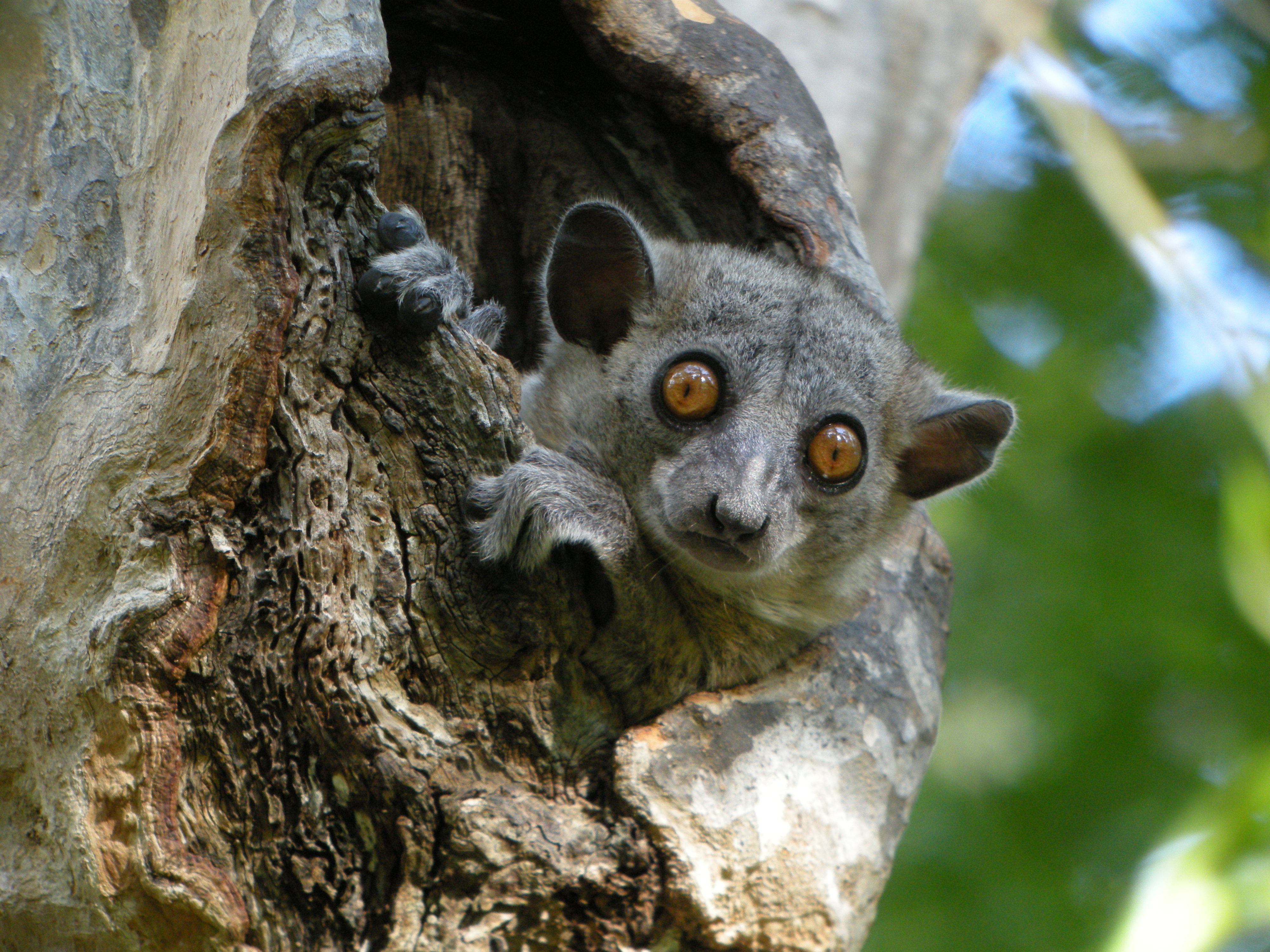
Madagascar separated from Africa roughly 160 million years ago and from India about 88 million years ago, leaving its wildlife to evolve in isolation. The fossa is the result: the island's only large predator, filling the ecological role that cats, wolves, and bears occupy on other continents. At Kirindy, fossas are seen more reliably than almost anywhere else in Madagascar. They hunt by day and night, moving through the canopy with a fluidity that belies their size -- adults can weigh up to 8.6 kilograms. Their primary prey is lemurs, and the primates know it: red-fronted lemurs, Verreaux's sifakas, fat-tailed dwarf lemurs, and red-tailed sportive lemurs all keep watch for the silhouette slipping through branches. The forest also harbors the Malagasy giant jumping rat, a rabbit-sized nocturnal rodent found nowhere else, along with narrow-striped mongooses, common tenrecs, and greater hedgehog tenrecs.
Baobabs Three Ways
Three of Madagascar's six endemic baobab species grow in and around Kirindy. Grandidier's baobab, Adansonia grandidieri, is the largest, reaching 30 meters with a massive, bottle-shaped trunk -- the same species that lines the famous Avenue of the Baobabs on the road from Morondava. Adansonia za is a tall, more slender species that ranges from 20 to 30 meters. The fony baobab, Adansonia rubrostipa, is smaller and more gnarled, its trunk often swollen and irregular. All three produce fruit rich in vitamin C that ripens toward the end of the dry season. Lemurs eat it. Locals eat it and feed it to livestock. The seeds can be sold in the southern city of Toliara. Beneath and between the baobabs, the forest includes spiny palms, Alluaudia, and euphorbs -- plants that give Madagascar's dry forests their otherworldly, succulent character.
A Forest Losing Ground
Between 1970 and 2000, more than 30 percent of Madagascar's spiny forest disappeared. Dry forests fared slightly better but still lost ground at a rate of 0.42 percent per year between 2000 and 2005. In Central Menabe, the region surrounding Kirindy, more than 40,000 hectares of land have been converted to rice fields in the last two decades, often granted to outside investors and Malagasy elites while local communities were marginalized. Illegal corn farming has further encroached on protected land. Kirindy's private reserve status offers some protection, but the forest exists as an island within a shrinking landscape. No active reforestation programs are underway -- what regrowth occurs is natural and slow. The 700 kilometers between Kirindy and the capital, Antananarivo, mean that enforcement is sporadic and attention from national authorities is intermittent. The dense forest with wild animals survives, for now, because enough people care to keep it standing.
From the Air
Located at 20.07S, 44.63E in western Madagascar, approximately 50 km northeast of Morondava. From altitude, the forest appears as a darker patch of woodland surrounded by lighter agricultural land and scrub. The contrast between the intact forest and the cleared areas around it is visible from cruising altitude. Morondava airport (FMNR) is the nearest airstrip. The unpaved road from Morondava passes through the Avenue of the Baobabs before continuing northeast toward the reserve. The Kirindy Mitea National Park extends to the south. The Tsiribihina River system lies to the north.