Kiriyama Castle: The Mountain Fortress That Held for 240 Years
For 240 years, nobody could take Kiriyama Castle. Perched on two mountain ridges in the rugged interior of Ise Province, the fortress commanded a view of the Tage Plain from an elevation of 560 meters, its earthworks and dry moats carved into the granite spine of the ridgeline. The Kitabatake clan built it in 1342, not out of ambition, but out of desperation -- their flatland castles had fallen one after another, and clan leader Kitabatake Akiyoshi needed a stronghold that could survive a long siege. He chose well. Kiriyama Castle sheltered rebel princes, hosted shogunal pilgrimages, and anchored a castle town of 3,500 buildings. It finally fell only when the most ruthless warlord of the Sengoku period, Oda Nobunaga, turned his armies against it.
A Clan Between Two Courts
The Kitabatake were a cadet branch of the ancient Minamoto clan, and their story is inseparable from one of Japan's most turbulent eras. During the Nanboku-cho period -- the wars between the Northern and Southern Imperial Courts that tore apart 14th-century Japan -- the Kitabatake served the Southern Court. They governed Ise Province as kokushi, a rank that made them the imperial administrators of a strategically vital region connecting Yamato Province to the Ise Plain, with access to both Kyoto and the sea. When the Southern Court's military fortunes faltered at the 1348 Battle of Shijonawate, it was Kitabatake Akiyoshi who sortied 500 cavalry from Kiriyama Castle and drove Ashikaga forces out of Yoshino, demonstrating the castle's value as more than a refuge. It was a launching pad. Akiyoshi lived out his final years at the fortified residence below the castle, the Tage Yakata, dying there in 1383.
Poets and Shoguns at the Gate
Not every visitor to Kiriyama Castle came with an army. After the Kitabatake reached an accord with the Ashikaga shogunate following the nominal end of the court conflict in 1392, the fortress took on a different character. In April 1484, Shogun Ashikaga Yoshihisa stayed at the castle during a pilgrimage to the Ise Grand Shrine -- a remarkable honor that reflected the Kitabatake's political stature. The castle burned in 1499 but was rebuilt within seven years, a testament to its strategic importance. In July 1522, the renga poet Socho spent several days at Kiriyama Castle and composed poems inspired by its mountain setting. The castle town below, sheltering 700 to 1,000 vassals in roughly 3,500 buildings, was no mere military outpost. It was a center of culture and governance, a small capital nested in the mountains where samurai administration and aristocratic refinement coexisted.
The Fall of the Mountain
The end came through betrayal as much as battle. When Oda Nobunaga invaded northern Ise Province in 1569, clan leader Kitabatake Tomonori fell back to his secondary fortress, Okawachi Castle. After inconclusive fighting, the two sides negotiated a peace sealed by marriage: Kitabatake Tomofusa would adopt Nobunaga's son, Oda Nobukatsu, in 1570. It was a poisoned gift. In 1575, Nobukatsu deposed and killed his adoptive father-in-law, seized full control of the Kitabatake clan, and turned its own apparatus against the survivors. His forces attacked the Tage Yakata in 1576, destroying the fortified residence at the base of the mountain. The remaining Kitabatake loyalists retreated to Kiriyama Castle for a final stand, but the fortress that had held for nearly two and a half centuries could not withstand the concentrated might of Nobunaga's war machine. The castle was taken and destroyed.
Ridgelines and Ruins
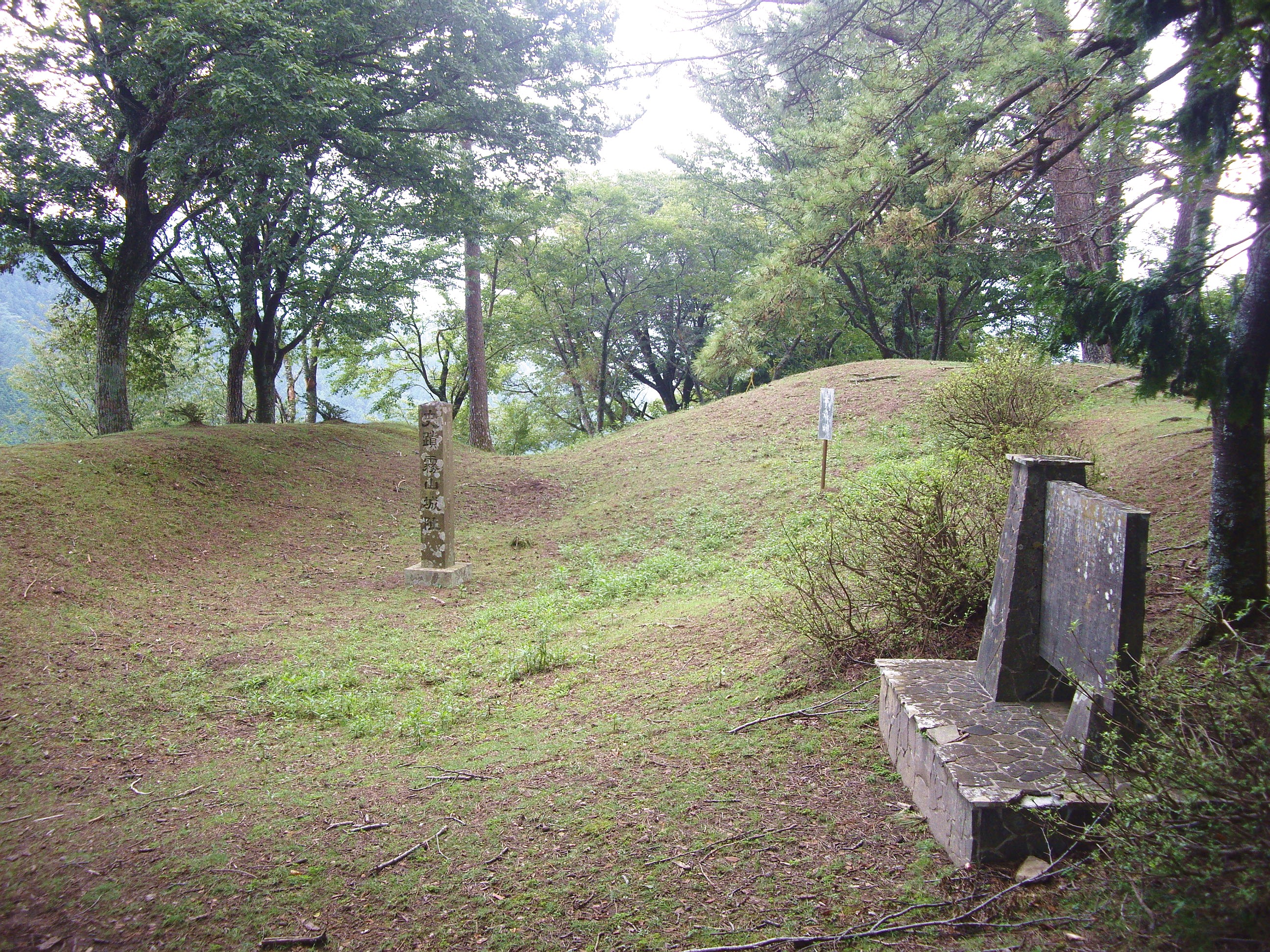
Today, Kiriyama Castle's twin ridgelines -- each about 120 meters long and 30 meters wide -- are silent and forested. The southwestern ridge, higher in elevation, served as the castle's core and once held a bell tower. Both ridges bear the outlines of kuruwa, the smaller defensive enclosures typical of yamashiro mountain castle construction. The ruins were designated a National Historic Site in 1936, and in 2006 they were consolidated with the Tage Yakata site and its surviving garden under the unified designation 'Tage Kitabatakeshi Jokan ato,' encompassing nearly 269,000 square meters. In 2017, the complex was named to the Continued Top 100 Japanese Castles list. Excavations have revealed foundations, earthworks, and the faint traces of the castle town that once sprawled across the valley. The mountains still guard the approach, and the site still feels like what Kitabatake Akiyoshi intended: a place where the terrain itself forms the first line of defense.
From the Air
Located at 34.523°N, 136.289°E in the mountainous Misugi area of Tsu, Mie Prefecture, deep in the interior of the Kii Peninsula. The castle ruins sit at 560 meters elevation on forested ridgelines, roughly 240 meters above the Tage Plain. The terrain is rugged and heavily wooded -- look for the narrow Tage valley cutting through the mountains. The nearest major airport is Chubu Centrair International Airport (RJGG), approximately 100 km to the northeast. Osaka Itami Airport (RJOO) lies roughly 90 km to the northwest. Best viewed at 4,000-6,000 feet AGL; the mountain ridgelines and cleared valley floor are the primary visual references.