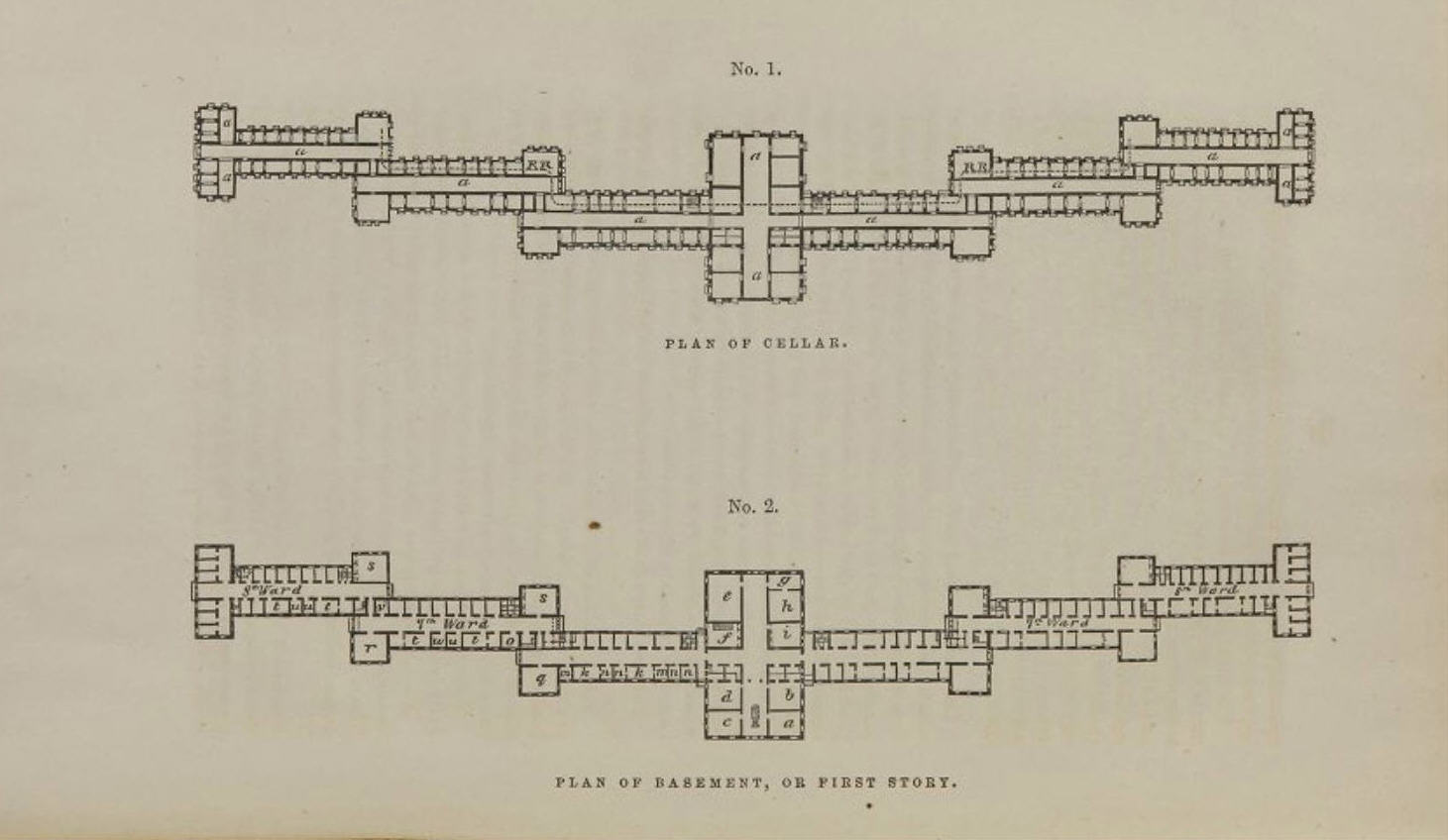
Kirkbride Plan
Thomas Story Kirkbride believed a building could heal the mind. It was a radical idea in the 1840s, when people suffering from mental illness were locked in county jails, chained in basements, or hidden in private homes. Kirkbride, a Philadelphia psychiatrist, proposed something different: vast, carefully designed hospitals where sunlight, fresh air, and dignified surroundings would do what chains and darkness could not. The result was one of the most ambitious experiments in American architecture and medicine - dozens of enormous institutions built to a single visionary plan, their staggered wings stretching outward like the wingspan of a bat.
A Reformer's Testimony
The story begins not with Kirkbride himself but with Dorothea Dix, a tireless reformer who testified before the New Jersey legislature in 1844. Her descriptions of how the state treated people with mental illness were vivid and damning: men and women confined in jails alongside criminals, forgotten in private homes, languishing in public building basements. Dix's advocacy led directly to the construction of the New Jersey State Lunatic Asylum in Trenton - the first complete asylum built on Thomas Story Kirkbride's design, constructed in 1848 by architect John Notman. Kirkbride had developed his approach from the philosophy of Moral Treatment and the idea of environmental determinism: that surroundings shape mental states, and that beauty and order could coax a troubled mind toward recovery.
Wings Like a Bat in Flight
From the air, a Kirkbride building is unmistakable. The standard plan called for eight wings extending from a central administration block, each wing offset from the next in a staggered formation - the signature 'bat wing' layout. This was not ornament; it was therapy made structural. The staggering ensured that every corridor had windows on both ends, flooding wards with sunlight and allowing cross-ventilation. Each wing operated as its own ward with a parlor, bathroom, clothes room, and infirmary, connected to the rest by speaking tubes and dumbwaiters. Patient rooms had ceilings at least twelve feet high, sized for one person only. The wings furthest from the center housed the most volatile patients, while the central block contained kitchens, reception areas, and apartments for the superintendent's family. Architectural styles varied wildly - from Richardsonian Romanesque to Neo-Gothic - but the footprint remained the same, making each Kirkbride simultaneously unique and instantly recognizable.
A Self-Contained World
Kirkbride envisioned his hospitals as complete communities. His 1854 guidelines specified a staff of 71 - roughly balanced between men and women - all required to live on or near the grounds. The superintendent's salary was set at $1,500 if his family lived at the hospital, $2,500 if they lodged privately. Engineers, carpenters, gardeners, seamstresses, ironworkers, cooks, dairymaids, and a carriage driver rounded out the workforce. Kirkbride insisted on fair wages, arguing that caring for people with mental illness was 'peculiarly trying to the mental and physical powers of any individual, and ought to be liberally paid for.' Patients who were able maintained the farmland and grounds as physical exercise and therapy. He required a minimum of 100 acres per hospital, with views that 'should exhibit life in its active forms.' Over the decades, these campuses grew into sprawling complexes with dozens of buildings.
The Slow Unraveling
The Kirkbride Plan's ambitions contained the seeds of its decline. These were immense, expensive facilities, and by the late nineteenth century, state budgets could no longer sustain them. Overcrowding turned therapeutic wards into warehouses. The medical community began questioning Kirkbride's core belief in the curability of mental illness through environment alone, and newer treatment philosophies pushed in different directions. One by one, the great bat-winged hospitals closed, were abandoned, or fell into disrepair. Today, at least 30 original Kirkbride buildings are listed on the National Register of Historic Places. Some have been demolished, others partially repurposed - transformed into condominiums, university buildings, or museums. A few stand empty, their long corridors still catching light through windows designed for a purpose most of us have forgotten.
A Legacy in Stone
What endures from Kirkbride's experiment is not any single building but an idea: that the spaces where we treat suffering matter. It was a deeply humane impulse, even if the execution eventually failed under the weight of economics and evolving medical science. The buildings themselves have become objects of fascination - haunted, beautiful, contested. The Trans-Allegheny Lunatic Asylum in West Virginia now hosts historic and paranormal tours. The Oregon State Hospital became a museum. The Traverse City State Hospital in Michigan, which operated from 1881 to 1989, has been redeveloped into a mixed-use complex. These conversions reflect an uneasy relationship with the past. Kirkbride dreamed of buildings that could heal. The buildings survived, but the dream did not - or perhaps it simply changed shape.
From the Air
Coordinates: 37.39°N, 121.95°W. The article's geographic tag places it near the site of the former Agnews Developmental Center in Santa Clara, California, one of many Kirkbride-influenced facilities. Nearby airports include San Jose International (KSJC, 4 nm northwest) and Reid-Hillview (KRHV, 5 nm southeast). From 3,000 feet AGL in clear conditions, the flat South Bay urban grid is prominent, with the remnants of large institutional campuses visible as distinctive green spaces amid suburban development.