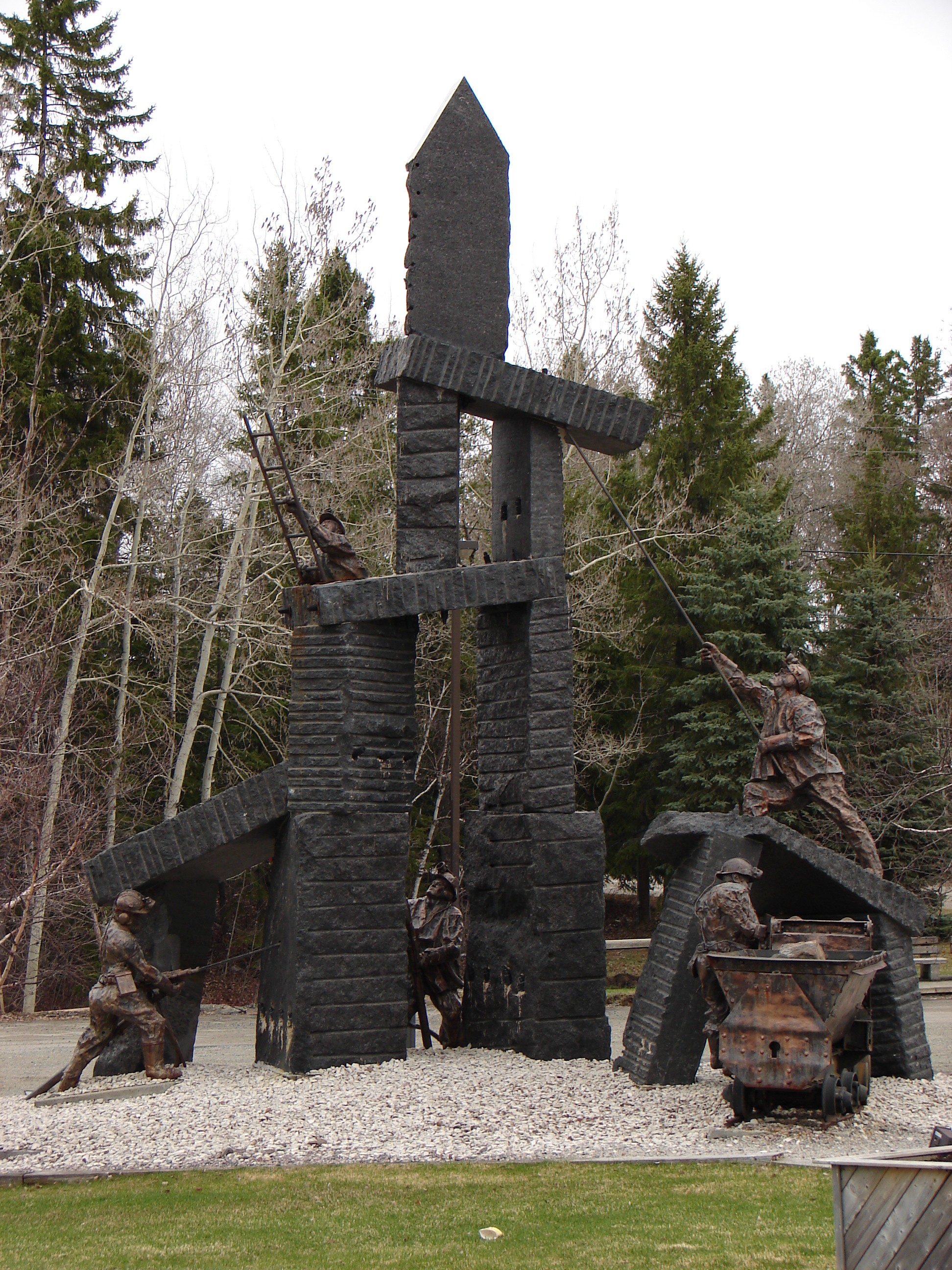
Kirkland Lake Miners' Memorial
The bolts holding it together came from a mine. The mucker, the ladder, the batteries on the miners' belts -- all authentic, all pulled from the underground workings that built this town. When the Miners' Memorial Foundation set out to honor Kirkland Lake's mining heritage, they insisted that every physical component be local and real. Even the rock was quarried from River Valley, north of Sudbury. The result, unveiled on July 25, 1994, is a 40-tonne, 10-meter-high black granite abstraction of a mine head frame, rising from a park on the edge of town where every visitor entering Kirkland Lake sees it first.
Seven Mines and a Golden Era
During the 1930s, Kirkland Lake was one of the richest gold-producing regions on Earth. Seven great mines -- Macassa, Tough-Oaks, Kirkland Lake Gold, Lakeshore, Wright-Hargreaves, Teck-Hughes, and Sylvanite -- poured one million dollars into the provincial economy and employed 4,640 workers. The mines defined the town completely. Families, churches, stores, hockey rinks -- everything existed because men went underground each day and brought gold back up. But the gold boom did not last forever. One by one the mines closed. By the time the Miners' Memorial Foundation formed, only a handful of operations remained, including the Macassa mine. The men and women who had built Kirkland Lake were aging, and the town risked forgetting the labor that had made it.
Bingo Cards and Volunteer Shifts
The memorial was not a government project or a corporate gift. It was a grassroots effort led by Steven Yee, a working miner and president of the United Steel Workers District 6 Union. His committee was composed largely of active miners. For ten years they raised money through community bingos and Nevada-ticket sales. The federal and provincial governments contributed, and the Cape Breton folk singer Rita MacNeil performed a fundraising benefit concert. The artists who designed the monument -- Rob Moir and Sally Lawrence -- were locals. When the individual components were finished, miners volunteered their off-hours to assemble the final structure. The ceremony at Kirkland Lake's 75th anniversary celebration drew hundreds. What the town received was not something designed in a Toronto studio or shipped from a distant foundry. It was theirs from bedrock to capstone.
Bronze Figures Made in the Likeness of Real Miners
The black granite and bronze figures were designed to be warm, not monumental in the cold institutional sense. The Foundation wanted visitors to feel the human reality of underground work, not just its danger. That is why each bronzed figure was sculpted in the likeness of an actual Kirkland Lake miner. One figure operates a mucker. Another climbs a ladder -- a deliberate symbol of the community's commitment to moving forward and improving workplace health and safety. The position reads as both celebration of progress and remembrance of those who died in the mines. The authentic equipment integrated into the monument reinforces the same message: these were real tools used by real people. The batteries, the stone bolts, the machinery -- each piece carries the weight and wear of actual underground use.
Standing on Oakes' Ground
The site of the memorial adds layers of meaning that deepen with local knowledge. The monument occupies the former property of Harry Oakes, founder of the Lakeshore Mine and Canada's largest taxpayer during the 1930s. Oakes was a dominant figure in Kirkland Lake's history -- prospector, mine baron, and ultimately a man whose unsolved murder in the Bahamas in 1943 became one of the century's great mysteries. By placing the workers' memorial on the mine owner's land, the town brought two halves of its history together in a single site. Before the monument, this spot held a bridge that had been a beloved local landmark, a place where people posed for photographs and gave directions. When the bridge was torn down as a safety hazard, it left what one historian called a spatial vacuum of cultural significance. The Miners' Memorial filled that vacuum and gave the location new meaning.
A Town's Front Door
Positioned at Kirkland Lake's periphery, the memorial is the first significant structure visitors encounter when entering town. This placement was intentional. The Foundation wanted anyone arriving in Kirkland Lake to know immediately that they were entering a mining town. The monument has since become far more than a symbol of identity. It inspired local author Bernie Jaworsky to write Lamps Forever Lit: A Memorial to Kirkland Lake Area Miners, a book born from the names listed on the monument -- Jaworsky wanted to collect the stories behind them. The monument's scaler figure was chosen for the cover of Karl Beveridge and Jude Johnston's book Making Our Mark, selected from among 13 monuments and murals across Ontario. Canada Post featured the mucker figure on a commemorative mining stamp. Today the surrounding park hosts community picnics and seasonal caroling, making the memorial a gathering place for celebration as much as remembrance.
From the Air
Kirkland Lake Miners' Memorial at 48.147N, 80.049W on the edge of Kirkland Lake, Ontario. The 10-meter-high black granite monument is located at the town's entry point. From the air, look for the park setting on the main road approaching town. Kirkland Lake itself sits along Highway 66 in the Timiskaming District. Nearest airport: Kirkland Lake Airport (CYKL) approximately 3nm from the memorial. Best viewed at 1,500-2,500 ft AGL to spot the monument's distinctive dark granite head-frame silhouette against the surrounding green parkland.