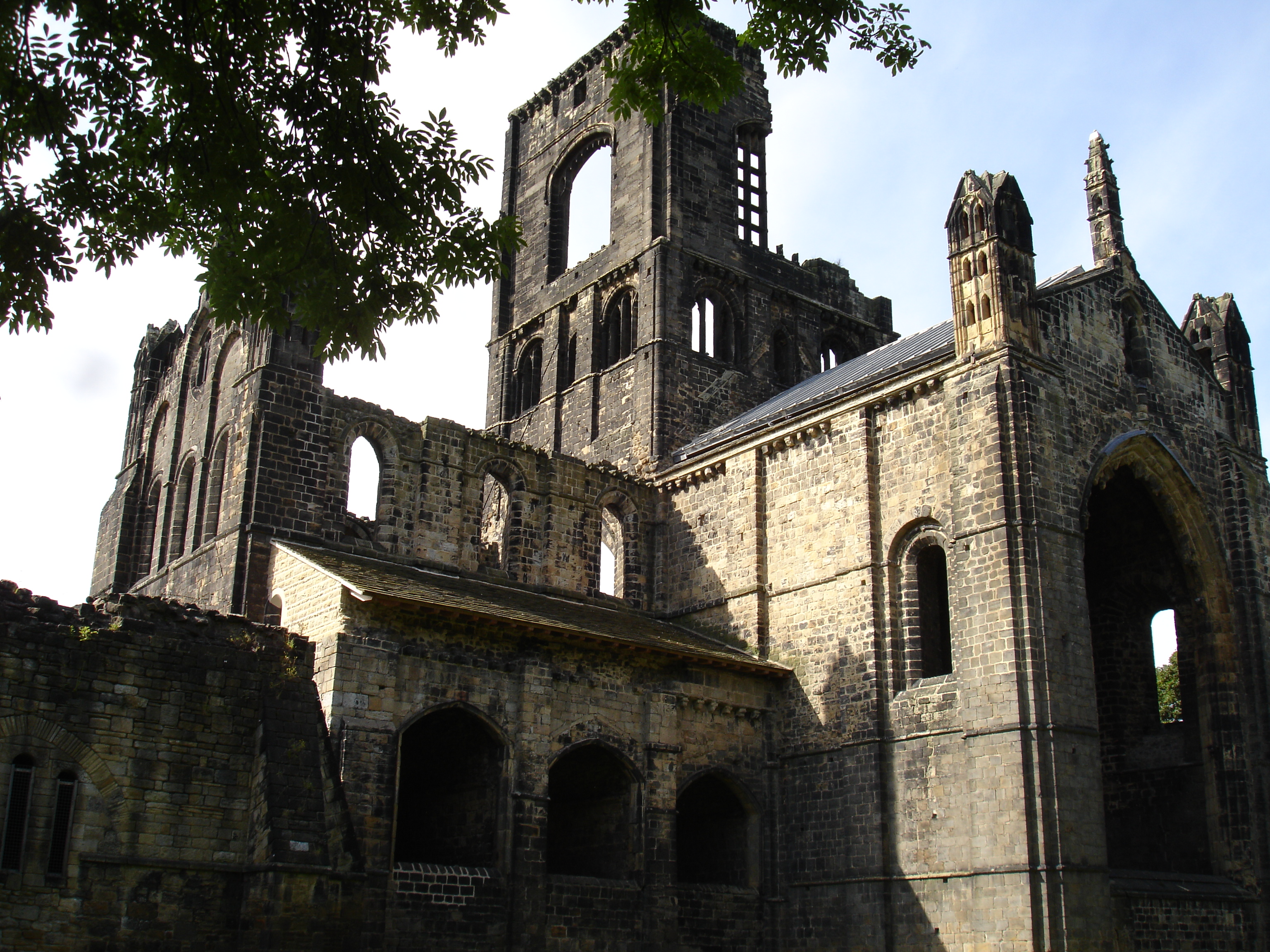
Kirkstall Abbey
Henry de Lacy was dying, and he made God a deal. If the Baron of Pontefract recovered from his illness, he would dedicate an abbey to the Virgin Mary. He recovered. In 1147, Abbot Alexander and twelve Cistercian monks from Fountains Abbey were given land at Barnoldswick to found a new house. They demolished the existing church, tried for six years, and found the place impossible. Searching for a better site, Alexander discovered a wooded stretch of the Aire Valley occupied by hermits. Some of the hermits joined the abbey. The rest were paid to leave. By 1152 the monks had settled at Kirkstall, and over the next thirty years they built one of the best-preserved Cistercian abbeys in England.
Stone from Across the River
The monks quarried Millstone Grit from Bramley Fall, on the opposite bank of the River Aire, and constructed their abbey in the austere Cistercian style -- plain windows, unornamented walls, no triforium in the nave. The architecture reflects the order's commitment to simplicity: the round-headed doorways and windows belong to the Romanesque tradition, while the pointed vaulting arches hint at the early Gothic that was beginning to reshape English building. The church follows the standard Cistercian plan, with a short chancel, transepts with three eastward chapels each, and a solid, workmanlike nave. The tower over the crossing was heightened in the 16th century, just before the monks were turned out. Most of the building was completed during Alexander's tenure as abbot, which ended in 1182.
Dissolution and Dismantling
The Dissolution of the Monasteries under Henry VIII ended monastic life at Kirkstall. The abbey was awarded to Thomas Cranmer in 1542, reverted to the crown when Cranmer was executed in 1556, and was purchased by Sir Robert Savile in 1584. Over the following centuries, the buildings were treated as a quarry. Stone from the abbey was reused in other structures across Leeds, including the steps leading to the river bank at Leeds Bridge in the city centre. What the quarrymen did not take, weather and neglect slowly eroded. Yet the main structure proved remarkably durable. The nave walls, the tower, and the chapter house survived largely intact, standing roofless but recognizable above the Aire.
The Romantic Ruin
In the 18th century, the picturesque quality of the ruins caught the eye of Romantic artists. J.M.W. Turner painted Kirkstall, as did Thomas Girtin and John Sell Cotman. The abbey became an emblem of the sublime decay that the Romantics found irresistible -- medieval architecture consumed by nature, stone arches open to the sky, trees growing through former cloisters. In 1851, the African American novelist William Wells Brown visited and described the 'pensive beauty' of the ruins in their 'pastoral luxuriance,' a reminder that the abbey's appeal crossed cultures and oceans. When Colonel John North purchased the estate in 1889, he presented it to Leeds City Council. The council undertook restoration and opened the abbey to the public in 1895.
Abbey in the City
Kirkstall Abbey now sits in a public park on the north bank of the Aire, surrounded by the suburban sprawl of northwest Leeds -- a medieval monastery marooned in a modern city. It is a Grade I listed building and scheduled ancient monument. The former gatehouse across the road houses the Abbey House Museum. The grounds host the annual Kirkstall Festival and have served as a venue for concerts, including two Kaiser Chiefs shows in 2011 that drew 10,000 people each night. BBC Television used the abbey as a filming location for the series Gunpowder in 2017. Shakespeare festivals were performed in the cloisters for fourteen years. The ruins that once inspired Turner now host rock bands and television crews, a transformation that the austere Cistercians who displaced those Aire Valley hermits could never have imagined.
From the Air
Located at 53.82°N, 1.61°W on the north bank of the River Aire, northwest of Leeds city centre in West Yorkshire. The abbey ruins and surrounding parkland are visible from lower altitudes along the Aire valley. Nearest airport: Leeds Bradford (EGNM) approximately 5 nm north-northwest. The A65 road runs adjacent to the site.