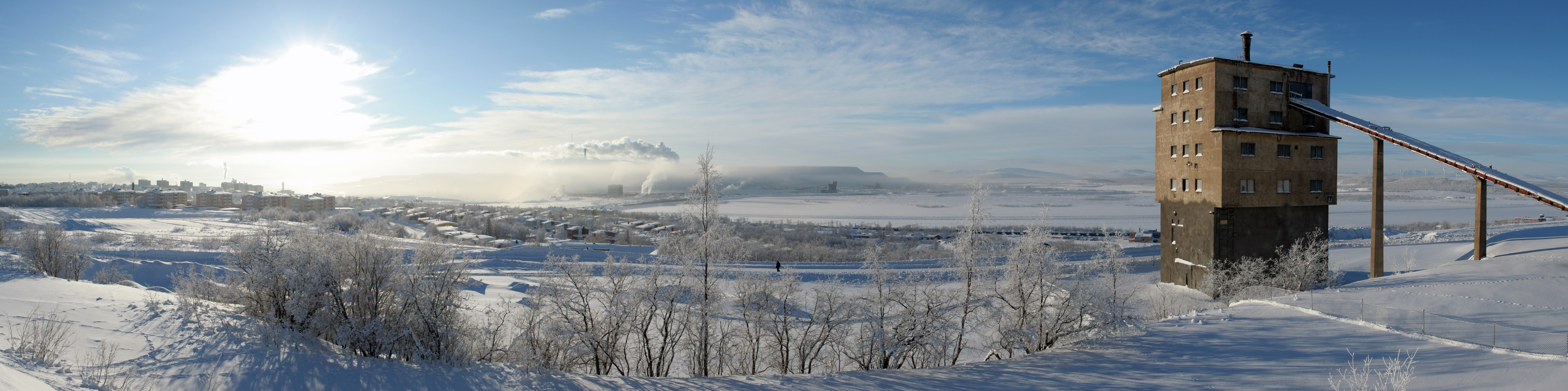
Kiruna Mine
Somewhere beneath Kiruna, Sweden, there is a void where a mountain used to be. The ore body at Kiirunavaara -- four kilometers long, up to 120 meters thick, plunging at least two kilometers into the Earth -- has been mined continuously since 1898. Over 950 million tonnes of iron ore have been hauled out. In 2018 alone, production reached 26.9 million tonnes. On May 18, 2020, the rock shifted: a mining-induced earthquake of magnitude 4.9 shook the region, a visceral reminder that removing this much material from the Earth's crust has consequences. The most visible consequence is happening on the surface, where the entire city of Kiruna is being moved to avoid collapsing into the mine that created it.
What Lies Below
The Kiruna ore is predominantly magnetite interspersed with apatite, averaging 0.9 percent phosphorus. Before mining began, the ore sheet stretched four kilometers across the surface and averaged 90 meters in width. Geophysical surveys suggest it continues as a coherent body at least 1,500 meters below the surface -- and possibly deeper. As of 2020, the main haulage level sits 1,365 meters below where the ore once outcropped at Kiirunavaara. The origin of this deposit has fueled decades of scientific debate. One school holds that the ore solidified from iron-rich magma; another, championed by geologist Tibor Parak in the 1970s, argues it formed as sediment in a volcanic environment. The geology shares striking parallels with El Laco volcano in Chile, a comparison that has kept the volcanic-origin hypothesis alive. What no one disputes is the scale: this is one of the richest iron deposits ever discovered.
From Open Pit to the Deep
Surface mining came first. Workers carved into the mountainside of Kiirunavaara in the final years of the nineteenth century, and in 1902 the completion of the Kiruna-Narvik railway opened a route to the ice-free Norwegian port of Narvik, making year-round ore shipment possible. By the 1960s, the surface ore was exhausted, and operations shifted underground using sublevel caving -- a method where ore is blasted from below and allowed to collapse under its own weight. Each level goes deeper. Until 1999, the mine reached 775 meters. After the turn of the millennium, it pushed past 1,045 meters. In 1985, reserves were estimated at 1.8 billion tonnes grading 60-65 percent iron. By 2018, proven and probable reserves stood at 683 million tonnes grading 43.8 percent iron -- lower grade, but still enormous, with decades of extraction ahead.
Moving a City
Sublevel caving is efficient but destructive. As underground chambers collapse to release ore, the ground above subsides. By 2004, mining-related subsidence had crept close enough to Kiruna's city center that a decision could no longer be deferred: the town would have to move. Initial proposals in 2007 placed the new center northwest of the mine, at the foot of Luossavaara mountain near Lake Luossajarvi. By 2010, the city council reversed course and chose an eastward relocation toward Tuolluvaara instead. White Arkitekter of Gothenburg and Ghilardi + Hellsten Arkitekter of Oslo, working with researchers from Lulea and Delft universities, won the design contract for the new city. Their vision is deliberately different from the old: denser, more pedestrian-oriented, with green and blue infrastructure replacing the automobile-centered layout of the original town. Physical relocation began in 2014 and is projected to continue until 2040.
Iron and Empire
LKAB, the state-owned mining company that operates the Kiruna mine, is more than a commercial enterprise -- it is one of the pillars on which modern Sweden was built. Swedish iron ore, shipped through Narvik and the Baltic port of Lulea, fed the steel mills of Europe through two world wars and the postwar industrial boom. The strategic importance of this supply line was so great that both the Allies and Nazi Germany maneuvered to control it during World War II. Today, LKAB has identified what it calls Europe's largest deposit of rare earth elements in the region surrounding Kiruna, suggesting that the mine's significance may extend well beyond iron in the decades ahead. Meanwhile, the city that iron built continues its slow migration eastward, a community reshaping itself around a hole in the ground that grows deeper every year.
From the Air
Located at 67.85N, 20.19E in Kiruna, Swedish Lapland, 145 km north of the Arctic Circle. The mine workings are clearly visible from the air: the original open-pit scar on Kiirunavaara mountain contrasts sharply with the surrounding boreal landscape. The town relocation zone is visible to the east. Kiruna Airport (ESNQ) is approximately 7 km east of the mine. The Iron Ore Line railway runs through the town connecting to Narvik (Norway) to the west and Lulea (Sweden) to the east. In winter, polar night lasts from early December to early January.