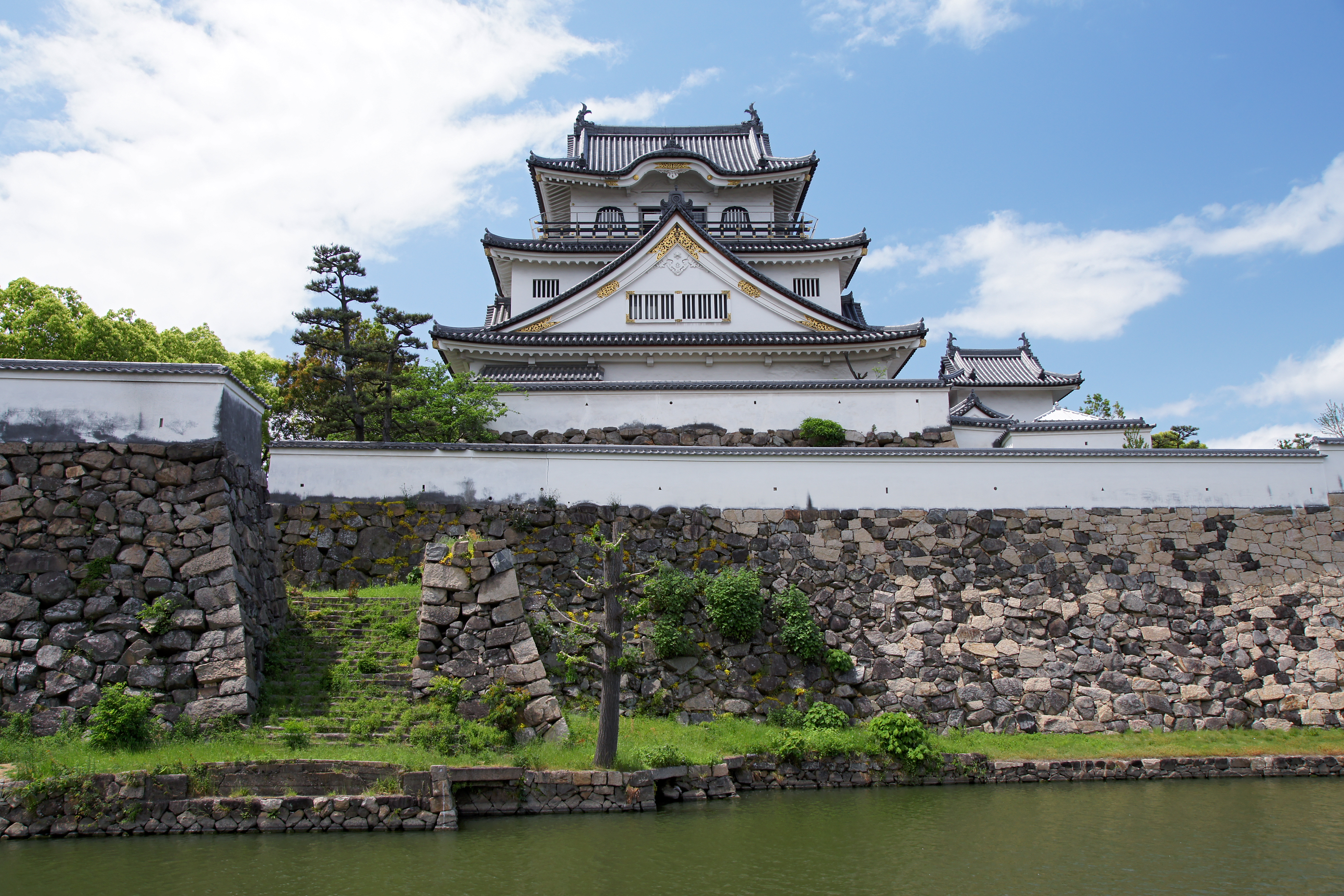
Kishiwada Castle: The Fortress That Hedged Its Bets
When the Koide clan patriarch faced the defining battle of Japanese history at Sekigahara in 1600, he chose not to choose. Koide Hidemasa and his eldest son fought for the losing Western Army, while his second son Hideie conveniently sided with the victorious Tokugawa forces. The gamble paid off -- Hideie inherited Kishiwada Castle and the domain that came with it. That kind of pragmatic survival defines this compact fortress on Osaka Bay, a castle that changed hands through centuries of feudal politics, withstood a two-month siege by religious insurgents, lost its tower to a bolt of lightning, and was ultimately rebuilt at two-thirds its original height to serve as a museum housing the very armor and weapons that once defended it.
A Crossroads on the Coast
Kishiwada Castle occupies one of those locations that practically demanded fortification. Sitting on a low hill at the coastal terrace of Osaka Bay, it commands the midpoint between Osaka and Wakayama along the Kishu Kaido, the ancient highway connecting the capital region with Kii Province. To the north lay the wealthy trading port of Sakai; across the water, the route to Shikoku and Kyoto. Rivers protected the castle's flanks to the north and south. No one knows exactly when the first defenses rose here, but by the 1330s, during the turbulent Nanboku-cho period, a local warlord named Kishiwada Osamu had built a fortified residence roughly 500 meters southeast of the current site. Power shifted from the Ashikaga to the Hosokawa to the Matsura, each clan holding this strategic chokepoint until the next wave of violence reshuffled the map.
The Siege and the Stronghold
The castle's bloodiest chapter came during the wars of unification. By the 1560s, Izumi Province had fragmented into a patchwork of local strongmen, and Kishiwada became the front line between Oda Nobunaga's forces and the Saiga Ikki -- followers of the Ikko-ikki movement who sought to overthrow the feudal system and establish a theocratic republic. Nobunaga seized the castle and stationed his kinsman Oda Nobuharu as castellan, specifically to prevent the Saiga Ikki and the armies of Ishiyama Hongan-ji temple from linking together. After Nobunaga's assassination in 1582, the feared alliance materialized. In 1585, the Saiga Ikki invaded Izumi Province, but Toyotomi Hideyoshi's generals Matsuura Munekiyo and Nakamura Kazuuji held the castle with 8,000 men through a grueling two-month siege. Kishiwada held. Hideyoshi then placed his uncle Koide Hidemasa as castellan and ordered the fortifications strengthened for the campaign into Kii Province.
An H-Shaped Fortress
Koide Hidemasa transformed Kishiwada into a proper castle, constructing a five-story tenshu -- the central tower -- in the Honmaru bailey. The inner enclosure measured roughly 100 by 50 meters, protected by stone walls and water moats. The secondary Ni-no-maru bailey extended toward Osaka Bay, its tall stone walls designed to repel attack from the sea. Smaller enclosures surrounded by moats guarded these two main compounds, which were connected by a narrow path, giving the castle its distinctive H-shaped configuration when viewed from above. For all its strategic importance, the castle was surprisingly compact -- roughly 500 square meters total, small relative to its towering tenshu and outsized role in regional politics. In 1623, a yagura watchtower was relocated from the famous Fushimi Castle to the Ninomaru bailey, adding a piece of borrowed grandeur.
Lightning and Reinvention
The Okabe clan took control of Kishiwada in 1640 and governed the domain for over two centuries, through the peaceful Edo period and into the upheaval of the Meiji Restoration. But nature accomplished what no army could. In 1827, a bolt of lightning destroyed the five-story tenshu, and the Tokugawa shogunate never authorized its replacement. After the Meiji Restoration ended feudal rule, the remaining buildings were demolished. The Honmaru and Ninomaru baileys survived as a public park, their stone walls and moats in surprisingly good condition. In 1954, a new three-story tenshu was built -- two stories shorter than the original -- to house a local museum. A gate and several yagura were reconstructed in 1969. The Honmaru Garden earned designation as a National Place of Scenic Beauty. In 2017, Kishiwada was listed among the Continued 100 Fine Castles of Japan, and it gained an unexpected moment of international fame as a filming location for the 2021 movie Snake Eyes.
The Danjiri Connection
The castle grounds sit at the heart of modern Kishiwada, a city best known for the Kishiwada Danjiri Matsuri, one of Japan's most spectacular and dangerous festivals, where massive wooden floats weighing four tons are dragged through narrow streets at alarming speed. The castle provides the backdrop for this annual September event, its stone walls and moats serving as a stage for controlled chaos that draws hundreds of thousands of spectators. A ten-minute walk from Takojizo Station on the Nankai Main Line or fifteen minutes from Kishiwada Station brings visitors to the castle entrance, where the reconstructed tower overlooks the bay. From the observation deck, you can see the waters of Osaka Bay stretching west, the same waters that once made this modest hilltop fortress worth fighting and dying for.
From the Air
Located at 34.459N, 135.371E on the coast of Osaka Bay in Kishiwada city, Osaka Prefecture. The castle sits near the waterfront in the city center. From altitude, look for the compact moat-ringed structure with its white three-story tower near the coastline, roughly midway between Osaka to the north and Wakayama to the south. Kansai International Airport (RJBB) lies approximately 8 nautical miles to the southwest on its artificial island. Osaka Itami Airport (RJOO) is about 25 nautical miles to the north-northeast. Best viewed at 2,000-3,000 feet AGL approaching from the bay side.