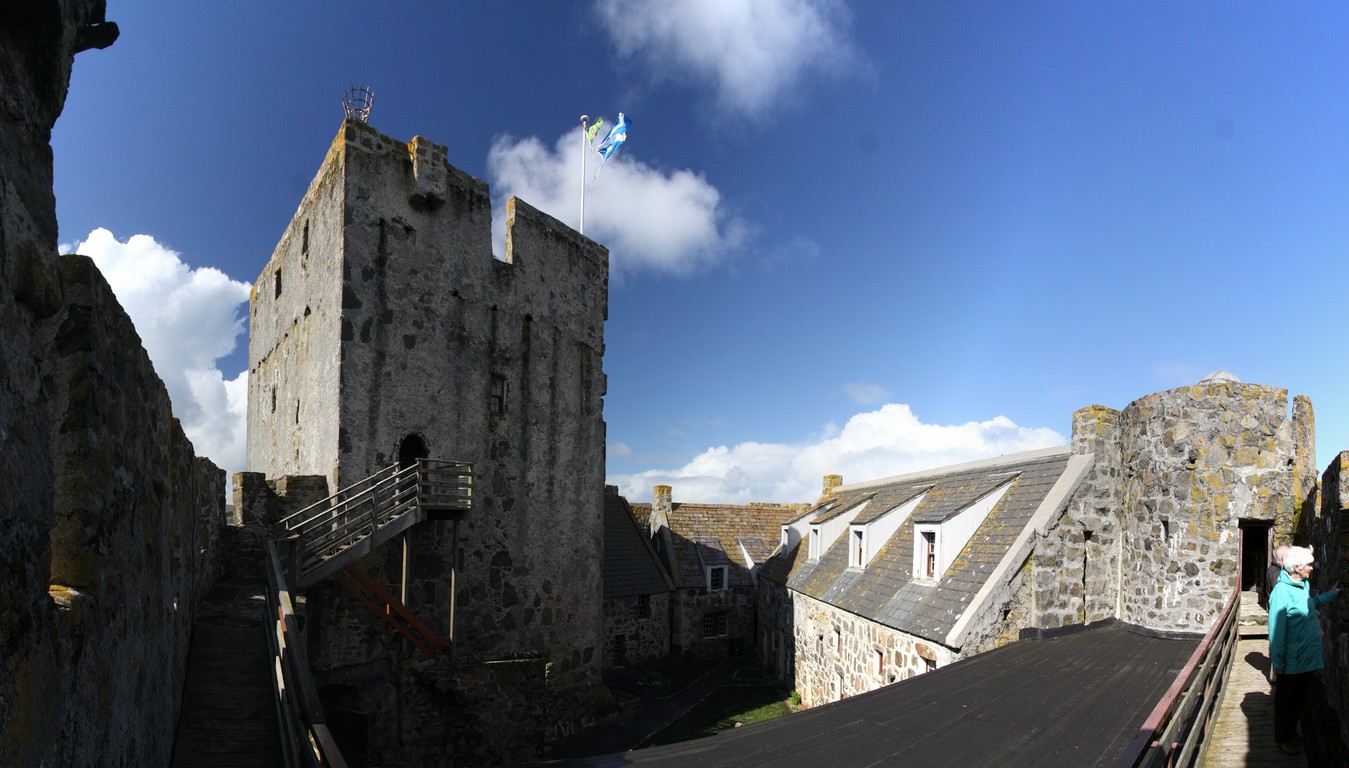
Kisimul Castle
The annual rent for one of Scotland's most storied castles is one pound sterling and a bottle of whisky. That was the price the chief of Clan MacNeil set in 2001 when he leased Kisimul Castle to Historic Scotland for a thousand years -- a deal that speaks volumes about both the MacNeil sense of humor and their fierce attachment to a fortress their clan has claimed, in legend at least, since the 11th century. The castle sits on a rocky islet in Castlebay harbour on the island of Barra, reachable only by boat, its walls rising directly from the water like a stone ship permanently at anchor in the Outer Hebrides.
Norse Roots, Gaelic Stones
The name Kisimul derives from the Norse ciosamul, meaning 'castle island,' a reminder that these waters were once Viking highways. The earliest documentary record dates from 1549, when Dean Monro described Barra's castle as sitting on 'ane strenthey craige' in the middle of a salt-water loch. But the MacNeils trace their occupancy far earlier. Legend holds that the castle was their stronghold from the 11th century, though the surviving masonry appears to date from the medieval period. Built on a rocky islet in the bay, just off the coast of Barra, Kisimul could only be reached by boat -- a natural moat that made it formidable against all but the most determined assault. The castle even has its own fresh water wells, allowing it to withstand siege.
From Stronghold to Ballast
Kisimul's fortunes mirrored those of the clan that built it. When the island of Barra was sold in 1838, the castle was abandoned, and its decay was swift and ignominious. Local fishermen prised stones from its walls to use as ballast in their vessels. Some of those stones ended up as paving in Glasgow streets -- a castle dismantled and scattered across Scotland in fragments. The indignity lasted nearly a century. In 1937, Robert Lister MacNeil, then chief of Clan MacNeil, purchased the castle remains along with most of Barra and began the painstaking work of restoration. He was reclaiming not just a building but a symbol of clan identity that had been quite literally carried off stone by stone.
A Thousand-Year Lease
The 2001 lease agreement between the clan chief and Historic Scotland encapsulated centuries of MacNeil character in a single document. For the annual sum of one pound and a bottle of whisky, the castle passed into public care for a millennium. The arrangement ensured professional conservation while preserving the clan's ancestral connection. Today, Kisimul stands restored in Castlebay harbour, its curtain walls and tower house visible from the ferry as visitors approach Barra. The island on which it sits was classified in the 2011 census as having no usual residents -- but the castle itself, open to visitors who make the short boat crossing from Castlebay pier, remains very much alive. It is a Category A listed building, among Scotland's most architecturally and historically significant structures, and perhaps the most characterfully rented property in the entire nation.
From the Air
Kisimul Castle sits at 56.952N, 7.487W in Castlebay harbour on the island of Barra in the Outer Hebrides. The castle on its rocky islet is clearly visible from the air as a stone structure in the middle of the bay. Nearest airfield is Barra Airport (EGPR), famous for its beach runway on the Traigh Mhor cockle strand -- the only scheduled airport in the world where flights use a beach. Approach from the southeast for the best view of the castle in its harbour setting.