Kistefos Museum and Sculpture Park
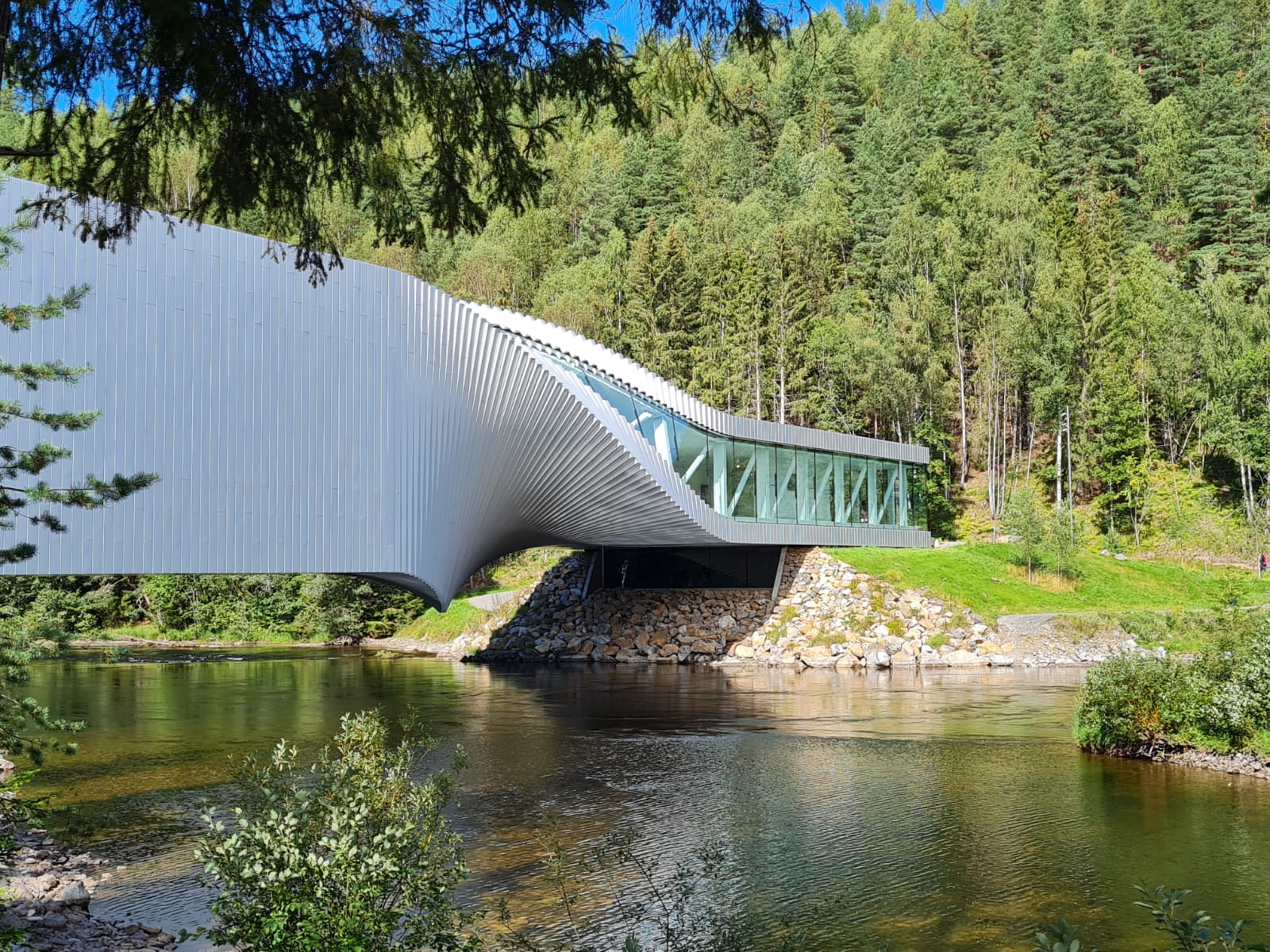
The building twists 90 degrees as it crosses the river. From the lower southern bank, its width faces you like a wall. At the midpoint, the structure rotates, so that by the time it reaches the higher northern shore, its length runs parallel to the water. This is The Twist, designed by Bjarke Ingels Group, and it is simultaneously a museum, a bridge, and a sculpture. It is also the most dramatic element in a place where old industry and contemporary art have been merging since 1996.
From Pulp to Permanence
Kistefos began as a wood pulp mill. The Kistefos Traesliberi was established in 1889 on the Randselva river in Jevnaker Municipality, about 60 kilometers north of Oslo. When the industrial era passed it by, collector and businessman Christen Sveaas saw something besides decay. He opened the sculpture park in 1996 with 25 works displayed among the old factory buildings, which remained fully equipped and intact. The Norwegian Directorate for Cultural Heritage recognized the site as one of ten significant technical and industrial heritage sites in the country. As Sveaas told Christie's: "Everything I commission must be site-specific. I want the artist to be triggered by the picturesque landscape and its history." That philosophy has shaped every addition since.
The Collection in the Landscape
Forty-six sculptures now occupy the grounds, placed along the river and among the trees with deliberate attention to their relationship with the terrain. Fernando Botero's voluptuous Female Torso stands in contrast to the spare Nordic landscape. Anish Kapoor's S-Curve reflects the surrounding forest in polished steel. Yayoi Kusama's Shine of Life adds her signature organic forms to the riverbank. Claes Oldenburg and Coosje van Bruggen contributed Tumbling Tacks, their characteristic transformation of the mundane into the monumental. Olafur Eliasson's Viewing Machine frames the scenery through a kaleidoscopic lens. The collection spans decades and continents -- Tony Cragg, Marc Quinn, Ilya Kabakov, Jeppe Hein, Lynda Benglis -- but each piece was chosen or commissioned for this specific place.
The Twist
By the mid-2010s, the park needed both a larger exhibition space and a second bridge to improve visitor circulation. Bjarke Ingels Group solved both problems in a single gesture. The Twist spans the Randselva as a 1,000-square-meter building that accommodates the difference in elevation between its two banks through a 90-degree rotation at its center. On the lower southern bank, two to three stacked gallery floors house media, paintings, and smaller sculptures, along with an information center and museum shop. On the higher northern bank, a floor-to-ceiling horizontal gallery stretches out for large installations. The glazed-glass walls follow the warping geometry, creating spaces that shift from side-lit to sky-lit to fully dark as visitors move through. It was called a "hybrid of architecture, infrastructure and sculpture" -- a description that fits the entire park.
Art Among the Machines
The old Nybruket Gallery, housed in a pulp mill building from 1896, continues to host secondary exhibitions. Its preserved machinery stands as a reminder that Kistefos was a working factory within living memory. The park's exhibition history reads like a catalog of contemporary art's biggest names: Ai Weiwei's Interlacing in 2012, Marina Abramovic's Entering the Other Side in 2014, exhibitions drawing from Norwegian masters like Edvard Munch and Harriet Backer alongside international provocateurs like David LaChapelle and Bjarne Melgaard. The juxtaposition is the point -- industrial tools and contemporary art share the same rooms, and neither pretends the other does not exist.
The River Runs Through It
The Randselva is not a backdrop at Kistefos; it is a participant. A Kassen's River Man sits partially submerged. The bridges -- old and new -- frame views up and down the water. The current that once powered the pulp mill now reflects the sculptures that replaced it. In summer, the Norwegian light stays long and low, turning the polished surfaces of Kapoor and Cragg into secondary light sources. The park is only open seasonally, and the concentrated visiting period gives it an intensity that year-round museums sometimes lack. For a few months each year, one of Europe's most unusual art destinations comes alive on the banks of a river that has been powering things -- first mills, now imaginations -- for more than a century.
From the Air
Located at 60.22N, 10.37E in Jevnaker Municipality, about 60 km north-northwest of Oslo. The park sits along the Randselva river, and The Twist bridge-museum is visible from the air as a distinctive curved structure spanning the water. Nearest airports include Oslo Gardermoen (ENGM), approximately 55 km east, and Notodden (ENNO) to the southwest. Best viewed at 2,000-3,000 ft AGL to see the river, the sculpture park layout, and The Twist.