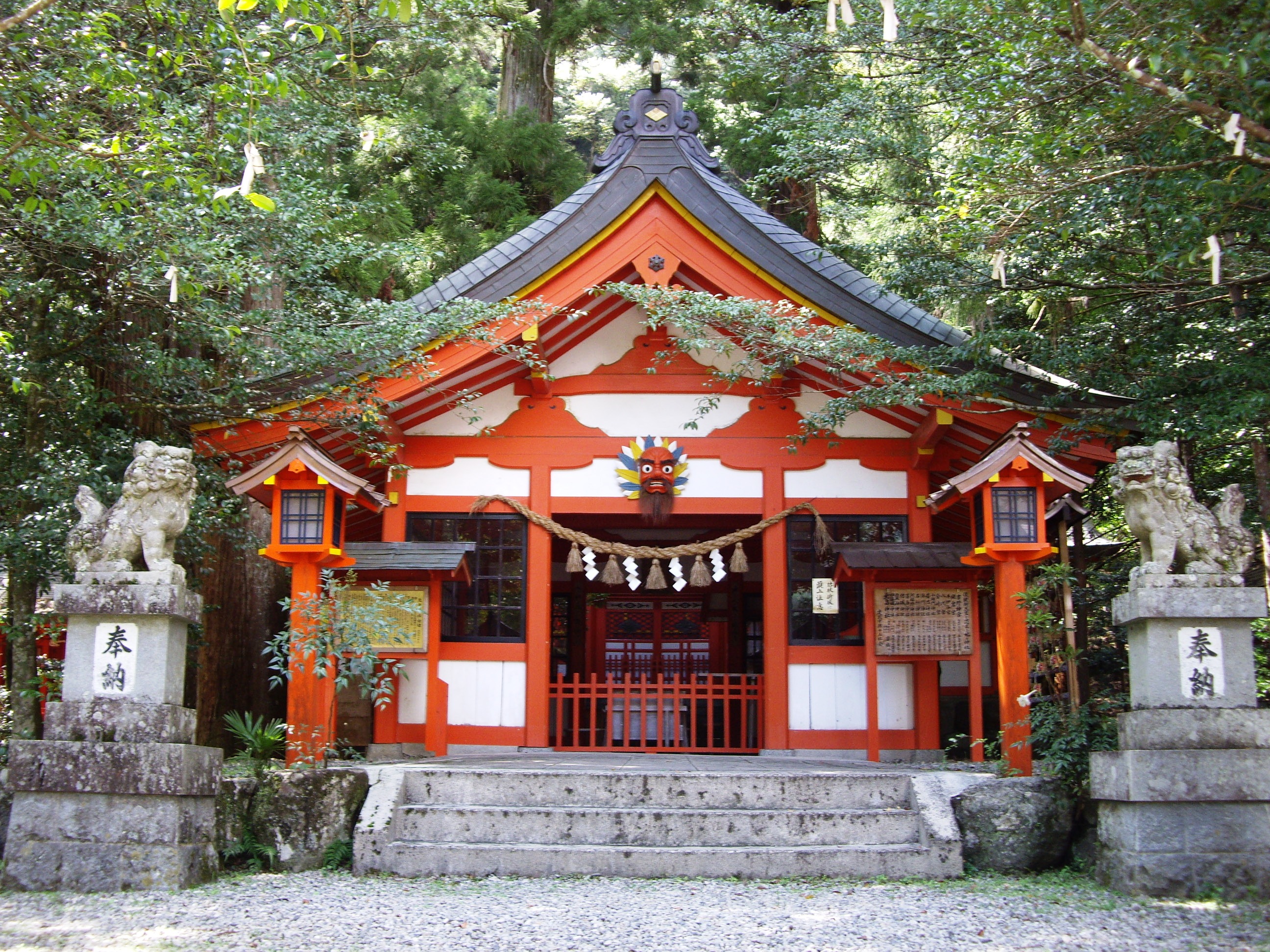
Kitabatake Shrine: Where Fallen Loyalists Became Gods
The Kitabatake clan lost everything -- their castle, their domain, their lives -- when Oda Nobunaga's adopted son turned on them in 1576. Three centuries later, the Meiji government made them gods. Kitabatake Shrine sits on the exact footprint of the Tage Yakata, the fortified residence that served the Kitabatake as their seat of power in Ise Province for over two hundred years. The shrine enshrines the deified spirits of Kitabatake Akiyoshi, the warrior who built nearby Kiriyama Castle in 1342, alongside Kitabatake Chikafusa and Kitabatake Akiie -- three generations of a clan that staked everything on loyalty to the Southern Imperial Court and paid the ultimate price. Today, the compound is both a place of worship and a designated National Historic Site, its gardens surviving as a rare physical link to the aesthetic world of medieval Japan's warrior aristocracy.
The Fortress Beneath the Shrine
Before there was a shrine, there was a fortress. The Kitabatake clan chose this site in the mountainous Tage area of what is now Tsu, Mie Prefecture, because the terrain was a natural stronghold. Rivers guarded the east, south, and north approaches. A steep wooded slope to the west climbed toward Kiriyama Castle, the mountain redoubt that served as the clan's last line of defense. On this protected ground, the Kitabatake built their yakata -- a fortified residence roughly trapezoidal in plan, measuring 200 meters north to south and 110 meters east to west. It was no crude garrison. Excavations in 1996 revealed the remains of numerous buildings from the first half of the 15th century, along with ceramic fragments imported from China, armor pieces, Buddhist statues, and ritual objects. The Kitabatake lords of Ise Province lived as both warriors and aesthetes, their residence a court in miniature surrounded by mountains.
Restoration Upon Restoration
The shrine's origin story involves two restorations separated by five centuries. The first was the Kenmu Restoration of the 1330s, when Emperor Go-Daigo attempted to reclaim imperial power from the Kamakura Shogunate. The Kitabatake clan fought fiercely for his cause, and Kitabatake Akiyoshi became one of the Southern Court's key commanders. When that cause was lost, the clan retreated to their mountain domain and endured. The second restoration came with the Meiji government in 1868. The new regime, eager to legitimize itself by celebrating earlier attempts to restore direct imperial rule, sought out sites connected to the Kenmu era and consecrated them as Shinto shrines. In 1643, a descendant of the clan -- Suzuki Sonbei Ieji, a fourth-generation grandson of the last Kitabatake lord Tomofusa -- had already built a small Hachiman shrine on the yakata site. In November 1881, the Meiji government transformed it into Kitabatake Shrine, replacing the Hachiman deity with the deified spirits of the Kitabatake loyalists.
The Garden That Outlived Its Makers
The most remarkable survival at the shrine complex is not the shrine itself but its garden. While the residence was destroyed in 1576 and the shrine buildings date to 1881 and later reconstructions, the garden created for the Kitabatake lords has endured across five centuries. It is designated a National Scenic Site, a distinction that recognizes its artistic and historical value alongside the National Historic Site designation that covers the broader archaeological zone. The garden represents the aesthetic sensibility of Japan's medieval warrior class -- men who governed provinces and led cavalry charges but also cultivated gardens in the Chinese-influenced style that defined elite taste during the Muromachi period. In 2006, the Japanese government unified the garden, the yakata ruins, and Kiriyama Castle under a single expanded designation: Tage Kitabatakeshi Jokan ato, encompassing nearly 269,000 square meters of protected land.
Fifteen Shrines, One Legacy
Kitabatake Shrine is one of the Fifteen Shrines of the Kenmu Restoration, a group of Shinto shrines established by the Meiji government to honor loyalists who fought for Emperor Go-Daigo's cause in the 1330s. In 1907, sixteen smaller shrines from surrounding Tage village were merged into the Kitabatake Shrine, consolidating local worship into a single site. The shrine buildings were reconstructed in 1928, and the shrine received an official rank under the pre-war system of ranked Shinto shrines. Its annual festival falls on October 13. The shrine is accessible by car in about ten minutes from Hitsu Station on the JR Central Meisho Line, a rural rail route that threads through the mountains of interior Mie. In 2017, the broader Kitabatakeshi Jokan complex was named to the Continued Top 100 Japanese Castles, recognition that the compound's military heritage is as significant as its spiritual one.
From the Air
Located at 34.519°N, 136.299°E in the mountainous Misugi area of Tsu, Mie Prefecture, approximately 500 meters south of Kiriyama Castle. The shrine and garden complex occupy the valley floor where the Tage Plain narrows into the surrounding mountains. Rivers are visible to the east, south, and north of the site. The nearest major airport is Chubu Centrair International Airport (RJGG), roughly 100 km to the northeast. Osaka Itami Airport (RJOO) is about 90 km to the northwest. Best viewed at 4,000-6,000 feet AGL to see the shrine compound in relation to the mountain ridgelines of Kiriyama Castle above.