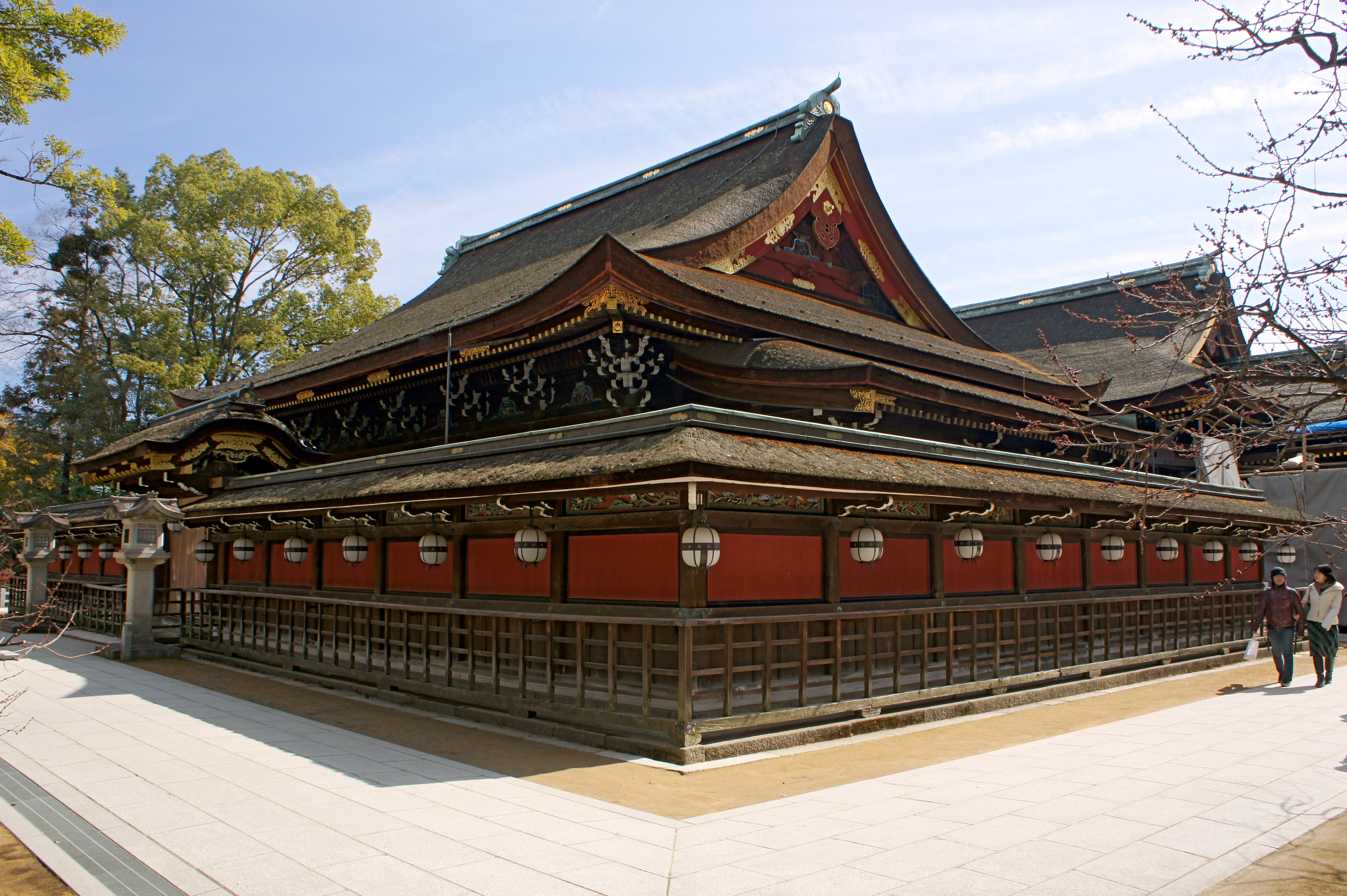
Kitano Tenmangu
Every February 25, geiko and apprentice maiko from Kyoto's Kamishichiken geisha district kneel on tatami mats beneath plum trees and serve tea to 3,000 guests at Kitano Tenmangu. The ceremony honors a man who died in exile over eleven hundred years ago -- a brilliant poet and bureaucrat named Sugawara no Michizane, whose restless spirit was so feared after death that an emperor built this shrine in 947 to calm it. The strategy worked rather well. Michizane's angry ghost became one of Japan's most beloved deities, the patron saint of scholars and students. Today, Kitano Tenmangu stands as the head shrine of some 12,000 Tenjin shrines across Japan, and the first in the nation's history to enshrine an actual human being as a god.
The Scholar Who Became a Storm
Sugawara no Michizane was born in 845 into a family of scholars during the Heian period, an era when poetry and calligraphy could make or break a political career. He rose through the imperial bureaucracy on sheer intellectual brilliance, eventually reaching the rank of Minister of the Right -- one of the highest positions at court. But his rivals in the powerful Fujiwara clan saw him as a threat. In 901, they engineered his exile to Dazaifu in distant Kyushu, far from the capital and everything he loved. Michizane died there in 903, heartbroken and disgraced. Then the misfortunes began. Plague swept Kyoto. Lightning struck the imperial palace. The sons of Michizane's chief political rival died one after another. The court concluded that Michizane's spirit was exacting revenge, and in 947, they erected Kitano Tenmangu to appease his wrath.
From Wrath to Wisdom
The pacification worked beyond anyone's expectations. In 986, the imperial court officially conferred upon Michizane the divine title of Tenjin, god of heaven. His transformation from vengeful ghost to benevolent deity is one of the most remarkable spiritual journeys in Japanese religion. By the Heian period's height, Emperor Murakami in 965 had ordered imperial messengers sent to report important events to Japan's guardian kami at sixteen shrines, and in 991, Emperor Ichijo added Kitano to that elite list. From 1871 through 1946, the shrine held official government ranking as a second-tier nationally supported shrine. But its true power has always been informal: because Michizane was a man of extraordinary learning in life, students across Japan have prayed to him for academic success for centuries. Even today, before university entrance exams, the shrine grounds fill with anxious students hanging prayer tablets on wooden racks.
Plum Blossoms and a Warlord's Tea
The shrine grounds bloom with red and white ume -- plum blossoms -- Michizane's favorite tree. The plum blossom festival, or baikasai, has been held on February 25 every year for roughly 900 years, marking the anniversary of Michizane's death. But the shrine's most famous tea tradition has another origin entirely. In 1587, the warlord Toyotomi Hideyoshi hosted the Grand Kitano Tea Ceremony on these very grounds, a massive affair where over 800 tea houses were erected in the shrine's bamboo grove and anyone -- samurai, merchant, or farmer -- could attend regardless of social status. The legendary tea master Sen no Rikyu presided alongside Hideyoshi's other tea masters. The modern outdoor tea ceremony, revived in 1952 for the 1,050th anniversary of Michizane's death, deliberately echoes that grand event, with geiko and maiko from nearby Kamishichiken serving matcha and wagashi to thousands of guests beneath the flowering branches.
The Twenty-Fifth Day
On the 25th of every month -- the date of both Michizane's birth and death -- Kitano Tenmangu hosts a bustling flea market that transforms the shrine's serene precincts into a lively bazaar. Hundreds of stalls sell antiques, kimonos, ceramics, street food, and curios beneath the ancient trees. Together with the similar market at Toji temple on the 21st, these two events inspired a local proverb: 'Fair weather at the Toji market means rainy weather at the Tenjin market,' a wry acknowledgment of Kyoto's famously unpredictable weather. The shrine itself is designated a National Treasure, its ornate Momoyama-period architecture a masterwork of carved wood and lacquer. But for most visitors, the real draw is more personal than architectural. Students come to pray. Families come for the plum blossoms. Bargain hunters come for the market. And everyone comes, knowingly or not, to pay respects to a wronged scholar whose fury shook an empire and whose memory now blesses a nation.
From the Air
Located at 35.031N, 135.735E in the Kamigyo-ku ward of northwestern Kyoto. The shrine complex with its distinctive tile roofs and surrounding plum orchards is visible amid the dense urban grid. Look for the large precinct northwest of the Kyoto Imperial Palace. Nearest airports: Osaka Itami (RJOO, 38 km southwest), Kansai International (RJBB, 100 km south). Best viewed at 2,000-4,000 ft AGL. The Kamo River to the east and the mountains of Kitayama to the north provide visual orientation.